Showing posts with label Scarlett Johansson. Show all posts

Saturday, February 13, 2016

Hail Caesar! review

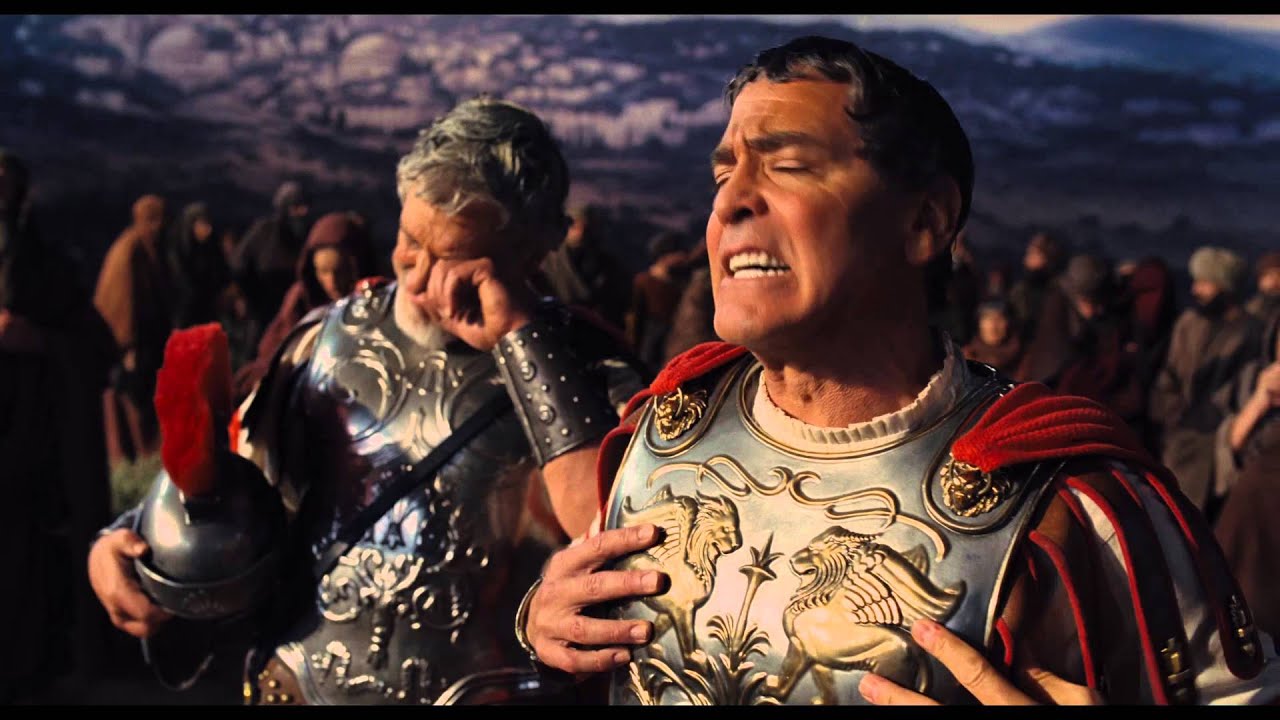
With their new farce “Hail Caesar!” the Coen Brothers conjure up the glory and garishness of gimmicky 1950s Hollywood. Like their other broad comedies, such as the cult-hit “The Big Lebowski,” their Americana ode to The Odyssey “Oh Brother, Where Art Thou” and the still-underrated espionage spoof “Burn After Reading,” “Hail Caesar!” is less interested in tight storytelling or following a discernable plot than it is with putting a genre’s idiosyncrasies under a microscope and under zooming in until they appear absurd.  There’s a love displayed for the type of bloated studio-era schlock that the Joel and Ethan are spoofing and that love shines through in perfect recreations of iconic film moments and stock genre tropes. In fact, the verisimilitude of the spoof is so earnest in its presentation that the comedy often gets lost in the movie’s high-concept production values.

If there is a single story to follow it’s that of Josh Brolin as a studio executive named Eddie Mannix - a no-nonsense busy-body who’s trying to juggle a handful of large film projects being mounted on the lot of Capital Pictures. The key film in development is a roman swords-and-sandals epic that features big-time prestige actor Baird Whitlock, played by George Clooney as a witless Charlton Heston type. The production is put on hold when an extra kidnaps the actor and holds him for ransom at a nearby beach mansion, occupied by a group of disgruntled Hollywood writers turned communist.  Alden Erhenreich plays a country bumpkin movie star who also finds himself caught up in the mystery.

There’s no lack of whimsy here and the movie is full of moments of pure exhilaration within its reimagining of Hollywood cinema, including the best song and dance sequence I’ve seen in the last 15 years, starring Channing Tatum and a group of actors dressed as sailors. Key scenes play out like sketch comedy, such as a silly dialogue set-piece between a small group of preachers, priests, and rabbis who are brought in to share their opinions on the depiction of Christ in one of the movies within the movie, as well as another scene in which Erhenreich tries to choke down his thick southern accent for a director played by Ralph Fiennes after getting cast last-minute in a formal costume drama.

Had these scenes, or the many others like them, existed without the connective tissue of the plot to justify their use within the film,  they could support themselves as Funny or Die videos or SNL digital shorts. The movie never quite gels as a story because said connective tissue--Josh Brolin and George Clooney’s overarching plot—is never tended to with the same amount of interest or care.  As the audience’s cypher Brolin never drums up enough pathos or relatability, or even enough of his own comedic presence—like, say, Jeff Bridges does as ‘The Dude’—to pull together all of the competing plot threads and many muddled themes regarding industry politics, personal morals and religion. That said, you can never ding the Coens for lack of trying.

Ehrenreich as the dopey Hobie Doyle, Tilda Swinton as a pair of yellow journalist twins and Scarlett Johansson as a jaded starlet all give loopy, mannered performances that live up the bigness of the movie’s comedic style, and if the “Hail Caesar!” had used one of them to follow as our main character, instead of Brolin’s bland almost-detective, it may have created a better sense of dramatic traction. The larger than life aesthetic gags are too slick and impressive on a technical level to register as comedy and a movie this big and this silly can’t sustain cinematic parlor tricks on this kind of scale without being a lot funnier. Ironically, the final result is a film that resembles the type of bloated, misguided star vehicles that the Coens are working so hard to send up.

Grade: C+

Originally Published in the Idaho State Journal/Feb-2016

Listen to more discussion about "Hail Caesar!" on this week's Jabber and the Drone Podcast.

Saturday, April 12, 2014

Captain America: The Winter Soldier review


                  Captain America is a tricky Marvel character to sell to global movie market, despite his recognizable brand and the backing of a powerhouse film production conglomerate. These days people are a little jaded when it comes to national pride and a character that fights for truth, justice and the American way is an increasingly harder pill to swallow, especially when party divisions have dramatically split the country on the specific interpretation of what the “American Way” is even supposed to be. Even when conflict is injected into the character to please those on the homeland, the blatantly patriotic imagery of Cap-Am risks appearing like propaganda to those abroad.
                Though Disney/Marvel Studio’s first attempt to introduce this character in 2011 wasn’t an altogether failure, it really only managed to work as a placeholder for the anticipated Avengers movie being hyped at time.  Now, with the overwhelming success of “The Avengers” in 2012, “Captain America: The Winter Soldier” is afforded the benefit of doubt by those who may have been skeptical before. Surprisingly, in changing time-period, style, tone and directors, this movie cleverly takes advantage of its second chance and manages to exceed expectations by simultaneously defying and celebrating its genre-conventions.
                Having grown up in the ‘30s and ‘40s, only to be preserved in ice and unfrozen to become a superhero soldier, fighting alongside sci-fi anomalies like Bruce Banner’s Hulk and Tony Stark’s Iron-Man, Steve Rodgers (Chris Evans) is now suffering from state of mild temporal dysphoria, with only his work as a SHIELD super-spy to keep him focused and grounded. However, when his boss and mentor, SHIELD’s leader Nick Fury (Samuel L. Jackson) is targeted and hunted by his colleagues, Captain America is then forced to go rogue and figure out how high the governmental corruption infiltrates. Black Widow (Scarlett Johansson) and military veteran Sam Wilson (Anthony Mackie) help Rodgers with his impossible mission, while keeping guard from a mysteriously lethal mercenary known as the Winter Soldier.
                It’s actually difficult to be prepared for just how exceptional this pop-corn thriller is. Not since Christopher Nolan’s “The Dark Knight” has a sequel so magnificently improved upon its predecessor in a way that actually fixes some of the problems of the previous film. Rather than the cartoony, gee-golly pulp aesthetic of Joe Johnston’s “Captain America: The First Avenger”, Joe and Anthony Russo’s steely, post-Bourn, politically-minded sequel resembles the kind of cool immediacy of Michael Mann’s “Heat”, as well as ‘70s paranoid dramas like “The French Connection" and "All the President's Men."  The tensely-blocked, handheld bursts of action-violence is impactful, the performances are confident--particularly Evans who'd previously appeared a little stiff within the do-gooder limitations of his characters--and unlike even the best films from Marvel’s amoeba-vers, this world feels lived-in and dangerous with a semi-realistic sense of scale and threat. 
                With that said, this is still a comic-book action movie aimed at a young teenage audience, and we're reminded of that whenever the plot makes an illogical leap or when there's an occasional tonal hiccup. This includes some high-concept sci-fi tech that feels out of place compared to the movie's more sober interpretation of the Marvel world, as well as, a sporadic line of Saturday-morning dialogue.  In the third act, as is the demand for any film that costs more than 100 million dollars, the movie eventually devolves into an extended effect-driven sequence, slowly drifting the whole thing away from the refreshing tactility and level-headed sophistication it had built up to that point.
                Flaws and nitpicks aside—though not excused—“Captain America-The Winter Soldier” is still an exciting and daring move forward for the superhero genre, and it at least hints towards a maturity that Marvel Studios hasn’t been as interested in exploring since the Iraq war metaphors of the first “Iron Man."  Here, themes of political unrest and social distrust regarding NSA monitoring and military drone technologies make this sequel not only satisfying as a genre picture, but timely and relevant as well.

Grade: B+

Originally Published in the Idaho State Journal/April-2014

Sunday, January 19, 2014

Her review


               Director Spike Jonze is an immensely talented dude but through his body of work his talent has always been obscured by his collaborations. Once known as a music video guy, he helped Weezer and The Beastie Boys (among others) rise to prominence in the Mtv 90’s. His filmography is just as eclectic, directing “Being John Malkovich” and “Adaptation” for the avant-surrealist writer Charlie Kaufman, and on the other end of the cultural spectrum, he has produced and been closely involved with Mtv’s ”Jackass”, as well as its feature-length fratsploitation mondo-comedies. Before his most recently released film “Her”, he also adapted Maurice Sendak’s children’s book “Where the Wild’s Things Are”.
                  What I mean to point out in all of this is that Spike Jonze, as a filmmaking auteur, despite the overall quality of his work, has rarely been given the credit he deserves as a singular talent unto himself because of the power of his industry associations. However, with “Her”, Jonze captures his own ideas about love, technology and the future and what comes out is not only a spectacularly realized, wholly original sci-fi milieu, but also a tender story about human relationships.
                Joaquin Phoenix is a somewhat elusive and distant actor and has spent his latter years widening the gap between himself and the audience; first with his ill-conceived mockumentary and then to much better effect in last year’s “The Master.” Here he brings us in significantly closer as Theodore Twombly, a lonely love-letter and greeting card copywriter living in the not-so-distant, but distant-enough-to-be-relatively-advanced Los Angeles. In an attempt to get over the somewhat recent separation from his ex-wife (Rooney Mara) and the early rumblings of inevitable divorce, Theordore decides to upgrade his operating system to a new, fully functioning and autonomous artificial intelligence named Samantha (voiced by Scarlett Johansson). Unlike his command functioned OS before, Samantha not only checks his emails and organize his work papers, but she also learns his sense of humor, gives him useful guidance about his personal life and eventually she even begins to develop real and reciprocated feelings towards her owner.
                This story deals in a high-concept that is easy to scoff at or dismiss as a wispy, digital “I Dream of Genie” male fantasy. But Jonze approaches the idiosyncratic plot details and his genre conceits with heart-breaking sincerity, a complete lack of judgment to or from his characters, and within the world he builds he displays an enviable hope for the future. Skynett paranoia or the fear of robo-fascism is never even hinted at. In fact, when Theodor’s office co-worker played by Chris Pratt, or his old college buddies played by Amy Adams and Matt Letscher learn of his fully dimensional romance with Samantha, they show happiness and support for their friend.
                This foundation of warmth and humanity is thoroughly embraced as it sets the stage for an emotionally complex and thoughtful final act that expands the parameters of science fiction and satisfies its character’s arc; a feat not easily achieved by even the simplest of movie structures, let alone a wacky genre-blending narrative like this.
                  “Her” is techo-centric, visually concerned piece of metaphor that also has a recognizable beating heart. The film’s environments are beautifully portrayed with a production design and cinematography so handsome and atmospheric that it has immediately been added to my short-list of movie-worlds I wish I could live in.  But even more remarkable is that it bothers to tackle big ideas, such as the loss of humanity and conenctiveness in our modern technological era and deeper existential themes about what it is that makes a person a person, but it never does so in an intellectually pushy or posturing way. Instead, Jonze holds our hand and relays these human truths like a bittersweet bedtime story.

Grade: A

Originally Published in the Idaho State Journal/ Jan-2014