Showing posts with label science fiction. Show all posts

Sunday, February 18, 2018

The Cloverfield Paradox review

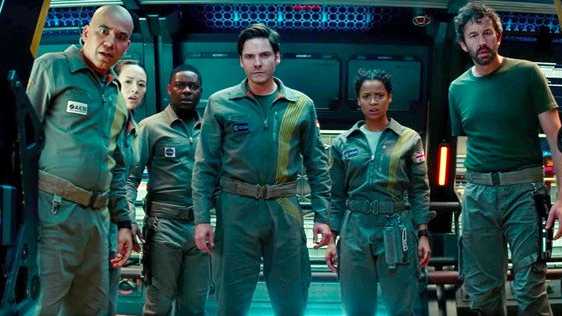
“The Cloverfield Paradox” is the third installment of this sci-fi anthology franchise and by far the least impressive of the three. Released by Netflix on Super Bowl Sunday, the same day the film was promoted during the game’s commercial interruptions, this space-thriller landed in the laps of its potential viewers with a dramatic thud. Director Oren Uziel and Doug Jung originally wrote this screenplay under the title “The God Particle," then acquired by J.J. Abrams’ Bad Robot company under the Paramount umbrella. After production began, the decision was made to include it as a spiritual successor to 2008’s “Cloverfield” and 2016’s “10 Cloverfield Lane.” This decision by Bad Robot to acquire unrelated scripts, to then include vague narrative threads to link them together in a similar cinematic universe has been increasingly arbitrary and forced in execution.

The film begins with a crew of scientists working in a space station designed to harness cosmic energy through the use of a massively powerful particle accelerator. Just below them, the earth is suffering from an energy crisis that has the world’s superpowers on the brink of war. It’s up to the Cloverfield team to bring back test results that will save us all. Unfortunately, upon firing up their super laser, the team is suddenly zapped into an alternate dimension on the other side of the sun, where the regular rules of reality are bent and nothing is familiar. Severed arms are writing secret messages, parts of the ship are found in the organs of their dead shipmates, and they find a strange female passenger caught in the walls and circuitry of the space station. The mission shifts to fixing the accelerator and getting back into their own reality.

Given how under-budget and schlocky most of this is, the picture features a talented cast of Hollywood notables such as David Oyelowo, Daniel Bruhl, Chris O’Dowd and John Ortiz. But it’s British actress Gugu Mbatha-Raw whose story we’re following as the main character. Because she lost her family back on her version of earth, the character is met with increasingly moral conundrums through the stresses of the plot. It’s too bad that Raw's performance is the most stilted, as she has to carry the entire emotional arc, but she also has the misfortune of delivering painfully obvious dialogue.

Even with a premise this familiar--the movie liberally borrows from "Solaris," "Event Horizon," "Sunshine" and more-- it didn't have to be this bad. The special effects are fine but always noticeable when the movie shifts from “Battlestar Galactica” looking soundstages to CGI outer space exteriors. Uziel even uses the old Star Trek technique of tilting the camera while the cast pretends to brace for impact, which also reveals the film’s monetary limitations. This deficit combined with the hokey dialogue and poorly executed attempts at dread and tension kept me from investing in either the attempts at emotional storytelling or the movie's base genre appeal.

“The Cloverfield Paradox” is a failure and waste of money for those who invested in it, but living its life on Netflix it isn't likely to damage the reputation of Abrams or the future of the Cloverfield concept. I definitely encourage the idea of an anthology universe, in which Bad Robot can continue to champion these large-scale Twilight Zone episodes, but I can't abide the gimmick when it produces work as unoriginal and as poorly made as this. If Abrams and company wish to continue this project, I would suggest they write screenplays with a vision already in mind rather than buying cheesy spec scripts and half-heartedly branding them during production.


Grade: D+

Originally published in the Idaho State Journal/Feb-2018

Sunday, May 28, 2017

Alien Covenant review


Ridley Scott returned to the “Alien” franchise with his 2012 prequel “Prometheus,”  showing  that the veteran Hollywood director still had a love for monumental science fiction storytelling and an eye for evocative imagery. Yet the viewers who were waiting decades to know more about the origins of 1979’s “Alien” were left with a handsome production undercut by a messy screenplay by writer Damon Lindelof that only teased an explanation, while leaving more questions to be answered.  Hopes that this year’s “Alien Covenant” would finally tie the narrative threads together are hopes to be had in vain, as this latest installment ventures down another lateral tangent that further broadens the mythology.

Much like the first third of the original “Alien,” “Covenant” sends another crew of explorers to an uncharted planet after receiving a fuzzed-out message by Elizabeth Shaw (Noomi Rapace), the lost survivor of the Prometheus ship. This traveling colony, having recently suffered from an electrical storm that killed many of their inhabitants in hyper-sleep, decides to change course to see if this mysterious planet can support human life. Aboard the vessel is their self-doubting, proudly religious Captain Oram (Billy Crudup), who’s insisting they take the risk to save time, while second-in-command officer Daniels (Katherine Waterston) has just lost her husband in the devastating accident and wants the Covenant to stay on course.  Once a pod of explorers is sent down to investigate the earth-like sphere, the crew discovers a biological terror they weren’t prepared to deal with.

Rounding out the cast is Danny McBride as red-neck pilot Tennessee, Amy Seimets as his wife Faris, Damian Birchir as Lope, and Michael Fassbender as the group’s resident android Walter.  They’re many other smaller performances in the picture and characters to be named, including an oddly short James Franco cameo, but John Logan and Dante Harper’s screenplay relegates most of these roles to serving the story as faceless creature-feature fodder and these extra crew members barely peak out of the movie’s larger obsession with awkwardly-paced, talky scenes of needless exposition.

While the initial introduction to this crew in mourning is an interesting place to begin a darker more sorrowful tone, the movie ultimately lacks the humanity and soul it needs to inform this choice. Instead, the film abandons this set-up and moves on to other concerns. The final moments of “Alien Covenant” contains a traditional attack sequence that feels tired and familiar by the time we get there and superfluous after an hour and forty minutes of exhausting scenes of cave-dwelling, interspersed with mindless attempts at shock

Longtime fans that are curious to see how Scott expands the Alien mythos will likely be divided on the Covenant’s retroactive continuity, as it seems to disregard a lot of speciation rules from the previous installments that followed writer Dan O’Bannon’s original “Alien.” In its place, we are introduced to various forms of alien spores, white monkey-looking creatures that burst out of people’s backs and early forms of the classic eggs and face-huggers. People new to the franchise will and should be totally lost in this minutia and those trying to follow along may need to create a complicated flow-chart to connect all the disparate creatures into one lineage. Whereas the original alien-lifecycle was once elegant and believable, O’Bannon’s simple mythology has now been muddied by two prequels that let the overarching thematic concerns and a handful of bad ideas overtake the storytelling.  This installment in particular is somehow both overreaching and lazy in its execution.

Like “Prometheus,” Michael Fassbender’s duel performance as the androids Walter and David steal the show; though within these scenes, the film’s divergence into highfalutin discussions about life, grief, religion, creation, obsession and flute playing loosens the necessary narrative tension for the movie to work as an effective thriller. Most of the monster attack scenes are only sprinkled in to remind us that this pre-sequel is still related to the known franchise, but the overall structure of the picture is compromised by wasted performances by otherwise good actors, under-rendered CGI, moments of ponderous meditation on themes that are never fully realized and rushed sequences of unearned gore.  

Grade: D+

Originally Published in the Idaho State Journal/May-2017\

Listen to this week's episode of Jabber and the Drone to hear more conversation about "Alien Covenant"

Sunday, July 27, 2014

The Purge: Anarchy review


               It’s difficult to enjoy a genre movie about government-sanctioned annual murder sprees when every three weeks or so our news is treated to another mass shooting or a real-life tragedy, but horror films and thrillers have occasionally been able to make poetic sense from of a senseless time.  In this regard, writer/director James DeMonaco’s  “The Purge: Anarchy”  at least tries to contextualize his brand of schlock alongside easy metaphors and well-worn, occupy-era allegory.
                While last summer’s surprise horror-hit “The Purge” only hinted at its dystopian sci-fi conceits, settling closer within the intimate, home-invader sub-genre, this sequel opens up DeMonaco’s futuristic setting. Rather than being locked into one location, we travel through the murderous streets, following a handful of frightened survivors as they look for temporary refuge from the bloody holiday. Pair number one consists of an inner-city mother and teenage daughter (Eva Sanchez and Zoe Soul) whose apartment door is kicked in by their sexually frustrated slumlord. After barely escaping his attack, they run into pair number two, a young disgruntled couple (Zach Gilford and Kiele Sanchez) whose car dies in the wrong side of town just before a city-wide alarm sets off the lawless free-for-all. The only thing keeping these four alive is a stoic police Sergeant (Frank Grillo) who’s on a path of vengeance, as he stalks the roads in his armored car.
                It’s clear that DeMonaco grew up on movies like John Carpenter’s “Escape from New York” and Walter Hill’s “The Warriors” and tries to bring the same sense of unflinching bleakness alongside a broad satire of our current social landscape. But like other throwbacky horror directors such as Eli Roth and Rob Zombie, DeMonaco’s films live and die within the borders of their pastiche. As a fan, he can come up with an exploitation premise that sounds great as a one paragraph synopsis on the back of a DVD. As a director, he seems to struggle when it comes to telling an engaging story with characters you might care about.
                Neither Purge is particular memorable or entertaining, given their anarchic concepts, and unlike the Carpenter film’s they endlessly reference, their dower tone makes it uncomfortable to revel in the mindless popcorn violence. Likewise, the ripped-from-the-headlines soapboxing about class wars and wealth disparity lacks the depth or insight for the film to really work as a think-piece. Instead, we are treated to a competent TV-level cast wandering around an aimless plot as they jump from one scenario to another—some of which are mildly rousing, most of which are poorly staged and severely devoid of the necessary filmic discipline to garner adequate thrills.
                At best, “The Purge:  Anarchy” is a fanboy wish fulfillment that will make you nostalgic for Regan-era paranoia, at worst, it’s a philosophically muddy piece of trash-cinema that juxtaposes awkwardly and flippantly against the kinds of real-world terror and random acts of violence reported nightly on CNN. Perhaps only time and distance can illuminate the appropriate perspective to really understand what these movies are trying to say and what they might be doing effectively. Regardless, in a contextual vacuum, they tease more than they satisfy.

Grade: C-

Originally published in the Idaho State Journal/July-2014

Sunday, April 27, 2014

Transcendence review


                Wally Pfister, the talented cinematographer behind modern classics such as “The Dark Knight”, “Inception” and “Moneyball” brings us his directorial debut in “Transcendence”, a sci-fi drama starring Johnny Depp as a mad scientist who becomes a highly sentient computer with ambiguous goals towards the human race.  Tonally and visually, considering his recent work with director Christopher Nolan, the movie is presented in a way we might expect; cold, stark, and sterile, mirroring the dehumanizing technologies that the plot warns the audience against.
                Though Pfister hands over the photography work to Jess Hill his fingerprints are all over the film, but unfortunately when it comes to storytelling, pacing, and drama this curiously drab blockbuster lacks the same sense of meticulous identity.  Many scenes drag their feet when the movie is begging for acceleration and the themes of loneliness, the gradual loss of individuality, and progress by any means are somehow bluntly beat into the ground without ever really committing to any of them.
                Depp stars as Will Caster, a Ted-Talking computer genius who’s figured out the process of creating fully formed artificial intelligence. His wife Evelyn, played by Rebecca Hall, is working in union to create medical nano-bots.  When her husband is fatally injured by a gunshot from a technophobic revolutionary, Evelyn does what she can to keep him alive and uploads his consciousness into the mainframe of his super-computer. There, he’s not only able to access all of his memories and knowledge but he's able to think exponentially faster and more efficiently, using Evelyn’s nano-technologies to heal the sick and injured and to build fields of solar panels, expanding his ever-growing digital network. 
                This cyberpunk Frankenstein plot should have provided a simple but useful framework for the actors and the screenplay to really go in a myriad of different, and hopefully interesting directions. Unfortunately, Phister never really gives us a clear sense of the key players in the narrative when it comes to why we should care about anything that’s going on. Depp and Hall’s tragic romance is underwhelming and almost nondescript, leaving all the pulp-genre elements of the film feeling derivatively old-hat.  We're never as sad as we should be about the Evelyn’s straining marriage to her computer husband as he becomes less human and we're never as worried as we are supposed to be about Will’s descent into cold calculation over compassion due to Depp’s flat-line performance through each point of his character’s arc. 
                Cillian Murphy and Morgan Freeman step over from Nolan’s stable of repertory actors and are given almost nothing to do here as concerned investigators. Them, along with Kate Mara as the leader of the human rebellion against Castor’s digital army, are strangely disconnected from the more interesting—though ultimately flailing--emotional story. Paul Bettany, as a former colleague of Depp’s character, who is then recruited by the militaristic insurgence, probably gives the best performance in the entire film, picking up the slack dropped by everyone else. Rebecca Hall is clearly trying her hardest but has absolutely nothing to work with or against, rendering her best scenes into an ineffectual, one-women juggling act.
                Despite the fact that “Transcendence” has the right budget, the right actors, and a promising director--given the pedigree of films he’s worked on as crew--the final result is a depressing slog, not worth your time or consideration.  It’s competently framed and lit but the screenplay lacks any kind of specificity or vitality, and the simple joys of the movie’s sci-fi conceits are almost instantly drowned in its bland austerity.

Grade: D+

Originally published in the Idaho State Journal/April-2014

Sunday, February 23, 2014

Robocop review


                   Paul Verhoeven’s 1987 sci-fi action film “Robocop” has been canonized as a modern classic of genre cinema and a towering example of how a movie can approach satire by commercial means. It’s no surprise however that this property was not immune from franchitis: the crippling disease that has the Hollywood serpent chomping down on its own tail. “Robocop” is a beloved pre-recognized staple of American movies, so it only makes sense that after two bad sequels and a failed original television series, in the age of effects-driven hero flicks, a studio would try to revive the tattered legend with all new mechanics, intended to make him sicker, faster, and more efficient.
                  In this PG-13 reboot, directed by Brazilian filmmaker Jose Padhilha, The Killing’s Joel Kinnaman plays Alex Murphy, an undercover drug cop in a future Detroit. Unlike the first incarnation, instead of getting his body shot to pieces, he is nearly killed in a car bomb explosion set outside of his home. In order to prove that military drones can be manned with a sense of human compassion, a war-profiteering business called Omnicorp builds Murphy a stealthy cybernetic body designed for street battle. Though they have already been using drones freely overseas, it is the effectiveness of the Robocop prototype that will determine the use of robotic soldiers in the home states.
                What really distinguishes this remake from the original is the way the story is centered on Murphy as he is torn between all of the distinct influences in his life. The CEO of Omnicorp, played by Michael Keaton, wants stretch the ethics of the mutilated cop by messing with his mental autonomy, so long as the polls are raised in the companies favor.  The military jarheads, as embodied by soldier-turned-trainer Rick Mattox (played by the great character actor Jackie Earl Haley) are invested in Robocop’s failure, with the belief that cold, emotionless drones are superior to the unpredictable flaws in human morality.  Dr. Dennett Norton (Gary Oldman), the engineer who has constructed Murphy’s new body, has genuine compassion for his wellbeing but is ultimately compromised by the monetary promises from his employers. Meanwhile, Robocop’s wife (the slightly underwhelming Abbie Cornish) and son (John Paul Ruttan) suffers the greatest from his near-death and his subsequence absence, as Omnicorp fills them lies while they continue to work out the kinks in his design.
                Though this is a remake nobody wanted or asked for, I am happy to say that despite the blatant commerciality that put this project into motion, the movie is actually satisfying on almost all accounts. Yes, it isn’t as biting or as clever as the original and it’s considerably less violent, but within the parameters set by the studio, Padilha manages to make a lean, gets-to-the-point action movie that isn’t afraid to share its insights on modern, post-terror paranoia. Obviously the movie’s core discussion of drone technologies is front and center of the text, but the movie also explores themes regarding media propaganda—with Samuel L. Jackson playing a Sean Hannity/O’Reilly type facsimile— the ignored rights of military vets, as well as broader topics like the nature of humanity and the obscurity of free will. And while almost every frame is jam-packed with ‘ideas’, it still makes time to highlight a great collection of fully realized performances from its ensemble cast.
                Original or not, this “Robocop” remake—despite what you might read on the internet—is a just a good little movie. And I say little because the scope of plot, while utilizing a large budget for special effects, is actually fairly contained within the internal goings on of Omnicorp and “Robocop” as he tries to solve his own murder.  Within this framework, the film moves along with clear attention to the character’s arc, the natural pace of the storytelling, and the thematic intentions of the narrative. Simply put, it just works.

Grade: B+

Originally published in the Idaho State Journal/Feb-2014

Sunday, January 19, 2014

Her review


               Director Spike Jonze is an immensely talented dude but through his body of work his talent has always been obscured by his collaborations. Once known as a music video guy, he helped Weezer and The Beastie Boys (among others) rise to prominence in the Mtv 90’s. His filmography is just as eclectic, directing “Being John Malkovich” and “Adaptation” for the avant-surrealist writer Charlie Kaufman, and on the other end of the cultural spectrum, he has produced and been closely involved with Mtv’s ”Jackass”, as well as its feature-length fratsploitation mondo-comedies. Before his most recently released film “Her”, he also adapted Maurice Sendak’s children’s book “Where the Wild’s Things Are”.
                  What I mean to point out in all of this is that Spike Jonze, as a filmmaking auteur, despite the overall quality of his work, has rarely been given the credit he deserves as a singular talent unto himself because of the power of his industry associations. However, with “Her”, Jonze captures his own ideas about love, technology and the future and what comes out is not only a spectacularly realized, wholly original sci-fi milieu, but also a tender story about human relationships.
                Joaquin Phoenix is a somewhat elusive and distant actor and has spent his latter years widening the gap between himself and the audience; first with his ill-conceived mockumentary and then to much better effect in last year’s “The Master.” Here he brings us in significantly closer as Theodore Twombly, a lonely love-letter and greeting card copywriter living in the not-so-distant, but distant-enough-to-be-relatively-advanced Los Angeles. In an attempt to get over the somewhat recent separation from his ex-wife (Rooney Mara) and the early rumblings of inevitable divorce, Theordore decides to upgrade his operating system to a new, fully functioning and autonomous artificial intelligence named Samantha (voiced by Scarlett Johansson). Unlike his command functioned OS before, Samantha not only checks his emails and organize his work papers, but she also learns his sense of humor, gives him useful guidance about his personal life and eventually she even begins to develop real and reciprocated feelings towards her owner.
                This story deals in a high-concept that is easy to scoff at or dismiss as a wispy, digital “I Dream of Genie” male fantasy. But Jonze approaches the idiosyncratic plot details and his genre conceits with heart-breaking sincerity, a complete lack of judgment to or from his characters, and within the world he builds he displays an enviable hope for the future. Skynett paranoia or the fear of robo-fascism is never even hinted at. In fact, when Theodor’s office co-worker played by Chris Pratt, or his old college buddies played by Amy Adams and Matt Letscher learn of his fully dimensional romance with Samantha, they show happiness and support for their friend.
                This foundation of warmth and humanity is thoroughly embraced as it sets the stage for an emotionally complex and thoughtful final act that expands the parameters of science fiction and satisfies its character’s arc; a feat not easily achieved by even the simplest of movie structures, let alone a wacky genre-blending narrative like this.
                  “Her” is techo-centric, visually concerned piece of metaphor that also has a recognizable beating heart. The film’s environments are beautifully portrayed with a production design and cinematography so handsome and atmospheric that it has immediately been added to my short-list of movie-worlds I wish I could live in.  But even more remarkable is that it bothers to tackle big ideas, such as the loss of humanity and conenctiveness in our modern technological era and deeper existential themes about what it is that makes a person a person, but it never does so in an intellectually pushy or posturing way. Instead, Jonze holds our hand and relays these human truths like a bittersweet bedtime story.

Grade: A

Originally Published in the Idaho State Journal/ Jan-2014