Showing posts with label salad fork. Show all posts

Sunday, July 31, 2016

Star Trek Beyond

After director J.J. Abrams stepped aside to let “Fast & Furious” helmer Justin Lin take his place, many hardcore Trekkies who'er already critical of this rebooted franchise became worried that Lin's third installment would drive the series further away from Gene Roddenberry’s more intellectual vision. While “Star Trek Beyond” doesn’t slow down the momentum or the pacing of this high-octane update, old-school Trek fans may be charmed by the  film's return to a warm and familiar sense of adventurous pulp and sci-fi optimism. Unlike the 2009 reboot, which had to reestablish everything with a new cast and a new style, and unlike its 2013 sequel "Star Trek Into Darkness," which reworked the story beats of the most beloved installment of the original Star Trek films, this outing is much smaller in scope and more contained as a story.

James Kirk (Chris Pine) is feeling melancholy about his place as the ship’s Captain, upon realizing that he has just surpassed the age that his father was when he died. Spock (Zachary Quinto) too is wondering how his place in this unified multi-cultural mission when he learns that the elder version of himself from another dimension (Leonard Nimoy) has passed away. With these character dilemmas in the background, the enterprise is called upon to investigate a deep-space distress call, where they are ambushed by a swarm of small enemy attack ships, crash-landing on a foreign planet. The group  becomes separated into pairs of survivors and have to regroup to find a means for escape as well as a way to stop their new enemy from unleashing a space virus on a nearby society of peaceful workers.

The plot dynamics of this particular adventure are somewhat generic and well worn, but that allows for more impact when it comes to the character dynamics and the focus of the films action sequences. The movie quickly gets us into the head space of this group and grounds the plot in the emotional hurdles of each member. The chemistry between Pine, Quinto and Karl Urban's Doctor McCoy informs the spectacle in a way that few summer tent poles remember to do.  Jon Cho as Sulu, Simon Peg as Scotty, and the recently deceased Anton Yelchin as Chekov are also given key sequences to shine. Zoe Saldana’s Uhura is sidelined the most within the original group as Sophia Boutella becomes the key female cast member playing the stranded warrior Jaylah, who allies herself with the Enterprise to rescue the 'red-shirts' from the evil Krall (Idris Elba).

Speaking of Krall, luckily the bright eyed adventure of the movie and creative set pieces more than make up for the lack of an interesting villain—Elba is unfortunately buried under too much make-up and plot to really resonate beyond his narrative function.

Simon Pegg and Doug Jung’s screenplay almost celebrates the filler spot many mid-franchise sequels eventually occupy, but it’s this multi-million-dollar smallness that rescues the picture from being too encumbered by plot and fan-service. There isn’t anything especially remarkable to say about “Star Trek Beyond” other than it knows how to balance tone, story, action and characters in way that keeps the audience from thinking too much about its construction as a piece of consumable popcorn product.

Grade: B+

Originally published in the Idaho State Journal/July-2016

Listen to this week's episode of Jabber and the Drone to hear more conversation about "Star Trek Beyond."

Sunday, January 4, 2015

Into the Woods review

        After the awards buzz and accolades that surrounded the 2013's cinematic adaptation of “Les Miserables,” it was only natural that another well regarded Broadway production would make it's way into the next year's crop of holiday releases. Disney's reworking of Stephen Sondheim and James Lapine's “Into the Woods” is a gleefully traditional musical comedy full of big stars doing big hammy performances, and it's camera-winking dorkiness is probably the most endearing thing about it. Though director Rob Marshall ("Chicago," "Nine") uses his mouse-house money to fully realize the fantasy world in which these intertwining stories take place, on some level, the movie still operates like a high-budget, high school musical staring the most popular jocks and cheerleaders of Hollywood, and within that tonal imagining there's definitely a charm to be had, but the film never quite makes the impact that the cast or the budget would suggest.
        In an extended overture we are introduced to this fairy tale mash-up world where in the same village lives Little Red Riding Hood (Lilla Crawford) and the Big Bad Wolf (Johnny Depp), Cinderella (Anna Kendrick) and Prince Charming (Chris Pine), Rapunzel (Mackenzie Mauzy), and Jack of the beanstalk fame (Daniell Huddleston). In the background while these stories play themselves out more or less like we have seen before, the primary plot focuses on baker and his wife played by James Cordon and Emily Blunt, who desperately want to have a child and who find themselves manipulated by a witch (Meryl Streep). Together they orchestrate all of these tales in such a way that they can obtain the items they need to perform a fertility spell. It's all very convoluted and for the most part incidental when giving in to the mindless joy of watching our favorite Grim's fairy tales unfold this ironic, post-modern context. Later, when the second half kicks into gear and adds a 'be careful what you wish for' twist to every premature happy ending, the movie oddly runs out of creative juice and the amicable tone of the first half of the film is replaced with ponderous and severely unearned character dilemmas.
         The cast is obviously having fun here and are given license to fully send-up the cliches attached to their stories and their character's. Chris Pine's turn as the egomaniac Prince Charming and Streep, who's doing her best Margaret Hamilton impersonation, keep things lively and funny. Blunt and Cordon also do a fine enough job working as the glue that keeps these dispirit plots from overwhelming the spinal narrative, but it's Marshall's lackluster visual design and directorial blandness that chains this movie to the floor and keeps it from fully taking flight. Much of this production is lit in muted blues and grays and creates for a dreary, damp looking post-Burton conceptual expression that doesn't reflect the buoyancy of the performances or Sondheim's varied musical numbers. Many scenes are shot in traditional coverage, composed mostly of simple masters, close-ups and over the shoulder shots, without hardly any swooping cranes, impressive single-takes or even occasional grandiose establishing shots that would open up the frame, resulting in musical set-pieces that feel small and televisual.
       Far less melodramatic or irritating as last-year's overlong “Les Miz”, and with sing-along musical sequences that are more confidently and skillfully performed, recorded and mixed, “Into the Woods” is a benign, if somewhat banal, movie going experience. Family's who're looking to escape the polar-vortex and/or the discomfort of having to talk to each other will most likely enjoy the majority what they see here, even if by the last thirty minutes they might be thinking more about their holiday dinner leftovers than how the movie will be resolved.

Grade: C+  

Originally published in the Idaho State Journal/Jan-2015

Monday, December 29, 2014

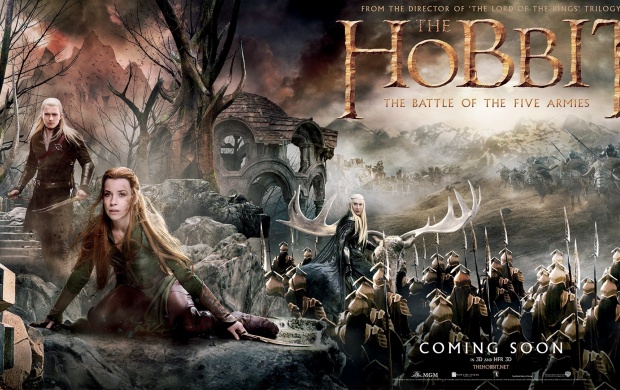
The Hobbit: Battle of the Five Armies review

       Given the critical and commercial success of the original “Lord of Rings” films and it's lasting cultural relevance that culminated in 2004 when “Return of the King” took home the best picture Oscar, I don't think it's a controversial statement to say that Peter Jackson's return to Middle Earth with this needlessly drawn-out Hobbit trilogy has been something of a thudding disappointment. Sure, these prequels have sold plenty of tickets and kept the popcorn industry afloat but even their most ardent defenders would probably agree that there has been a significant and noticeable drop in quality. Shot in a faster frame-rate to smooth out the performance of the 3D graphics and cartoonish CGI, the Hobbit films have been far more interested in testing new technologies and cashing in on recent nostalgia then gracefully or even faithfully adapting the (comparatively shorter) J.R.R. Tolkien novel.
With “Battle of the Five Armies” I found my self finally defeated by my disappointments and  expectations and passively willing to experience this conclusion as a theme park ride rather than a story that I could possibly be engaged in, and actually, once set in that frame of mind, this movie breezed by rather inoffensively. Still, there's hardly any story speak of as it's only intention is to wrap everything up and because of the added content and tangential plot byways the movie gets lost in from time to time, a severer lack of point of view and purpose keeps this installment from transcending the tech-demo action-schlock that Jackson has apparently settled for.
After the dragon Smaug is quickly and anti-climatically destroyed by the peoples of Lake Town the humans are caught in an awkward position when they they ask to borrow some of the newly available treasure to rebuild their burning village and the Dwarves' fearless leader Thorin (Richard Armitage) refuses to share the wealth, now taking up his mantel as the new king of the mountain. The wood elves feel like they deserve a piece too since they did their part in helping the Dwarves reach Smaug's cave, and just as the three armies begin to duke it out for the booty the same Orcs who have  been perusing the heroes since the beginning of the journey come back to finish what they started.
Along side the battle set-pieces that dominate the picture there exists a number of cameo plots, such as Gandalf (Ian McKellen) escaping near death after getting kidnapped by a not-so-mysterious evil force who's planning on making his big comeback, as well as a narratively inert love-triangle between the warrior elf Legolas (Orlando Bloom), the wood elf Taurial (Evangeline Lilly) and Kili (Aiden Turner), a young Dwarve who frankly doesn't have a shot. And in all of this, Bilbo (Martin Freeman), the titular Hobbit, is nearly sidelined and drown out of the film, serving almost no functional purpose.
There are faint ghosts of Tolkein's themes regarding greed and the petty but complicated nature of war and global economics that hums in the background of the spectacle but “Battle of the Five Armies” never settles on one place, one character, or one situation long enough to let anything substantive break through the bells and whistles. On a technical level everything moves along through the nonsense just sufficient to entertain but the the film's slap-dash plotting and heavy reliance on digital trickery kept me from truly believing in this world or caring about the people in it, and after the last three years of enduring this labored mess of an epic I desperately wish Peter Jackson would just go back to making-low budget horror films with puppets.

Grade: C-

Originally published in the Idaho State Journal/Dec-2014

Exodus: Gods and Kings review

         If Hollywood knew what they were doing, Bible stories would be the next major source for untapped IPs. They’re ripe with special effects potential and simplistic, Campbellian hero’s journey narratives, and not only will they draw in big crowds in the flyover states but if they keep it Old Testament they could even play well abroad. “Exodus: Gods and Kings” is Riddley’s Scott’s adaptation of the famous story of Moses and unlike Darren Aronofsky’s reinterpretation of “Noah” from earlier this year, this film in perfect step with the biblical text in terms of major plot details and the overall message of building trust in God, but rather than then the parable function it serves in the bible as a morality tale, Scott is far more interested in its cinematic function as a setting for swords and sandals spectacle, and maybe that’s not entirely a bad thing.
The first third of the movie teases a “Prince of Egypt” like tension between Moses (Christian Bale) before he becomes the self-identified revolutionary of the Hebrews and his adopted brother Ramses II (Joel Edgerton) before he becomes the Pharaoh. Having been raised as Egyptian royalty, Moses slowly learns through the oppressed peoples he visits on a business trip that he’s actually one of them, which then causes his existential collapse and his eventual exile from the kingdom. After wandering the desert for a bit, Moses makes a new life for himself when he marries and becomes a sheep herder, and all seems well until his newly acquainted Hebrew God asks him to return to Egypt to confront the Pharaoh and free the slaves.
Throughout the picture there’s a constant war between the spiritual and philosophic concerns of the content and the overbearing aesthetics and grandiosity of the production. The brother-against-brother storyline isn't properly milked for its dramatic potential as we’re initially told it’s going to be. Instead, midway through, Moses and Ramses are full-on enemies and that’s pretty much that.  There’s a small but significant thematic thread dealing with Moses’ increasingly taxing relationship with the elusive Biblical God, and every so often those concerns are dealt with in a semi-thoughtful and humanistic way; first when Moses is abruptly asked to leave his family to save his people, and then later as God instructs him sit and watch the Egyptians he grew up with tortured and killed by a host of terrifying plagues.
          The scenes depicting Moses’ struggle with his faith is about the only relatable thing here as the majority of the film feels and looks like a Las Vegas production, bathed in gold-tinted color-corrected lighting schemes, and spotlighting  a cast of Caucasian actors cheaply bronzed to look more ethnic , wearing bejeweled accessories and thick drag-queen eyeliner. Not helping this is a series of distracting and smirk-inducing casting choices with equally bizarre performances, including John Turturro as Moses and Ramses’ king father, Sigourney Weaver as their queen mother, who, with the exception of one scene, is seemingly only there to walk in and out of rooms, and Breaking Bad’s Aaron Paul as a crazy-eyed Hebrew slave who has looks as if he had a bad month and wandered on set without any discernible direction.
         You can always expect a level of technical craft when it comes to a Riddley Scott production and you certainly get that here.  The sets are lavish, the cinematography is atmospheric and the special effects sequences such as the plagues and famed parting of the Red Sea, visually captures your attention. But despite Scott’s minimal attempt at humanizing this tale, a large gilded heap of camp buries the story elements and turns this overlong  epic into a theatrical Circ de Sole performance, and like a well-lit show at the Luxor, it has its entertainment value even if it lacks artistic credibility.

Grade: C-

Originally published in the Idaho State Journal/Dec-2014

Sunday, November 23, 2014

Big Hero Six review

            “Big Hero Six” is the perfect example of a post-modern, post-comic-con style of movie that casts its net wide enough to pull in fans of Pixar's emotional whimsy, tech-heavy Japanese anime and fast-paced, Marvel-esque, action set-pieces.  This makes  a lot of sense, seeing as this film is based on a Marvel comic property, of which Disney now owns the vast majority, and produced by Pixar brain-child John Lasseter—admitted fan and enthusiast of anime legend Hayao Miyazaki. But somewhere in this rowdy pastiche there’s still a focused and poignant coming of age story that grounds the referential spectacle, even when the film seems to be at odds with its more sophisticated leanings.
           We're introduced to the future utopia of Sanfransokyo (a literal cultural melding of east and west) through the lead character Hiro (voiced by Ryan Potter), as he wins big money at underground robot battles, of which his older, more collegiate brother Tadashi (Daniel Henney) disapproves. Later, after an exciting tour of his brother’s robotics school, where he meets a like-minded team of four other young inventors, he decides that his best work shouldn’t be displayed in street-level sport. Despite his young age, he applies to join the program by demonstrating his swarm of interlocking mini-bots at a competitive conference, but just after he wins the competition and accepts his admittance at the school, his future goes up in flames when his brother and the college’s lead technician are killed in a terrible explosion. Hiro is then left to mourn his brother through his last invention; an inflatable, non-lethal nursing bot named Baymax (Scott Adsit), who’s determined to lower the child’s stress-level however he can, even if that means helping Hiro and the other students find the masked murderer, who’s now using the mini-bots for wrong-doing.
           What elevates this film past the usual 3D animated fare is the familial warmth for all of these characters injected into the script and the specificity expressed in the world-building. The central relationship between Hiro and the bouncy, Michelin-Man looking Baymax is both funny as the literal-minded robot consistently misunderstands his frustrated, revenge-driven child owner, and overcast with a cloud of melancholy as the story repeatedly draws us back to the themes of personal loss and misdirected grievance. Before the point in which this movie even begins, Hiro and his older brother are established as orphans, raised by their kooky aunt (Maya Rudolf), who runs a street-side bakery to support the two of them. Baymax, though funny in his childlike reaction to new phenomena, is ultimately acting as an emotional Band-Aid for the protagonist and seeks to heal his pain through adventure. Pretty heavy stuff for kids movie, but not unlike the depths Disney or Pixar have previously explored. Where the movie suffers, however, is in its pandering to the blockbuster aesthetic.
           Once Hiro and his friends discover the whereabouts of the movie’s villain the tone shifts dramatically into action-figure ready, comic book popcorn fodder. Whether cleverly commenting on the banality of Marvel’s third-act, superhero destruction-quota, or simply falling prey to it, when the team suddenly builds robotic super-suits that give them all different powers and a large chunk of the movie’s second half is devoted to sequences of flying in between buildings and falling debris, I wondered how much of this was to advance the un-traditional buddy movie so well established in the first act and how much of it is only to serve the dynamic 3D animation. Nevertheless, at its best, “Big Hero Six” is a wonderfully imaginative and tender science-fiction parable and even when it is driving in autopilot, it’s impressively crafted, interesting to look at, and never boring.

Grade: B+

Originally published in the Idaho State Journal/Nov-2014

Friday, October 10, 2014

Gone Girl review


              With the bulk of David Fincher’s films there exists an exciting tension that comes from the dichotomy between the pulpy familiarity of the genres he plays around in and the classical, detail-oriented approach in which he presents them. Whether it’s a gimmicky serial killer thriller like “Se7en”, a paranoid chase mystery like “The Game” or police procedural like “Zodiac,” Fincher always maximizes the drama of every scene with a precise eye for camera placement and a deliberate pace that in today’s mode of mainstream filmmaking would typically be seen as a liability. Come to think of it, amongst all the comic book adaptations and the franchise blockbusters, Fincher is one of the only filmmakers working today that's allowed to make large-scale, slow-burning pop-corn flicks for grown-ups.
                “Gone Girl” is based on the best-selling airport novel and adapted by the book’s author Gillian Flynn, and like aforementioned films, this is another exploration of what would normally be seen as B-movie terrain, but crafted with an assured hand.  Every scene is meticulously blocked and designed and the sleek, steel-cool tone of this potboiler gracefully glides along, lulling you into every bear-trap that's built into the narrative. Surprisingly, even when the story changes gears halfway through and solves what seemed to be the propelling force of the drama, the characters are so conflicted with interesting contradictions that the movie quickly recovers from the jarring switch.
                On the surface, the plot seems like the type of stuff most lifetime movies are made of. Nick Dunne (Ben Affleck) is a seemingly dutiful husband who, on the day of his wedding anniversary, comes home to find that his wife Amy (Rosamund Pike) has gone missing, with some evidence in the house suggesting a violent struggle. After a few days of building media attention, Nick becomes the prime suspect and his personal life, as well as the intimate details of his marriage, becomes scrutinized and analyzed by every outsider looking in, including the small town detectives working on the case (Kim Dickens and Patrick Fugit), his twin sister (Carrie Coon), and his high-profile, celebrity lawyer (Tyler Perry).
                As a performance-driven film, the success of this stylish neo-noir is totally dependent on the ability of its actors. Whether they're cast against type or because of their extratextual association with their characters, such as Ben Affleck, whose relationship with the public has always been a bit of rollercoaster, the film mines every performance for latent connotations that the audience might bring and uses them to either support the plot or to purposely mislead you. Tyler Perry’s goody-goody reputation is played against his confident lawyer role, while television’s Neil Patrick Harris plays Amy’s all-too-concerned and creepy ex-boyfriend Desi.  Rosamund Pike as the icy New York socialite-come-small-town-homemaker not only keeps the story’s problematic sexual politics from getting in her way, but, even as many of her scenes are shown in flashback, ends up stealing the entire movie.
                Despite just how high-concept and silly this thing eventually gets, building slowly from a mournful mystery to a shockingly violent fever-pitch, Fincher’s knack for storytelling pulls you into this almost three hour spectacle without a single minute wasted. In using the same technical team behind his last few movies “The Social Network” and “The Girl with the Dragon Tattoo,” his collaborations have created a shorthand between the cinematography, editing, and sound design that hums in near-perfect harmony.  The sparse visual sense by director of photography Jeff Cronenweth and the melancholy ambiance of Atticus Ross and Trent Reznor’s score drenches every scene in tonal atmosphere, creating a heightened dream-like reality in which this movie is afforded the pleasure of straddling the line between observant social satire and sleazy, late-night cable-television camp.
                                                                                                                                         
Grade: B+

Originally Published in the Idaho State Journal/Oct -2014

Saturday, August 30, 2014

Sin City: A Dame to Kill For review


                2005’s “Sin City” was a visually ambitious effort by troublemaker director Robert Rodriguez, adapting the black and white Frank Miller comic book as accurately as possible. In employing never before seen green-screen technology, animating almost everything except the actors, he envisioned a graphically unique movie universe that romanticized and exaggerated the film noir style, digitally sculpting entire sets and moods with angular lighting concepts and isolating certain characters and props with splashes of sharply contrasting color. Sure, it was gimmicky and the style vastly outweighed the substance, but, it in a midnight-movie way, it was purely cinematic and it suggested whole new possibilities between the worlds of digital animation and adult-themed action movies.
                Then again, what we took for granted in Rodriguez’s successful experiment was the apparent tight-wire act it accomplished with tone and execution. Lesser adopters of this technique, like Zach Snyder’s “300,” “Watchmen,” and “Sucker Punch,” proved that world building and visual panache must to be balanced with sensitive direction, considerate acting , and, at the very least, functional storytelling to pull a film together, lest the entire thing becomes an overblown videogame cut-scene. While the original “Sin City” was light on story, it was effectively moody, paced exceptionally well and doled things out in such a way that it continually surprised the audience. Now, nine years later, Rodriguez’s long-planned sequel “Sin City: A Dame to Kill For,” performs like an over-confident cover-band, lazily going through the motions, believing that it doesn’t matter if it slogs through the song as long it nails the guitar solo.
                Like its 2005 predecessor, this is a triptych narrative that interweaves three short stories, all staring different protagonists. Joseph Gordon Levitt plays Johnny, an egotistical gambler who gets in over his head when he wins a game of poker against the cartoonishly evil Senator Roark—played with some conviction by Booth Powers. The second plot, in which the film takes its name, tells the backstory of private eye Dwight McCarthy (previously played by Clive Owen , now Josh Brolin) who gets tangled in the web of a spider-women named Ava (Eva Green), and who vows revenge after a brutal double-cross leaves him disfigured. The last tale tracks the mental deterioration of a stripper named Nancy (Jessica Alba), who seeks to kill the Senator responsible for death of her fatherly protector Hartigan, played in both films by Bruce Willis.
                In this triple-scoop serving of splat-tastic pulp there’s no shortage of stars hamming it up as they deliver the Miller’s tough-guy dialogue, as well as no shortage of ultra-violent black and white money-shots. However, for all its hack and slash and stylish masculine bravado, what the movie does lack is any tangible sense of mood, danger, or dramatic tension.  
                 The Joseph Gordon Levitt short is inexplicably split apart, and though the first half builds to an interesting conflict, when we pick back up 25 minutes later the story putters out in a flatulent anti-climax.  Alba was always distractingly miscast as Nancy Callahan but now that she’s expected to do more than just provide cheesecake as a damsel in distress, her failings as a dramatic actress are even more apparent in this totally unnecessary follow-up  to the last movie’s most emotionally resonant segment.  Here she broods at the bottom of a whiskey bottle, talks to Obi-Wan Bruce Willis from beyond the grave and comically takes to the streets on a motor-cycle.  The title story, based on a vintage Sin City text, narratively anchors the rest of flab around it, highlighting the movie’s best performance in Eva Green vamping it up as the archetypal femme fatale. But even with this Rodriguez manages to spoil the experience by over playing his digital color-correction tricks and over-exploiting the 3D exploitation.             
                Unfortunately, “Sin City: A Dame to Kill For” is a depressing disappointment, not only for the audience who may still remember the energy and audaciousness of the first film and have been anticipating this sequel for many summers, but for the talented cast and creators responsible for its deflating results.

Grade: D

Originally published in the Idaho State Journal/Aug-2014

Wednesday, August 27, 2014

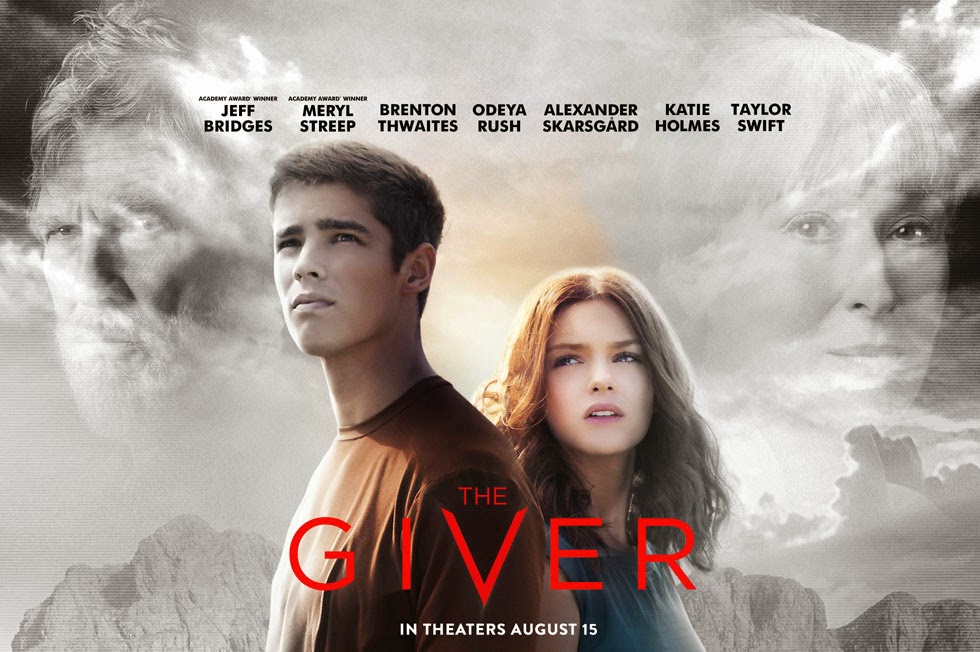
The Giver review


                As it turns out, I was the only American in my age group who wasn’t encouraged to read Lois Lowry’s “The Giver” in middle school. For many, this young-adult utopian science-fiction novel was a significant literary moment in their lives and is regarded with the utmost reverence. I was there for The Hobbit, R.L. Stine, and, though a little too old to fully appreciate it, I was even there for the early Harry Potter buzz. Nevertheless, I completely missed this phenomenon and wasn’t even aware of “The Giver” until a few friends of mine begun complaining about the trailers for its recent movie adaptation.
                In the wake of politically-minded YA sci-fi adaptations such as “The Hunger Games” and its shameless clones “Divergent” and the upcoming “Maze Runner,” it makes perfect sense that the suits in Hollywood would choose this pop-culture moment to green-light Lowry’s 1993 novel. In toeing the line of this tween-friendly genre, this adaptation has been given a slick CW makeover, with just enough cold austerity to imply the type of thematic depth, to which these kinds of films usually can’t commit. That is why, despite its mercenary attempts at cashing-in, it is both surprising and nice to say that this film works pretty well, even if it simply functions without a whole lot of pizazz. 
                In the distant future, society has bubbled itself into a tight-knit, highly-monitored community that is able to exist without pain, suffering, war or hunger. Children are studied at a young age for specific attributes and skills and are placed into jobs on their eighteenth birthday by the Chief Elder, played with a sinister calm by Meryl Streep. Jonas (Brenton Thwaites) is a chosen last in his graduating class to work, not as a scientist or laborer, but as a special archivist called The Receiver. This work consists of intensive sessions where he shares psychic memories of the old-world with an elder called ‘The Giver’ (Jeff Bridges) behind the walls of an isolated library restricted to the outside public. With these memories comes a heightened sensitivity to both the extreme joys of music, diversity, and love, as well as the depressing realities of, sickness, prejudice and war. Jonas is then left to decide whether to share the raw truth with everyone else or work keep it concealed.
                Tellingly, the cinematography conveys Jonas’ psychological arc from a worker bee to a revolutionary through the use of color, beginning with the first item he notices, a brilliant red apple. After his first few sessions, everything else begins to fade out of the digital grayscale into muted pastels, ending in a color explosion.  This depiction of enlightenment of course brings to mind Dorothy’s journey in “The Wizard of OZ” as well the biblical story of Adam and Eve, as their knowledge of good and evil also began with fruit.  Politically, the story’s Stepford-society recalls films made during the height of post-soviet red-scare and unlike the socialist-leanings of Suzanne Collins’ “Hunger Games” adaptations, this story’s more concerned with possible threat of government controlled egalitarianism.  But, lest we get too caught up in the barely-coded ethos of the source material, the movie itself moves from point A to B with little fuss and sufficiently rewards those who’re willing to accept its middling ambitions.
                Thwaites blank-slate performance unfortunately never matures as his character is supposed to be encumbered by the painful realities of the truth, and as a hero he ultimately fails to inspire much empathy. However, veteran director Phillip Noyce, better known for adult spy-thrillers such as “Clear and Present Danger” and “Patriot Games,” paces the film deliberately and with enough care and attention to the dramatic beats of the story that the movie is occasionally able to do the actors’ work without their help.  Key scenes are skimmed over in montage, leaving the emotional component slightly underdeveloped, but as a cursory introduction to dystopian fiction, “The Giver” at least tries to infuse the YA genre with enough visual creative dynamism to keep things interesting.

Grade: C+

Originally published in the Idaho State Journal/Aug-2014

Sunday, July 27, 2014

The Purge: Anarchy review


               It’s difficult to enjoy a genre movie about government-sanctioned annual murder sprees when every three weeks or so our news is treated to another mass shooting or a real-life tragedy, but horror films and thrillers have occasionally been able to make poetic sense from of a senseless time.  In this regard, writer/director James DeMonaco’s  “The Purge: Anarchy”  at least tries to contextualize his brand of schlock alongside easy metaphors and well-worn, occupy-era allegory.
                While last summer’s surprise horror-hit “The Purge” only hinted at its dystopian sci-fi conceits, settling closer within the intimate, home-invader sub-genre, this sequel opens up DeMonaco’s futuristic setting. Rather than being locked into one location, we travel through the murderous streets, following a handful of frightened survivors as they look for temporary refuge from the bloody holiday. Pair number one consists of an inner-city mother and teenage daughter (Eva Sanchez and Zoe Soul) whose apartment door is kicked in by their sexually frustrated slumlord. After barely escaping his attack, they run into pair number two, a young disgruntled couple (Zach Gilford and Kiele Sanchez) whose car dies in the wrong side of town just before a city-wide alarm sets off the lawless free-for-all. The only thing keeping these four alive is a stoic police Sergeant (Frank Grillo) who’s on a path of vengeance, as he stalks the roads in his armored car.
                It’s clear that DeMonaco grew up on movies like John Carpenter’s “Escape from New York” and Walter Hill’s “The Warriors” and tries to bring the same sense of unflinching bleakness alongside a broad satire of our current social landscape. But like other throwbacky horror directors such as Eli Roth and Rob Zombie, DeMonaco’s films live and die within the borders of their pastiche. As a fan, he can come up with an exploitation premise that sounds great as a one paragraph synopsis on the back of a DVD. As a director, he seems to struggle when it comes to telling an engaging story with characters you might care about.
                Neither Purge is particular memorable or entertaining, given their anarchic concepts, and unlike the Carpenter film’s they endlessly reference, their dower tone makes it uncomfortable to revel in the mindless popcorn violence. Likewise, the ripped-from-the-headlines soapboxing about class wars and wealth disparity lacks the depth or insight for the film to really work as a think-piece. Instead, we are treated to a competent TV-level cast wandering around an aimless plot as they jump from one scenario to another—some of which are mildly rousing, most of which are poorly staged and severely devoid of the necessary filmic discipline to garner adequate thrills.
                At best, “The Purge:  Anarchy” is a fanboy wish fulfillment that will make you nostalgic for Regan-era paranoia, at worst, it’s a philosophically muddy piece of trash-cinema that juxtaposes awkwardly and flippantly against the kinds of real-world terror and random acts of violence reported nightly on CNN. Perhaps only time and distance can illuminate the appropriate perspective to really understand what these movies are trying to say and what they might be doing effectively. Regardless, in a contextual vacuum, they tease more than they satisfy.

Grade: C-

Originally published in the Idaho State Journal/July-2014