Showing posts with label 2014. Show all posts

Sunday, January 11, 2015

My Top-10 films of 2014


If I were to identify a theme present in most of the films on my top-10 this year it would be genre films that managed approach things from an interesting angle or simply films with familiar trappings that completely subverted my expectations. I guess as someone who see's a lot of movies, reads about a lot of movies, and ends up writing about a lot of movies, I want to be surprised, and this list consists of the ten best surprises I encountered this year.

Forget the loaded titled that sparked a short-lived Twitter campaign, this debut feature from writer/director Justin Simien is one of the sharpest and smartest comedic satires about race since Spike Lee's “Do The Right Thing."  “Dear White People” examines culture-clash in a post-racial America through a nuanced lens of youthful identity panic and turns what could have been a simple and predictable story about a racially divided college into a universal message about learning how to define yourself instead of living up to the expectations of others.

From South Korean genre director Bong joon-ho comes his first English language film, a multinational post-apocalyptic action thriller about a team of survivors fighting their way through a train that separates the worlds population by class as they get closer to the engine room. There they hope to find a path to freedom and equality. This is an unapologetic, bleak vision of our world's current Geo-political mess, in which joon-ho refuses to supply any easy answers. Filled with shocking blasts of action violence and beautifully arranged set-pieces, “Snowpiercer” takes the tropes of a familiar hero story and forces the audience to examine difficult political questions.

Set in small town, rural America, this mini-budge revenge tale is another film that leaves you guessing all the way through. Almost a Coen Brothers archetype, our protagonist is an unassuming, ill-equipped nebish who takes on more than he is capable of dealing with when trying to right the wrongs between two warring families. While the tone or look of the film never suggests overt comedy, the priceless scenes of actor Macon Blair fumbling through learning how to shoot guns, dispose of a bodies and hide from his pursuers creates a nervous laughter throughout.

There have been plenty of indie flicks about young couples who're stuck in a vacation home to work through their relationship problems, but never one as chilling and surreal as director Charlie McDowell and writer Justin Lader's “The One I Love.” Mark Duplass and Elizabeth Moss are sent to vacation house per recommendation of a counselor and after some drinking and music they find that the house provides a type of strange existential therapy that can't easily be explained. I don't want to say too much because going on the ride is all the better when you don't know anything about it. All I will say is that the movie takes an absurd premise and follows it to it's natural extremes, and does so without overshadowing the original theme of what it takes for a young marriage to resolve problems of trust and communication.

David Fincher's adaptation of Gillian Flynn's popular airport novel “Gone Girl” also examines trust issues between sorted lovers. Fincher is a master at work here, as he takes what could have been a overwrought and over-written B-movie, and through his own cinematic brilliance, he confidently guides us through a brooding noir yarn that somehow manages to jump the shark three times and recover just as quick.

Indie veteran and uber-cool NY hipster Jim Jarmusch made a film about rock and roll, vampire junkies and reworked a well-worn and tired cinematic myth to create a sarcastic and post-modern world of his own. Tilda Swinton and Tom Hiddleston are captivating as bored shut-ins who have to live their lonely lives away from the public that worships them. Jarmusch's romantically lit vision of the deteriorating industrial neighborhoods of Detroit also suggests that these character's observations about the generational and economic changes in high/low culture has had a measurable effect on America's global relevance.

Jake Gyllenhaal gives his best performance yet in Dan Gilroy's black-as-coal media satire “Nightcrawler.” Here he plays Luis Bloom, a desperate and eager swindler who goes to uncomfortable lengths to film the fallout of crime scenes before his competitors get there first. Gilroy compares the hunger to succeed with a sociopaths lack of empathy, creating a nocturnal LA milieu where the loners and losers rule the city.

Forget those warm and fuzzy flicks about an older mentor and his younger talented protegee looking for words of wisdom. Damien Chazelle's “Whiplash” re-examines this familiar set-up as an abusive and epic power struggle. Miles Teller as the masochistic and ambitious college jazz drummer and JK Simmons as his Hannibal-Lector-like teacher steal the air from every scene as they fill their spaces full of raw and tangible tension, boiling to a fever pitch until arriving at one of the best movie ending of last decade.

Richard Linklater's twelve year project about a Texas boy growing up in a broken family creates an emotional scope far larger than the average coming-of-age drama usually aspires. By watching these actors age on camera and by composing each scene as a mini narrative within the larger context of someone's life, this movie becomes a living photo album full of the key memories that define who we are--be it the big moments that change everything or the small, insignificant moments that we forget as time passes.

Unlike anything else this year, this intimate sci-fi horror slinked it's way into brain and never let me go. Scarlett Johansson says very little as a predatory vixen who roams the poorly lit streets of Scotland looking for her prey. Without explicitly trying, British director Jonathan Glazer illustrates a compelling allegory about sexual power dynamics and gender politics, wrapped in a sensual thriller that will possess a patient audience with it's icy atmosphere and nightmarish visuals.

Honorable Mentions:
Guardians of the Galaxy, Captain America: The Winter Soldier, Stranger by the Lake, Birdman, Foxcatcher, The Grand Budapest Hotel, Dawn of the Planet of the Apes, Obvious Child, Locke


Originally Published in the Idaho State Journal/Jan-2015

Sunday, January 4, 2015

Into the Woods review

        After the awards buzz and accolades that surrounded the 2013's cinematic adaptation of “Les Miserables,” it was only natural that another well regarded Broadway production would make it's way into the next year's crop of holiday releases. Disney's reworking of Stephen Sondheim and James Lapine's “Into the Woods” is a gleefully traditional musical comedy full of big stars doing big hammy performances, and it's camera-winking dorkiness is probably the most endearing thing about it. Though director Rob Marshall ("Chicago," "Nine") uses his mouse-house money to fully realize the fantasy world in which these intertwining stories take place, on some level, the movie still operates like a high-budget, high school musical staring the most popular jocks and cheerleaders of Hollywood, and within that tonal imagining there's definitely a charm to be had, but the film never quite makes the impact that the cast or the budget would suggest.
        In an extended overture we are introduced to this fairy tale mash-up world where in the same village lives Little Red Riding Hood (Lilla Crawford) and the Big Bad Wolf (Johnny Depp), Cinderella (Anna Kendrick) and Prince Charming (Chris Pine), Rapunzel (Mackenzie Mauzy), and Jack of the beanstalk fame (Daniell Huddleston). In the background while these stories play themselves out more or less like we have seen before, the primary plot focuses on baker and his wife played by James Cordon and Emily Blunt, who desperately want to have a child and who find themselves manipulated by a witch (Meryl Streep). Together they orchestrate all of these tales in such a way that they can obtain the items they need to perform a fertility spell. It's all very convoluted and for the most part incidental when giving in to the mindless joy of watching our favorite Grim's fairy tales unfold this ironic, post-modern context. Later, when the second half kicks into gear and adds a 'be careful what you wish for' twist to every premature happy ending, the movie oddly runs out of creative juice and the amicable tone of the first half of the film is replaced with ponderous and severely unearned character dilemmas.
         The cast is obviously having fun here and are given license to fully send-up the cliches attached to their stories and their character's. Chris Pine's turn as the egomaniac Prince Charming and Streep, who's doing her best Margaret Hamilton impersonation, keep things lively and funny. Blunt and Cordon also do a fine enough job working as the glue that keeps these dispirit plots from overwhelming the spinal narrative, but it's Marshall's lackluster visual design and directorial blandness that chains this movie to the floor and keeps it from fully taking flight. Much of this production is lit in muted blues and grays and creates for a dreary, damp looking post-Burton conceptual expression that doesn't reflect the buoyancy of the performances or Sondheim's varied musical numbers. Many scenes are shot in traditional coverage, composed mostly of simple masters, close-ups and over the shoulder shots, without hardly any swooping cranes, impressive single-takes or even occasional grandiose establishing shots that would open up the frame, resulting in musical set-pieces that feel small and televisual.
       Far less melodramatic or irritating as last-year's overlong “Les Miz”, and with sing-along musical sequences that are more confidently and skillfully performed, recorded and mixed, “Into the Woods” is a benign, if somewhat banal, movie going experience. Family's who're looking to escape the polar-vortex and/or the discomfort of having to talk to each other will most likely enjoy the majority what they see here, even if by the last thirty minutes they might be thinking more about their holiday dinner leftovers than how the movie will be resolved.

Grade: C+  

Originally published in the Idaho State Journal/Jan-2015

Monday, December 29, 2014

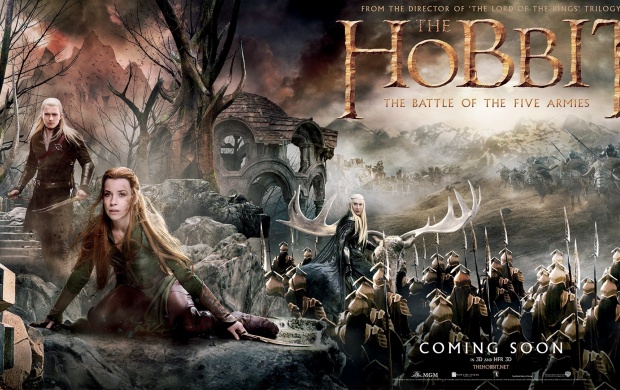
The Hobbit: Battle of the Five Armies review

       Given the critical and commercial success of the original “Lord of Rings” films and it's lasting cultural relevance that culminated in 2004 when “Return of the King” took home the best picture Oscar, I don't think it's a controversial statement to say that Peter Jackson's return to Middle Earth with this needlessly drawn-out Hobbit trilogy has been something of a thudding disappointment. Sure, these prequels have sold plenty of tickets and kept the popcorn industry afloat but even their most ardent defenders would probably agree that there has been a significant and noticeable drop in quality. Shot in a faster frame-rate to smooth out the performance of the 3D graphics and cartoonish CGI, the Hobbit films have been far more interested in testing new technologies and cashing in on recent nostalgia then gracefully or even faithfully adapting the (comparatively shorter) J.R.R. Tolkien novel.
With “Battle of the Five Armies” I found my self finally defeated by my disappointments and  expectations and passively willing to experience this conclusion as a theme park ride rather than a story that I could possibly be engaged in, and actually, once set in that frame of mind, this movie breezed by rather inoffensively. Still, there's hardly any story speak of as it's only intention is to wrap everything up and because of the added content and tangential plot byways the movie gets lost in from time to time, a severer lack of point of view and purpose keeps this installment from transcending the tech-demo action-schlock that Jackson has apparently settled for.
After the dragon Smaug is quickly and anti-climatically destroyed by the peoples of Lake Town the humans are caught in an awkward position when they they ask to borrow some of the newly available treasure to rebuild their burning village and the Dwarves' fearless leader Thorin (Richard Armitage) refuses to share the wealth, now taking up his mantel as the new king of the mountain. The wood elves feel like they deserve a piece too since they did their part in helping the Dwarves reach Smaug's cave, and just as the three armies begin to duke it out for the booty the same Orcs who have  been perusing the heroes since the beginning of the journey come back to finish what they started.
Along side the battle set-pieces that dominate the picture there exists a number of cameo plots, such as Gandalf (Ian McKellen) escaping near death after getting kidnapped by a not-so-mysterious evil force who's planning on making his big comeback, as well as a narratively inert love-triangle between the warrior elf Legolas (Orlando Bloom), the wood elf Taurial (Evangeline Lilly) and Kili (Aiden Turner), a young Dwarve who frankly doesn't have a shot. And in all of this, Bilbo (Martin Freeman), the titular Hobbit, is nearly sidelined and drown out of the film, serving almost no functional purpose.
There are faint ghosts of Tolkein's themes regarding greed and the petty but complicated nature of war and global economics that hums in the background of the spectacle but “Battle of the Five Armies” never settles on one place, one character, or one situation long enough to let anything substantive break through the bells and whistles. On a technical level everything moves along through the nonsense just sufficient to entertain but the the film's slap-dash plotting and heavy reliance on digital trickery kept me from truly believing in this world or caring about the people in it, and after the last three years of enduring this labored mess of an epic I desperately wish Peter Jackson would just go back to making-low budget horror films with puppets.

Grade: C-

Originally published in the Idaho State Journal/Dec-2014

Exodus: Gods and Kings review

         If Hollywood knew what they were doing, Bible stories would be the next major source for untapped IPs. They’re ripe with special effects potential and simplistic, Campbellian hero’s journey narratives, and not only will they draw in big crowds in the flyover states but if they keep it Old Testament they could even play well abroad. “Exodus: Gods and Kings” is Riddley’s Scott’s adaptation of the famous story of Moses and unlike Darren Aronofsky’s reinterpretation of “Noah” from earlier this year, this film in perfect step with the biblical text in terms of major plot details and the overall message of building trust in God, but rather than then the parable function it serves in the bible as a morality tale, Scott is far more interested in its cinematic function as a setting for swords and sandals spectacle, and maybe that’s not entirely a bad thing.
The first third of the movie teases a “Prince of Egypt” like tension between Moses (Christian Bale) before he becomes the self-identified revolutionary of the Hebrews and his adopted brother Ramses II (Joel Edgerton) before he becomes the Pharaoh. Having been raised as Egyptian royalty, Moses slowly learns through the oppressed peoples he visits on a business trip that he’s actually one of them, which then causes his existential collapse and his eventual exile from the kingdom. After wandering the desert for a bit, Moses makes a new life for himself when he marries and becomes a sheep herder, and all seems well until his newly acquainted Hebrew God asks him to return to Egypt to confront the Pharaoh and free the slaves.
Throughout the picture there’s a constant war between the spiritual and philosophic concerns of the content and the overbearing aesthetics and grandiosity of the production. The brother-against-brother storyline isn't properly milked for its dramatic potential as we’re initially told it’s going to be. Instead, midway through, Moses and Ramses are full-on enemies and that’s pretty much that.  There’s a small but significant thematic thread dealing with Moses’ increasingly taxing relationship with the elusive Biblical God, and every so often those concerns are dealt with in a semi-thoughtful and humanistic way; first when Moses is abruptly asked to leave his family to save his people, and then later as God instructs him sit and watch the Egyptians he grew up with tortured and killed by a host of terrifying plagues.
          The scenes depicting Moses’ struggle with his faith is about the only relatable thing here as the majority of the film feels and looks like a Las Vegas production, bathed in gold-tinted color-corrected lighting schemes, and spotlighting  a cast of Caucasian actors cheaply bronzed to look more ethnic , wearing bejeweled accessories and thick drag-queen eyeliner. Not helping this is a series of distracting and smirk-inducing casting choices with equally bizarre performances, including John Turturro as Moses and Ramses’ king father, Sigourney Weaver as their queen mother, who, with the exception of one scene, is seemingly only there to walk in and out of rooms, and Breaking Bad’s Aaron Paul as a crazy-eyed Hebrew slave who has looks as if he had a bad month and wandered on set without any discernible direction.
         You can always expect a level of technical craft when it comes to a Riddley Scott production and you certainly get that here.  The sets are lavish, the cinematography is atmospheric and the special effects sequences such as the plagues and famed parting of the Red Sea, visually captures your attention. But despite Scott’s minimal attempt at humanizing this tale, a large gilded heap of camp buries the story elements and turns this overlong  epic into a theatrical Circ de Sole performance, and like a well-lit show at the Luxor, it has its entertainment value even if it lacks artistic credibility.

Grade: C-

Originally published in the Idaho State Journal/Dec-2014

Thursday, December 18, 2014

Horrible Bosses 2 review


         After the surprise success of “The Hangover,” Hollywood hastily responded with a few high-concept, men-behaving-badly comedies to cash in on the trend. 2011’s “Horrible Bosses,” while not a laugh-a- minute classic by any means, was one of the better copycats.  Though the plot was merely serviceable,  it was at least highlighted by a few uncharacteristic performances from the likes of Kevin Spacey doing his gleefully-mean “Swimming with Sharks” thing, a bald and bug-eyed Colin Farrell, enjoying a break from being the heartthrob, and Jennifer Aniston being completely and unapologetically filthy. The film also reminded us of the comedic prowess of Jamie Foxx, who, after his Oscar success, was scrambling to find his footing again (and has yet to stabilize), and it successfully introduced Charlie Day, of FX’s “It’s Always Sunny in Philadelphia,” to the big screen.
           “Horrible Bosses 2,” however, continues to prove that comedy sequels usually can’t deliver the oftentimes incalculable chemistry of the first, which isn’t to say that the proceeding film--a little sitcom-ish and sloppy in its execution--was all that effective or original to begin with.  Here, the leading trio of Jason Bateman as the straight-man, Jason Sudeikis as the Vince Vaughn-esque, man-child player, and Charlie Day as the expressive over-reactor, never perform as naturally or as effortlessly as did the first time. Instead, their interactions appear forced and tired, the screenplay is thoughtlessly slapped together, and the movie’s exertion to stimulate laughs becomes increasingly unfunny as the plot lumbers from incident to incident.
           This time around the boys try to make it as their own bosses, creating and mass-marketing a Sky-Mall ready bathroom device called the Shower Buddy.  After accepting a shady deal with a larger cooperation to help fund and sell their product, new boss Bert Hansen (Christoph Waltz) and his petulant son Rex (Chris Pine) steal most of the profit for themselves, as well as the rights to their invention. This then, or course, leads the three dim-wits to go back to their criminal scheming, as they try to enact a complicated and illogical plan to fake the kidnapping of Bert Hansen’s son, using the ransom to buy back their company.
          With our leads now visibly bored and ineffectually improving their way through the entire film, the movie’s comedic success is thrust upon the efforts of the supporting cast, but the screenplay’s 1+?=comedy approach gives none of these actors anything substantial or funny to work with. Barely in the movie, Waltz is totally wasted and serves as nothing but a tedious mechanism for the majority of the film. Aniston returns as the nympho-dentist but is now stripped from the comedic place of power and irony that made her performance in the first film vaguely clever and is instead reduced to the butt of a sexist, male fantasy joke.  Jamie Foxx is clearly still having fun playing the criminal with a heart of gold but he too is chained to a messy script that gives his character a lack of believable motivation.  Chris Pine ends up with the best lines in the movie and the funniest stuff to do here but as game as he is, even he can’t keep this boat from sinking.
          Nobody asked for a “Horrible Bosses 2”, really, so nobody should be surprised that it basically sucks. Evenly-lit and comprised of mostly mid-shots and close-ups, the movie lacks just as much ambition visually as it does narratively. And neither of these problems would be particularly damning if the film could at least deliver the laughs, but, minus Chris Pine doing some entertaining sleaze and a too-little-late gag involving a chain-link fence, sadly, it does not.

Grade: D

Originally published in the Idaho State Journal/Dec-2014

Sunday, November 30, 2014

The Hunger Games: Mockingjay Pt.1 review

         Truth be told, I have never been as sold on this Hunger Games stuff as much as the general zeitgeist demands.  I don’t really have any interest in reading the books and though I don’t specifically hate anything about the films, they've never grabbed my attention, mostly because I can’t see anything past their base influences and trope-y plot conceits. But what I do appreciate about this franchise, and more specifically this last film, Mockingjay Pt. 1 (of two, because Hollywood), is that they try to discuss ideas of governmental power, class divisions, ideologies, and political revolution with a younger, impressionable Gen-y audience that frankly needs to hear about this stuff, as it’s more relevant right now than they probably even know.
Katniss Everdeen (Jennifer Lawrence), having broken the tradition of the annual Hunger Game battles, has now been chosen by the rebel army to be the stern face of the growing revolution against the Capital, known as the Mocking Jay. Meanwhile, her old fighting partner Peeta Mellark (Josh Hutcherson) is being held within the custody of her enemies, releasing distressing interview footage exclaiming that Katniss has been brain-washed by the rebels. This then prompts the leaders of the revolution (Philip Seymour Hoffman, Julianne Moore) to hire Katniss to star in their own propaganda news-reels as they fight in the rubble of their former districts, recently leveled to nothing by the merciless President Snow (Donald Sutherland).
What makes this installment more substantial and engaging is that they have finally done away with the worst element of the past films, those stupid Hunger Games.  Now that they don’t have to build the plot around a series of hokey Home Alone traps and thematic violence they never really had the guts to show in any meaningful way, this movie feels freed from the pressures of fan service, focusing more on directly with the political allegories. It’s gestures towards ideological battles and the complicated role that propaganda plays during war is far more sophisticated and tense than the series has been known to provide thus far.
          Katniss is sure that Peeta is being puppeted or mislead to say the things he says against her and he believes the same of her, and in the real world, where the political right and left are split 50/50, that’s exactly how each party frames the other’s point of view.  In the movie, while bombs are being hurled and bodies are being stepped over, the battle for truth is the most important one being fought because both sides don’t seem to be all that concerned with moving the line of objectivity wherever they need to make a convincing argument.
        Sometimes, however, the message is a little muddled. After a previous scene where Katniss speaks furiously into a camera about mistreatment of her people by the Capital, her leaders re-cut the speech into a propaganda video that recalls the look and style of a "Hunger Games" movie trailer. It’s a meta moment that while clever on the surface and grin inducing, maybe doesn't mean quite as much we are supposed think it does. (Is this about the compromising nature of celebrity? Are Hollywood films propaganda pieces? What are you getting at movie?)
Director Francis Lawrence revels in the story’s bleakness and designs many unnerving action moments that work quite well, including a visually striking break-in sequence at the end of the film, anxiously cross cut with footage of Katniss speaking directly with Sutherland who's eating the scenery up as beard twirling Snow. But, with all that said, I still don’t care about Katniss’ lingering feelings for her childhood friend Gale (Liam Hemsworth), the dialogue is painfully bogged down with exposition and superfluous explanation—remember, these movies are made for teenyboppers—and the Oscar winning Jennifer Laurence does some of the worst fake crying she’s ever done on camera. It’s not a perfect film and while it does some things very well, it’s not the first, second or even 100th film to ever do them, but, in my estimation, after spinning its tires in the dirt with the two previous installments, “Mocking Jay pt.1” is at least finally going somewhere.

Grade: B-

Originally Published in the Idaho State Journal/Nov-2014

Sunday, November 23, 2014

Big Hero Six review

            “Big Hero Six” is the perfect example of a post-modern, post-comic-con style of movie that casts its net wide enough to pull in fans of Pixar's emotional whimsy, tech-heavy Japanese anime and fast-paced, Marvel-esque, action set-pieces.  This makes  a lot of sense, seeing as this film is based on a Marvel comic property, of which Disney now owns the vast majority, and produced by Pixar brain-child John Lasseter—admitted fan and enthusiast of anime legend Hayao Miyazaki. But somewhere in this rowdy pastiche there’s still a focused and poignant coming of age story that grounds the referential spectacle, even when the film seems to be at odds with its more sophisticated leanings.
           We're introduced to the future utopia of Sanfransokyo (a literal cultural melding of east and west) through the lead character Hiro (voiced by Ryan Potter), as he wins big money at underground robot battles, of which his older, more collegiate brother Tadashi (Daniel Henney) disapproves. Later, after an exciting tour of his brother’s robotics school, where he meets a like-minded team of four other young inventors, he decides that his best work shouldn’t be displayed in street-level sport. Despite his young age, he applies to join the program by demonstrating his swarm of interlocking mini-bots at a competitive conference, but just after he wins the competition and accepts his admittance at the school, his future goes up in flames when his brother and the college’s lead technician are killed in a terrible explosion. Hiro is then left to mourn his brother through his last invention; an inflatable, non-lethal nursing bot named Baymax (Scott Adsit), who’s determined to lower the child’s stress-level however he can, even if that means helping Hiro and the other students find the masked murderer, who’s now using the mini-bots for wrong-doing.
           What elevates this film past the usual 3D animated fare is the familial warmth for all of these characters injected into the script and the specificity expressed in the world-building. The central relationship between Hiro and the bouncy, Michelin-Man looking Baymax is both funny as the literal-minded robot consistently misunderstands his frustrated, revenge-driven child owner, and overcast with a cloud of melancholy as the story repeatedly draws us back to the themes of personal loss and misdirected grievance. Before the point in which this movie even begins, Hiro and his older brother are established as orphans, raised by their kooky aunt (Maya Rudolf), who runs a street-side bakery to support the two of them. Baymax, though funny in his childlike reaction to new phenomena, is ultimately acting as an emotional Band-Aid for the protagonist and seeks to heal his pain through adventure. Pretty heavy stuff for kids movie, but not unlike the depths Disney or Pixar have previously explored. Where the movie suffers, however, is in its pandering to the blockbuster aesthetic.
           Once Hiro and his friends discover the whereabouts of the movie’s villain the tone shifts dramatically into action-figure ready, comic book popcorn fodder. Whether cleverly commenting on the banality of Marvel’s third-act, superhero destruction-quota, or simply falling prey to it, when the team suddenly builds robotic super-suits that give them all different powers and a large chunk of the movie’s second half is devoted to sequences of flying in between buildings and falling debris, I wondered how much of this was to advance the un-traditional buddy movie so well established in the first act and how much of it is only to serve the dynamic 3D animation. Nevertheless, at its best, “Big Hero Six” is a wonderfully imaginative and tender science-fiction parable and even when it is driving in autopilot, it’s impressively crafted, interesting to look at, and never boring.

Grade: B+

Originally published in the Idaho State Journal/Nov-2014

Sunday, November 9, 2014

Nightcrawler review


In the wake of the media blitz surrounding the recent Ebola scares and the minute-by-minute news coverage devoted to the few cases brought over to America by health officials working in the highly affected regions of Africa, Dan Gilroy’s sleazy suspense film “Nightcrawler,” which skewers media outlets who profit on paranoia, would seem hilariously timely and ironic if it weren’t so real and unsettling.  The now-viral video segment in which Fox News’ Shepard Smith broke the journalistic fourth wall and stepped away from his network’s regular programming to reassure fear-gripped Americans that they’re okay and that the reality of the situation isn’t necessarily as bad as the news might have us believe, suggested, at least for a brief moment, a tipping point in which basic human morals outweighed the media’s weekly bottom-line.  
Though set in the microcosm of local LA reporting, “Nightcrawler,” without apology, thoroughly skewers the world of cutthroat exploitation journalism by framing its argument around tangential concerns of economic desperation and the rise of internet self-help woo-woo, wrapped in a stingy self-reflexive jab at Hollywood’s tendency to alter reality in favor of the glamour and grime of ‘reality-ness .’ In short, this is probably the smartest and most immersive thriller likely to be seen this year, despite having been released on a minimally-attended Halloween weekend.
As the uncomfortably desperate people-pleaser Louis Bloom, Jake Gyllenhaal drops a third of his usual body-mass to play the type of character we’re usually used to seeing him hunt down as a cop in films like “Zodiac” or last year’s “Prisoners.”  We follow closely as he steals, lies and manipulates his way through Los Angeles looking for low-level work, until he finally finds the job of a lifetime when he pulls over on the side of the road to investigate a car-crash and discovers a freelance video operation headed by a mustachioed Bill Paxton who’s there to capture and sell grisly footage of crime and destruction for the local nightly news. With a small amount of dishonestly earned startup capital, Bloom buys himself a digital camera and hires a criminally underpaid ‘intern’ named Rick (Riz Ahmed) and together they comb the city’s suburbs looking for valuable blood and mayhem.
Rene Russo, who, along with Gyllenhaal is nomination worthy here, plays the producer of a fledgling LA news station who strikes an exclusive deal with Bloom, so long as he keeps bringing in the gory goods, which of course only enables his troubled psychosis. Given the parable-like meta-metaphor going on here, it’s not a stretch to assume that she stands in for the sensational media as a whole; the local news, the global news, the 24 hour cable news, Hollywood, the tabloids, reality TV, and the rest of the morally neutral enterprises that bank on perpetuating negativity.  
Somewhere between the fast-talking, self-centered ice of “American Psycho’s” Patrick Bateman and Robert De Niro’s portrayal of the comically pathetic Rupert Pupkin in Scorsese’s cult masterpiece “The King of Comedy,” what makes Bloom such a fascinating and terrifying character to watch is that he’s too good at his job. While we can’t believe the depraved lengths he’s willing to go to get to the scene of the crime before his competition or the lines he’s willing cross to get the perfect shots of carnage he needs, in today’s economic circumstances, we somewhat admire his tenacity and his keen ability to rig the system, given his ability to completely disconnect from humanity.  
With Gilroy’s patient and subtly stylish direction, at times recalling the William Friedkin’s street-movies “Cruising” and “The French Connection,” we’re lulled by the darkly romantic atmosphere of the film into rooting for the character’s success, which later slaps us with our own moral convictions and creates an uneasy tension in our bellies. It’s this kind of blackly humorous, subversive cynicism that will both turn off the portion of the audience who like their movies to leave them feeling good and tickle those who appreciate razor-sharp and perversely misanthropic satire.

Grade: A

Originally published by the Idaho State Journal/Nov-2014