Showing posts with label James McAvoy. Show all posts

Sunday, February 12, 2017

Split review


M. Knight Shyamalan’s latest film “Split” combines his love of Hitchcockian thrills and with his predilection for high-concept myth-making and fuses these obsessions in a way that’s surprisingly energetic and captivating. I have to say surprising because since the heights of his career in early 2000 Shyamalan has only recently come off a long losing-streak s. After big budget genre-flops such as “Lady in the Water” and “The Last Airbender” he lost of lot of credibility as a coherent storyteller with both audiences and critics alike. Halving his costs under the pop-horror banner of Blumhouse Productions, it seems that he’s now able to make smaller, more efficient work without the pretenses of prestige. 

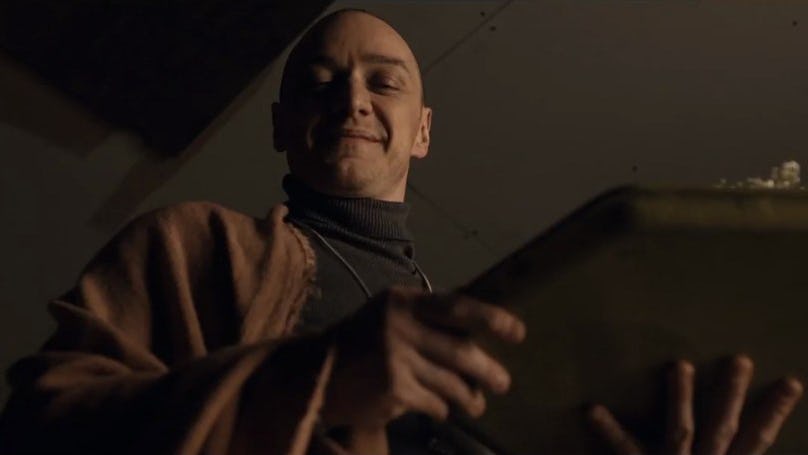
James McAvoy is given the spotlight playing a troubled man named Kevin who constantly switches between multiple personalities. After a complicated battle of dominance between the personalities inside of his mind, he kidnaps three teenage girls in the hopes to appease a brooding darkness growing from within. Anya Taylor-Joy plays Casey Cook, the most introverted and ostracized of these women, and through this kidnapping experience she's forced to relive her past abuse. Haley Lu Richardson and Jessica Sula portray the other two girls who can’t understand why Casey has no will to fight. As they try to come up with clever ways to escape McAvoy’s underground lair, Casey tries to get to know and manipulate Kevin’s separate personalities.

We get to know McAvoy as a brutish clean-freak and fetishist named Dennis, a passive-aggressive English woman named Patricia, a nine-year-old attention-seeker named Hedwig, a nervous fashionista named Barry and a demonic force of nature known only as The Beast. While Dennis and Patricia--the personalities responsible for the kidnapping--have the most control over their host, the others have sought the help of a psychiatrist named Dr. Karen Fletcher (Betty Buckley), who's beginning to notice that her patient has something to hide.

Like any Shyamalan film, there’s a lot of plot here and his characters are subservient to the whims of the director’s set-ups and reveals. His depiction of mental illness has less to do with diagnose-able science and more with pulp mythology that’s rooted in past psychodramas and paranormal science-fiction.  If you’re willing to suspend your disbelief and give in to the script’s wacky concepts, as a thriller, the movie works well enough. The ticking-clock set up at the beginning of the film allows for constant tension that keeps everything on a track, even as scenes digresses into long-winded explanations of the movie rules through clunky, expository dialogue.

McAvoy’s having a lot of fun with these multiple roles and approaches the film’s goofy plot with just the right amount on whit and sarcasm to aid in its occasional black comedy. Anya Taylor-Joy is more informed by her character’s flashbacks than by her performance, but her emotional stillness helps to ground the movie’s themes and dramatic stakes.

“Split” is a mixed bag; it’s overwritten, it’s a bit hokey and Shyamalan has some problematic and concerning ideas about abuse-survival as a means of martyrdom, but the film is never boring and it managed to keep me engaged with the story as it moved along.  Thrill rides don’t necessarily have to be realistic, and though I wish this ride hadn’t stopped every ten minute to explain something that didn’t need explaining, despite it's failings, I appreciated the end-result.

Grade: B-

Originally Published in the Idaho State Journal/Feb-2017

Listen to this week's episode of Jabber and the Drone to hear more conversation about "Split."

Saturday, June 4, 2016

X-Men: Apocalypse review

20th Century Fox’s X-Men series has a been one of the longest running and most volatile of Hollywood’s plentiful superhero franchises. When director Bryan Singer helmed the first two entries around the turn of the century his objective was to naturalize the pulp materials his movies were based on and to internalize the comic book’s over-the-top sci-fi premise into a relatable political allegory about governmental oppression and systemic bigotry. Since then, the X-Films have been passed along to many directors and many writers and the sincerity of its themes have been gradually muddied by competing aesthetic choices, bad screenplays and a timeline that’s tangled itself into more knots than a pocketed pair of earbuds.  

When Singer returned to the property for 2014’s “X-Men: Days of Future Past” he had of lot of narrative housecleaning to get back to his original vision, but was still able to carefully land his albatross of a time-travel plot with all toes touching the ground.  The promise of “Days of Future Past” was that the slate was now clean and the films going forward no longer had to answer for the mistakes of the past, that’s why the latest entry, “X-Men: Apocalypse,” is all the more disappointing, as it relapses into many of the same inconsistencies found within its weaker predecessors.

Moving ten years forward from the events of the last film, this installment sees our heroes faced by an ancient mutant named Apocalypse (Oscar Isaac) brought back from the dead from the depths of the pyramids of Egypt. Once this god-like entity is restored he is put on a path to destroy the earth of human dominion by recruiting four powerful soldiers who are sympathetic to his cause. After Magneto (Michael Fassbender) is ripped away from his newly established anonymous life in eastern Europe he joins Apocalypse alongside a young Storm (Alexandra Shipp), Angel (Ben Hardy), and Psylocke (Olivia Munn).  When Professor Xavier (James McAvoy) catches wind of this new force he assembles a new team to keep his school safe, as well as the future of the world as we know it.  

This film somehow manages to suffer simultaneous from being too much and not enough. There are too many characters and too many subplots to keep track of and yet none of them are really explored with enough depth or purpose to justify their inclusion. The heroes such as Beast (Nicholas Hoult), Cyclops (Tye Sheridan), Quicksilver (Evan Peters) and Mystique (Jennifer Lawrence) are explore to some capacity and have some stakes in the plot but the script lacks a sense of focus and drive by its constant shifting of the story’s center of consciousness. Is this supposed to about Mystique trying to save the soul of her mentor and friend Magneto? Is it about Cyclops’ journey to find belonging and responsibility within the group as a new student? Is it a political allegory about the arms race of the 80s? None of these plot ideas are fully flushed out and much of the film feels like a poorly paced build up to a non-climax.  

Secondly this movie suffers from a style that is far campier than we’ve been treated to from this series thus far, with flashier set-pieces, hokier dialogue—courtesy of hack screenwriter Simon Kinberg—and ridiculous costuming.  The film’s 3D minded cinematography heightens every battle scene into cartoony weightlessness. Because of this, the action sequences are less vital and less tactile and the visuals appear flattened and cheap when projected in two dimensions.


Still, McAvoy and Fassbender are great actors and there are moments of candy-coated pop filmmaking to be found in this mess, along with the DNA of the comic book’s higher minded ideas as well as Singers’ passion for minority social justice. “X-Men: Apocalypse” isn’t the worst film in the franchise—“X-Men Origins: Wolverine” still has that distinction—but this material has clearly become tired and strained from being worked and reworked over the last 15 years and as a result th movie never settles into a comfortable mode of its own.   

Grade: C-

Originally Published in the Idaho State Journal/May-2016

Listen to this week's episode of Jabber and the Drone to hear more conversation about "X-Men: Apocalypse."

Saturday, May 31, 2014

X-Men: Days of Future Past review

After essentially kick-starting the cinematic superhero renaissance fifteen years ago, the X-Men movie series has undergone many drastic creative shifts, including confusing continuity tangles and some exceedingly bad press surrounding one of its directors. Following two especially disappointing sequels in “X-Men: The Last Standm” by substitute director Brett Ratner and the unforgivably dreadful spin-off “X-Men Origins: Wolverine” a few years later, the franchise was partially revitalized in 2011 with the ‘60s cold-war installment “X-Men: First Class," starring Michael Fassbender and James McAvoy. James Mangold’s “The Wolverine” was also watchable but mostly forgettable in the long run. Now, in an attempt to clean the slate, original director Bryan Singer has the unfortunate job of tying all of these films together and bridging their plot-holes with his newest entry, a time-travel thriller called “X-Men: Days of Future Past”, staring key players from both timelines.

Not only is there very high stakes for the cautiously optimistic fans who have endured and celebrated previously great and awful X-films, “Days of Future Past” has many tasks to carefully maneuver for itself. It must be reasonably faithful to the beloved comic story in which it takes its name, it has to tie together two timelines that are just different enough to makes things complicated, and it has to ret-con the mistakes of the previous sequels. Surprisingly, while not home-run success, it manages to do so with only a few notable discrepancies.

The plot immediately drops us into the near future of 2023, in a post-apocalypse where most of the X-Men have been killed by giant self-regenerating robots called the Sentinels who patrol the earth to terminate all of mutant kind. Aged Professor, Charles Xavier (Patrick Stuart) sends Wolverine’s consciousness back into his younger body during the ‘70s where he must inspire the recently jaded and crippled Professor (James McAvoy) to let out his imprisoned enemy Magneto (Michael Fassbender) to stop a misguided Mystique (Jennifer Lawrence) from assassinating the engineer responsible for starting the newly-formed Sentinel program. Jumping back and forth from these two events in time, we watch the future X-Men try as hard as they can to hold their defense, while Wolverine (Hugh Jackman) has to prevent all the pawns of their eventual destruction from falling into place.

While I'm more than aware of the narrative heavy-lifting this plot has to do before we can even get into the main points of its story, unfortunately the first third of the film gets to a wobbly start with achingly stilted, tech-jabber dialogue and blunt introductions to the characters and their vague future-world, all of which are too brief and glossed over to effectively build to an appropriate emotional connection. But once Jackman gets zapped into the 70s and we get the 411 on where our "First Class" heroes have been since the last movie, the pieces start to come together, slowly building towards a grand climax that’s just as good or even better than anything we've previously seen from the series.

While “Days of Future Past” occasionally feels pieced together from hunks of scripts that were torn from different drafts, rewritten by committee and reshaped in the editing room, about half of its movie-parts contain genuinely original superhero moments; most notably some great comedic action sequences with X-newbie Quicksilver (Evan Peters), where his speed powers are portrayed by showing us how he moves normally in the slowed-down world around him. X-Men mainstays such as Lawrence, Fassbender, McAvoy, and Jackman are just as reliable as we have come to expect and newcomers like Peter Dinklage,  who plays the mutant-phobic scientist Bolivar Trask, are given their own scenes to steal as well. Most of all, by the end of the film, however rocky it was to get there, it’s very gratifying to see the fruits bared from the franchise’s willingness to apologize for its past mediocrities.

Grade: B -
Originally Published in the Idaho State Journal/June-2014