Showing posts with label Logan Lerman. Show all posts

Sunday, October 26, 2014

Fury review


               While still retaining the base entertainments of the war genre, David Ayer’s WW2 flick “Fury” tackles topics of humanity, masculinity, ideology and national loyalty in a dense and deliberate way. It’s an ensemble buddy war drama in the tradition of “The Dirty Dozen”—or maybe even more testosterone-driven westerns such as “Rio Bravo” and especially “The Wild Bunch”—but with a leftist post-Vietnam, post-9/11 introspective sensibility that questions the overall effectiveness of war as a means to an end and ponders the long-lasting impact on the individual soldiers caught up in its hell. Sometimes wallowing in its moral greys and other times manipulating the audience with the visceral simplicities of black and white, the mix of these two ideological outlooks, and the way Ayre attempts to balance them within the narrative, is a subtextual war of its own.
               This story of a team of tank fighters, who, at the tail end of the Second World War, are moving through the devastated villages of Germany, begins when one member is brutally killed and a new soldier is brought in to replace him; a 19 year old typist named Norman (Logan Lerman), who’s ripped from his cozy job and thrown into the rainy, blood stained fields of battle. There he meets the steadfast leader Don Collier (Brad Pitt), the teams’ bible thumping gunman Boyd Swan (Shia LaBeouf ), Grady Travis (Jon Bernthal), a troubled southerner who probably takes too much glee in his murderous duties, and a Mexican-American soldier named Trini Garcia (Michael Pena) who’s already showing early signs of PTSD. It’s clear from the first few missions that Norman is in way over his head, and, having just lost one of their own, rolling into some of the most dangerous tank battles against the Nazi’s near-impervious Panzers, the rest of team doesn’t have the patience for him to get comfortable with the idea of taking a human life.
               Ayer’s follow-up to his 2012 found-footage cop-drama “End of Watch” builds on the themes of brotherhood and masculinity in a more cohesive and more pessimistic way. The extremely tense and explicitly violent war scenes are spaced appropriately by character building moments of reflexivity, letting the audience get to know and sympathize with this group of men who’re trying their hardest to keep their emotional vulnerability bottled in.  However, though the performances are sensitively portrayed and the battle scenes are competently staged and shot, when their tank rolls over the dead bodies of their enemies and they poke their heads out of their mobile shelter to shoot down the newly appointed Nazi youth, some of whom are younger than our movie’s hero, the nobility of nationalistic bravery becomes difficult to identify or enjoy. And sometimes--if I’m giving the movie the full benefit of the doubt--that’s the point.
               In one key scene, after a village battle has ended, Lerman and Pitt’s characters enter the home of two German sisters, and after Pitt’s Collier pulls them out of hiding, visibly frightened and shaking with fear, he offers them both eggs and breakfast as a peace offering.  Though this moment breathes with steady directorial observation, as the story progresses, what follows on their path is a series of increasingly depressing and devastating act of violence until the movie’s final showdown between the out-manned, out-gunned Fury and a sizable SS militia.
               Does “Fury” want to be a think piece about the lowest depths of depravity world governments have forced on the innocent minds of naïve recruits looking to serve their country, who then have to numb their souls in order to toe the line, or does it want to be a rousing coming of age story about having your blinders removed and being forced to see what evil looks like by figuring out your place in opposition against it?   It’s difficult to tell sometimes, resulting in a technically accomplished action-drama that tests your moral barometer as you’re often unsure if you want to cheer along or wince in disgust.

Grade: B -
Originally published in the Idaho State Journal/Oct-2014

Sunday, April 6, 2014

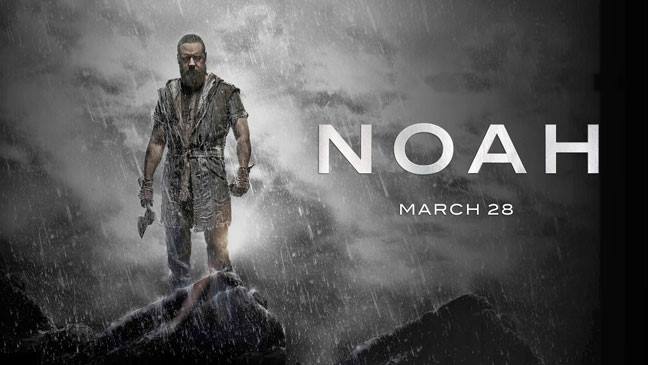
Noah review


                Everyone knows the story of Noah and the great flood of The Bible, or at least they think they do.  Stories like this one and many others that have permeated the social sphere are usually not remembered, recited or quoted with accuracy or even with any of the relevant context to the scriptures that surrounds them. Instead, these tales have become a kind of cultural meme, and in the case of “Noah” over time the myth has been whittled down to the iconography of animals, rainbows and a big wooden boat. 
                New York filmmaker Darren Aronofsky, most well-known for his bleakly-pitched, visceral indie work like “Requiem for a Dream” and “Black Swan”, cares nothing about the memetic simplicity or even the moral dichotomies within the Noah story of the original biblical text.  With his recent adaptation—working within a much bigger budget than he’s usually afforded—he transgresses the familiar narrative in search for the darker implications of the legend.
                In this alternative universe version of “Noah” , Russell Crowe plays our hero as he is shown by the creator visions of a watery apocalypse that will destroy every living person in the world. His grandfather Methuselah (Anthony Hopkins) informs him that he has been called to save his family and the animalia of the planet by building a large ark that will float along the earth’s surface during the imminent flood. (Yeah yeah yeah—we know all that.) However, this time around, what Noah isn’t telling his family is that perhaps the creator never intended for the human race to survive past their death once they have saved the other species.  This becomes even more complicated when Noah’s adopted daughter Ila (Emma Watson) is struggling to bare children with his eldest son Shem (Douglas Booth), while at the same time his younger son Ham (Logan Lerman) is begging for a wife to validate his budding manhood.
                Much has been written about the fundamentalist reaction against Aronofsky’s additions to the source material, and it’s obvious within the first ten minutes that accuracy is not his aim. Much of the movie’s second half deals with the existential angst that these characters have to endure in the face of their seemingly elusive deity. Noah is forced to ponder if he was chosen because he’s the best of mankind or simply the best man for the job. The psychological weight this brings down on him and his family when they hear the screams outside of the arch as the flood rises around them exemplifies the universal truth of moral and spiritual uncertainty that this adaptation is interested in.  The disgruntled faithful should know that, as a story, the slanting of the text to better examine these characters and to give these actors more pathos to deal with is not where the movie fails…but this does lead me to my other point: rock monsters.  
                Maybe in a grand statement of defiance, or perhaps in a broad brushstroke of creative freedom, Aronofsky includes many Tolkien fantasy elements that unfortunately overpower the first half of this otherwise dark film with misjudged silliness. But besides scene-ruining rock monsters, Hopkins’ wizard-like Methuselah seems to serve more as a writing device than as a character, telling us what we already know or could gather from the plot, handing out magic-grow tree-seeds, and going on and on about berries.   Luckily the power and paranoia of the second half just barely saves the film from the Dungeons and Dragons nonsense of the first half. 
                I see no reason why details about the rather short biblical verses shouldn’t be altered for the sake of exploring characters and situations in a more complex or subversive way, even if the film’s pot boils over with too many discordant ideas from time to time. “Noah” is, without a doubt, an audacious and deeply melancholy cinematic experience, but it may alienate fans of the book.

Grade: C+

Originally published in the Idaho State Journal/March-2014