Showing posts with label Aaron Eckhart. Show all posts

Sunday, September 18, 2016

Sully review

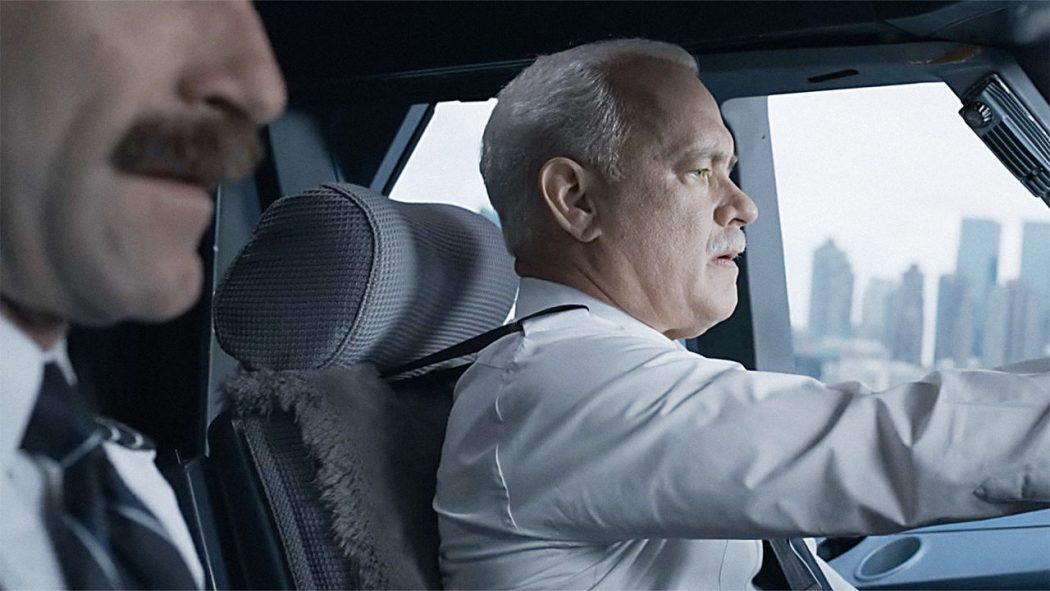
Both as an actor and as a director, Clint Eastwood has explored his fascination with the conflicted hero narrative. World weary and downtrodden seems to be the resting constitution of most of his protagonists and their stories usually test their personal doubts with a greater conflict that effects the good of their environments. In this year’s “Sully” Tom Hanks takes on this position as the real life commercial airplane pilot Captain Chesley Sullenberger, who in 2009 safely landed an American Airlines jet of 155 passengers along the surface of the Hudson river with no casualties. The story caught the aged, life-long pilot in the middle of a media storm where he and his co-pilot Jeff Skiles (Aaron Eckhart) was crowned heroes by many, while simultaneously enduring pressure and scrutiny by the organization investigating the crash.  

Using Sully’s tested psychosis as the story’s framing device, much of the story is told in flashback, as well as the occasional PTSD-induced nightmare sequence. Hanks plays Sully with a lot of insular angst and quietude and uses his eyes to convey his character’s discomfort and mounting self-doubt. It’s not a particularly showy performance and it leans further into Hanks’ transition into that of a senior performer. Eckhart is then given more room to be vocal and expressive about the nature of their character’s odd position within the media and their stressful behind-the-scenes case.  

The film is also interested in the notion of experienced intuition verses blind empiricism, as the board of investigators keep telling both pilots that every simulation demonstrates that they should have been able to safely make it back to the tarmac without risking a dangerous water-landing (as well as destroying expensive company equipment.) This argument, as presented by the film, could be read as a condemnation of expert analysis and a celebration of blue-collar, folksy instinct but the conclusion to this case wisely factors in human experience and emotional error as a variable itself, saving the picture from slipping too far into an anti-science, finger-wagging appeal to the viewer’s emotions.

 The special effects and the flight recreations are both familiar to the experience of flying and the fear that comes with its risks.  The daydreams and nightmare sequences are  realistic and spiked with harrowing 9/11 imagery, which ties in subtly with New York and America’s exaltation of Sully’s rescue landing.

“Sully” is a competent drama. Hanks is a professional, Eastwood knows exactly how to tell this story and the screenplay aims low enough for both of them to hit their intended marks. If the film does have a flaw it’s Todd Komarnicki’s successful but safe adaptation of Sullenberger’s book “Highest Duty.” Kormarnicki tries to weave in Sully’s past as a war pilot and crop duster to show his experience and his relationship with the air, but that gesture is never really paid off or integrated well enough to fully inform the character or the plot. While studied and precise, the screenplay lacks the amount of narrative ambition it needed to propel the picture from good actor’s showcase to being truly great film.

Grade: B

Originally Published in the Idaho State Journal - Sep/2016

Saturday, February 1, 2014

I, Frankenstein review

               Like Frankenstein’s monster himself, “I Frankenstein”—brought to us by the creators of the “Underworld” franchise—is a soulless aberration made up of bits and chunks, sewed together from other pop-culture references and genre tropes. Trying desperately hard to be cool without any regard to logical plotting or coherent storytelling, this corpse of an action movie proves that the basin of Hollywood’s bad ideas apparently has no bottom.
                In the dark rainy city of god-knows-where Frankenstein’s monster, played by Aaron Eckhart, stumbles into a holy war between undercover demons and gargoyles sent to protect earth by the archangel Gabriel.  The gargoyles live in and protect a massive cathedral in the center of the unnamed city, where they decide, against their better judgment, not to kill Eckhart’s superfluous character—named Adam by the gargoyle queen—even though they know that he murdered his creator and that he doesn’t have a soul. You see, the demons need to build an army of animated corpses like Adam because in this universe they can only possess soulless bodies.  Though apparently they can’t just possess a regular buried corpse because that would be too simple and this movie never passes on an opportunity to toss a narrative hurdle in its path.
                Years into the future, in what I guess is supposed to be modern times, Niberious the prince of demons, played by Bill Nighy, is working to recreate Dr. Frankenstein’s results in a lab, ran by two scientists who are unaware of his evil conspiracy.  The lead physicist Terra (Yvonne Strahofsky) gets wind of her employer’s actions after she encounters Adam when he breaks into her lab to retrieve his master’s 19th century journal.  Adam must then choose between protecting himself and joining the gargoyles in their battle against the possible threat of an army of demon possessed Franken-zombies.
                Overwrought and underwhelming this movie tries to stuff in every mistake made by every action-horror fantasy from the last 15 years. It attempts to balance myth and legend against genre tradition and bizarre Christian metaphors, resulting in a head spinning slosh of clanging production notes. And oh my god is this movie is stupid. I mean it’s bad… Like, really bad. It’s bad in a way I didn’t know movies could still be. But is it so bad it’s good? Not quite, though not for any lack of trying.
                  Practically every single thing that this movie wants to do it can’t seem to do at all. The performances all around are as stiff as a log and comprised of nothing but a series of slow-motion poses, but I can hardly the blame the actors when their characters speak in nothing but clunky exposition. The stylized violence, which should be fun in theory, is undercut by the fact that the angels/gargoyles are beamed up to heaven as soon as they are killed, while the demons explode into a badly rendered ball of CGI fire, sending them back to hell; a cheesy conceit that will make you nostalgic for the dated effects in “Ghost”. 
                There’s even an attempt to create a pseudo-romance between Adam and Terra the electro-physiologist. Of course when Eckhart bares his toned body, as he removes his war-tattered hoodie, we are immediately reminded that his character is a cadaver, patched together by other peoples dead flesh—hardly a sexy moment.
                Len Wiseman’s “Underworld” series, as stupid as most of it is, was occasionally watchable in all its pleather-clad monster brooding, but this mash-up mythology, directed by Stuart Bettie, only diminishes the good-will towards its antecedents. Designed to look like an Evanescence music video or a PS2 video-game cut scene, whatever campy joy one might want to find between the cracks of this schlocky mess is buried miles under a heap of dull self-seriousness.

Grade: F

Originally published in the Idaho State Journal/Feb-2014