Showing posts with label Tom Hanks. Show all posts

Sunday, September 18, 2016

Sully review

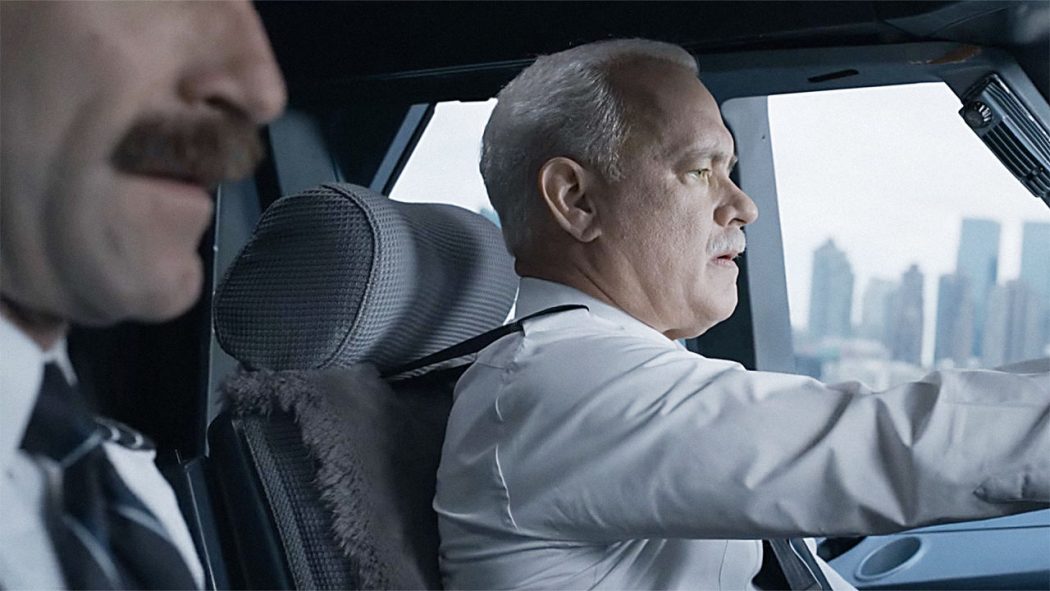
Both as an actor and as a director, Clint Eastwood has explored his fascination with the conflicted hero narrative. World weary and downtrodden seems to be the resting constitution of most of his protagonists and their stories usually test their personal doubts with a greater conflict that effects the good of their environments. In this year’s “Sully” Tom Hanks takes on this position as the real life commercial airplane pilot Captain Chesley Sullenberger, who in 2009 safely landed an American Airlines jet of 155 passengers along the surface of the Hudson river with no casualties. The story caught the aged, life-long pilot in the middle of a media storm where he and his co-pilot Jeff Skiles (Aaron Eckhart) was crowned heroes by many, while simultaneously enduring pressure and scrutiny by the organization investigating the crash.  

Using Sully’s tested psychosis as the story’s framing device, much of the story is told in flashback, as well as the occasional PTSD-induced nightmare sequence. Hanks plays Sully with a lot of insular angst and quietude and uses his eyes to convey his character’s discomfort and mounting self-doubt. It’s not a particularly showy performance and it leans further into Hanks’ transition into that of a senior performer. Eckhart is then given more room to be vocal and expressive about the nature of their character’s odd position within the media and their stressful behind-the-scenes case.  

The film is also interested in the notion of experienced intuition verses blind empiricism, as the board of investigators keep telling both pilots that every simulation demonstrates that they should have been able to safely make it back to the tarmac without risking a dangerous water-landing (as well as destroying expensive company equipment.) This argument, as presented by the film, could be read as a condemnation of expert analysis and a celebration of blue-collar, folksy instinct but the conclusion to this case wisely factors in human experience and emotional error as a variable itself, saving the picture from slipping too far into an anti-science, finger-wagging appeal to the viewer’s emotions.

 The special effects and the flight recreations are both familiar to the experience of flying and the fear that comes with its risks.  The daydreams and nightmare sequences are  realistic and spiked with harrowing 9/11 imagery, which ties in subtly with New York and America’s exaltation of Sully’s rescue landing.

“Sully” is a competent drama. Hanks is a professional, Eastwood knows exactly how to tell this story and the screenplay aims low enough for both of them to hit their intended marks. If the film does have a flaw it’s Todd Komarnicki’s successful but safe adaptation of Sullenberger’s book “Highest Duty.” Kormarnicki tries to weave in Sully’s past as a war pilot and crop duster to show his experience and his relationship with the air, but that gesture is never really paid off or integrated well enough to fully inform the character or the plot. While studied and precise, the screenplay lacks the amount of narrative ambition it needed to propel the picture from good actor’s showcase to being truly great film.

Grade: B

Originally Published in the Idaho State Journal - Sep/2016

Sunday, October 20, 2013

Captain Phillips review


               English director Paul Greengrass has defined his career by way of making films about post nine-eleven paranoia. He tackled this subject most explicitly in the movie “United 93”, about the airplane that was voluntarily crashed by its passengers on September 11th, before it could fly into its Washington DC target.  Of course, he originally made his name directing two of the most profitable and critically praised sequels of all time, in “The Bourn Supremacy” and “The Bourn Ultimatum”—a franchise that I kind of don’t ‘get’. But even in those films, as pulpy as they are, Greengrass brought a sense of terror-awareness into their genre tropes.
                With “Captain Phillips”, a true story about a blue-collar freight-sailor whose ship is attacked by a small group of armed Somalia pirates, Greengrass returns to the type of Hitchcockian claustrophobia that got him awards consideration in 2006 for his work in “United 93”.
                Perhaps more of a situation than a story, the screenplay focuses on the emotional turmoil that the characters go through while trying to survive this tense ordeal. The film begins calmly while we watch the Phillips (Tom Hanks) as a he prepares his crew for the worst. After receiving an alarming email, he stages a loose terror-drill and shows the men where they need to hide when/if they are attacked. When their ship is eventually taken over, these men are forced to helplessly wait in the dark corridors of the engine room while Phillips tries to peacefully negotiate with the desperate assailants.
                 Also, at the front of the film, the screenplay makes some lite—and somewhat incidental—thematic juxtapositions, in regards to the world’s economic struggles.  We see Hanks as Phillips talking to his wife (Catherine Keener) about the competitive job market in the United States just before a cut to the land-bound pirates making deals with their war-lords about how much money they are expected to bring home.  But pay no attention to the man behind the subtexual curtain; while the political gesturing isn’t explored enough to register the way it’s supposed to, “Captain Phillips” is a lean, no-nonsense thriller, and a fairly effective one at that.
                 The always-dependable Tom Hanks plays this character with a firm consistency and a sharp consciousness of his emotional state. He begins the film as a the kind of hard-working boss who isn’t particularly liked by his employees but who still manages to send tender emails back home to his worried family. Later, when the action kicks into gear, we see how his demeanor changes into a selfless, humble man who tries his best to keep his crew safe, even as he puts himself at risk. By the end of the film, after he has been put through the worst  kind of psychological torment, Hanks successfully shows us how Phillips is able to hide his inner terror with a fragile facade of courage. The rest of the ensemble, including African non-actor Barkhad Abdi , who plays the leader of the pirates, should be praised for their convincing performances as well.
                As a stylist, Greengrass never directs his action movies in an overly- showy or attention-seeking manner. Rather, his approach is indebted to the story and how best he can serve it.  While “Captain Phillips” isn’t saying as much as it thinks it is, it knows how to raise the stakes and keep them up for the duration of the film. Occasionally, to create a sense of documentary realism, the camera shakes or the focus pulls more than is probably necessary, but the tension is strong enough and the performances are good enough to keep you invested in how this set-up will play out.
               
Grade: B+

Originally published in the Idaho State Journal/Oct-2013