Showing posts with label 2015. Show all posts

Saturday, February 27, 2016

The Witch review

Robert Eggers debut horror film “The Witch” is one of those rare tour de force first features that spotlights a true talent to look out for.  This black metal folk tale is a near-perfect study in tone and immersive tension, with a keen sense of setting and period that boasts a handful of completely credible performances. It not only uses the macabre to sell its aesthetics as a horror film but it embraces a true sense of darkness and slithering evil that will stay in your consciousness long after the initial shock of its deranged third act.

Even more astonishing, “The Witch” has finally broken the hex that dictates that movies starring actors from “Game of Thrones” must suck (“Pompeii,” “The Other Woman,” “Terminator: Genisys”). Ralph Ineson and Kate Dickie play the mother and father of a 1630 puritan family who decide to leave their New England pilgrim community to settle their own property in the middle of a nearby gloomy forest. There they hope to build a purer relationship with God, away from the noise of regular society. Their eldest daughter Thomasin (Anya Taylor-Joy) has begun to question the logic of her parents, their son Caleb (Harvey Scrimshaw) is coming to terms with his difficult puberty, their two young twins may or may not be talking to evil spirits through the family's farm goats and their unbaptized newborn has just gone missing. After the kidnapping, the family begins to find themselves crushed with religious guilt, exposing each member’s personal struggles with sin. Soon internal battles with lust, pride and dishonesty manifests themselves into real or perceived oppressions from the dark forces lurking within the shrouded forest.

What makes this film more narratively enriching than your average cabin in the woods shocker is that the screenplay, laced with biblical, old-English dialogue, is just as committed to the drama and the interior lives of the characters as it is with hitting all the intended genre beats as a thriller. The performances by the mostly-unknown cast are realistic and heartbreaking, especially by lead actress Taylor-Joy whose emotional and symbolic arc within the film is both complex and challenging. Rather than lacing the plot with empty boo-scares and gotchya moments, every character is tormented by their own guilt and their own fears, with the titular Witch preying on the family’s vulnerabilities in ways that are visually creative and truly horrific.  

The sets look lived in and the grim 1600's period imagery is never played for theatrical camp. Because of the intense attention to the film's cosmetic details, Eggers portrayal of pagan magic is strangely believable within the context of this satanic melodrama. Cinematographer Jarin Blaschke uses single-source lighting-schemes with metaphoric intent, etching the characters and subjects out of the natural darkness, while never defaulting to flat desaturation or an overuse of digital color-correction.

Some might search for a contemporary message within the story and when talking about dangerous accusations of witchcraft, feminism rises to the surface, and if you’re looking for it, that’s certainly in there. But the picture’s more prevalent theme is of man’s relationship with sin and the unhealthy consequences of repression. 

Given the character’s conflicts with their own faith alongside the high-contrast imagery that's obscured by spindly tree-branches, Swedish art-house auteur Ingmar Bergman would have been proud of this film's relative mainstream success.

“The Witch” was released wide and is being sold as a casual winter horror programmer but unlike the seemingly generic title, this movie is anything but a lazy and predictable experience. The pace is deliberately slow and not unlike Kubrick’s “The Shining,” its taught sense of dread moves closer to you as each sequence pulls the cord a little tighter. There’s certainly entertainment to be had in all its artful spookiness, but this is not really a popcorn film. Rather, this is a masterful study in atmosphere, history and religious philosophy that deserves as much discussion as it deserves your gasps and nightmares.


Grade: A+

Originally Published in the Idaho State Journal/Feb-2016

Listen to more discussion about "The VVitch" on this week's Jabber and the Drone Podcast.

Saturday, January 16, 2016

My Top 10 Films of 2015


2015 was a particularly strange year for movies. Critics and fanboys lost their minds for George Miller’s “Mad Max: Fury Road,” a movie I thought was laudable as a piece of action filmmaking, but certainly not a new standard for the genre. Likewise, the year’s end brought in a wave of earnest prestige pictures that are sure to be forgotten once the awards campaigns have come to an end--*cough* I’m looking at you “Spotlight.” When looking back at my personal top-10 of last year, I find a strange mix of films that range wildly in genre, size and scope.

10 – Steve Jobs – Aaron Sorkin returns to familiar territory with his screenplay about Macintosh maestro Steve Jobs. For some, this might have come too close to the tone and characterizations depicted in his admittedly stronger screenplay for David Fincher’s “The Social Network,” but Michael Fassbender, Kate Winslet, Michael Stuhlbarg, Jeff Daniels and Seth Rogan internalize Sorkin’s dense, walk-and-talk dialogue confidently and Danny Boyle’s serviceable direction showcases this oddly-structured biopic with a sense of urgency.

09 – Tangerine – Sean Baker’s micro-budget indie, shot entirely on a modified iPhone5, is one of the most vital films to come out of the festival circuit in years. This comedy chronicles a wacky night of misadventure between two transgendered prostitutes who work out of a janky donut hut on Hollywood Boulevard. Though the situations and setting of this very-specific world might sound like the usual set-up for a naval-gazing cautionary tale, Baker injects immediacy and levity into the film and refuses to let the characters feel sorry for themselves.

08 – The Martian – This has to be on my list on the basis of that it's the least problematic Ridley Scott movie since 2000’s “Gladiator.” Matt Damon carries this “Call of the Wild” on Mars story with a good sense of comedic timing and relatability. Along with the 70s disco soundtrack, it’s the optimistic celebration of intelligence and science found in Drew Goddard’s adapted screenplay that culminates into an idiosyncratic and likeable sensibility--not often found in much of Scott’s recent work.

07 – Dope – Three nerds who attend a high-school in south-central Los Angeles are on the run from both the police and the gangs, when one of them accidentally gets the group involved in a drug ring while fumbling to impress a girl. This teen comedy/heist-movie highbred is full of contagious energy and an adventurous spirit towards the well-worn tropes it gladly subverts. The familiar teen-movie themes of trying to fit in are translated into interesting discussions of racial identity and class, as this movie depicts the difficulties of wanting to excel and stand-out within  urban communities.

06 – Room – Lenny Abrahamson’s “Room” explores the human condition and the power of childhood imagination through the dark tale of a women who fights for her son’s safety and innocents while forced to raise him within the woodshed of a deranged kidnapper. Abrahamson explores this enclosed space like a science fiction reality, slowly revealing to the audience more devastating truths as we learn the finer details through the perspective of Jacob Tremblay’s child protagonist. Brie Larson also gives a heartbreaking performance as the young mother.

05 – It Follows – This tribute to 80s minimalist horror takes the absurd premise of an evil entity that follows a person after he or she has slept with the last carrier of the curse and shoots it with such competency and atmosphere that the viewer is forced to think about the deeper connotations of its fantasy rules. The film’s soundtrack and the artful use of subject camera infuses every scene with palpable terror.

4 – Sicario – Speaking of subtly brooding thrillers, Denis Villeneuve’s boarder-noir “Sicario” stretches the movie’s narrative tightrope as much as it can and holds the tension in place for it's entire run-time as we descend into the film's criminal hell-scape. Emily Blunt, Josh Brolin and Benecio Del Toro all give career-best performances and Roger Deakin’s cinematography brings him back to the southwest desolation of 2007’s “No Country for Old Men.”

3 – Ex Machina – Alex Garland’s directorial debut delivers on the promise of his visionary screenwriting on projects such as “28 Days Later” and “Sunshine.” Here he explores the psychology and philosophic ramifications of developing artificial intelligence with a minimal chamber thriller starring Oscar Isaac as a lonely, billionaire tech-genius and Domhnall Gleeson as an unassuming coder, tasked with testing the self-awareness of the world’s first living machine,  who's played wonderfully by Alicia Vikander.

2 – Inside Out – Pixar has a history of breaking hearts with their tender family fare, but it’s difficult to be prepared for just how genuine and vulnerable “Inside Out” is. The mechanics of the narrative, following the anthropomorphized emotions within the mind of a 12 year old girl, are surprisingly complicated and multifaceted, but “Up” writer/director Peat Doctor never loses sight of the raw, emotional core of his story within a story. More importantly, this film reminds us that big-budget Hollywood product can be thoughtful and nuanced and doesn't need to pander to the lowest common denominator to have a wide appeal.


1 – The Tribe – I saw this Ukrainian drama within the first few months of 2015 and knew by its end that it was unlikely that I would see a better film within the remainder of the year. Miroslav Slaboshpitsky depicts a boarding-school for the deaf as a lawless wasteland, where survival of fittest is the only sense of order established between groups of unsupervised teenagers. It’s difficult to describe the power of the wordless apocalyptic world Slaboshpitsky creates, but it’s the nervous tension generated between the shock of what we are seeing and the deliberate patience in which it’s shot that makes for one of the most vital pieces of visceral cinema of 2015.

Honorable Mentions:
Creed, Beasts of No Nation, Star Wars: The Force Awakens, The Big Short, Mad Max: Fury Road, What We Do In The Shadows,  Kingsmen: The Secret Service and Carol 

Published in the Idaho State Journal/Jan-2016

Listen to more discussion about the best and worst films of the year on this episode of the Jabber and the Drone podcast.

Sunday, January 3, 2016

The Big Short review

Adam McKay, director of silly Will Ferrell vehicles such as “Anchorman” and “The Other Guys,” turned down the opportunity to helm Marvel’s “Ant-Man” in favor of “The Big Short,” a topical satire about a group of mavericks on the margins of Wall-Street who were able accurately predicted the housing collapse against the grain of conventional wisdom. Like 2014’s “The Wolf of Wall Street,” this film portrays America’s unhealthy reinforcement of cutthroat capitalism like Greek tragedy, in which the key figured of this morality play are tricked into a game where winning and losing is the exact same thing.

This film is boasts a large cast of heavy-hitters that includes Christian Bale as a an eccentric annalist named Michael Burry who first discovers a way to profit from the eventual bursting of the housing bubble in 2005, long before anyone could see it growing. Ryan Gosling plays Jared Vennet, a mercenary banker who catches wind of this prediction and hires a team of low-level Wall Street traders to check the progression of this collapse, with the aims of selling big just before the ground beneath them breaks. This team of foul mouthed number-crunchers is ran by Steve Carrell’s Mark Baum, a noble-to-a-fault day-trader who is caught in a moral quagmire when he quickly learns how far and how deeply in trouble the world economy has become and how it will effect living standards of the middle class. Producer Brad Pitt even makes an appearance as a nihilistic ex-yuppie who lends his expertise to two hapless dorks looking to break into the world of finance.

This movie juggles a lot of big personalities and plays almost like heist film in which the big score is cursed with a moral backfire. Based upon this description, you may assume that the film is a huge bummer, and it kind of is, but where McKay’s history in comedy comes in handy, both with his features and from his time as a writer on SNL, is that he allows for enough appropriate comedic distanced to nervously laugh at the story’s heady subject matter. The screenplay by McKay and Charles Randolph, works hard to break through the seemingly impenetrable amount of necessary exposition and finance jargon one has to recon with to accurately adapt the source text from Michael Lewis’ book of the same name. Lewis’ “Moneyball,” adapted for the screen by Aaron Sorkin and Steven Zaillian, took a much more intimate and human approach to the subject of how the prediction of numbers effects the real lives of which those numbers represent, mostly because of the sober and melancholy style of its director Bennett Miller.

In contrast, McKay simply acknowledges that the Wall Street world is not one that most of the audience lives in and decides to play the tragedy of corporate corruption like a perverse farce of the American dream. One could say that the many stylistic choices used here, including the use of catchy rock music, quick edit and goofy, non-diegetic asides where celebrities explain economic concepts, is a sign of McKay’s lack of confidence with the material—over compensating by dressing up the “grown up talk” in a lot bling and flash—and one is probably correct in that assessment. Nevertheless, when it comes to the fundamentally activist aim of the movie’s themes, McKay’s showy delivery certainly helps to digest and discern the material and to simultaneously entertain and outraged at the same time.

Despite all of the star power involved in the cast the ensemble shines within individual scenes and while Bale’s jittery performance could have used maybe two less acting-ticks, Carell’s hysterical and empathetic portrayal as a man who is hanging on to the last shreds of dignity and morality helps to ground the audience into the movie’s complex emotional truth .

Sometimes “The Big Short” feels a little too eager to impress and you’ll never shake the feeling that McKay is trying to convince you that the movie's vegetables are an airplane, but overall it has enough subversive punk-rock energy and a noble enough purpose to keep the enjoyable style from overwhelming the sobering substance. 

Grade - B

Originally published in the Idaho State Journal/Jan-2016

Sunday, December 27, 2015

Star Wars: The Force Awakens review

When George Lucas sold the rights to “Star Wars” along with his company Lucasfilm to Disney and it was announced that Spielberg’s spiritual successor J.J. Abrams, of “Super 8” and the recent “Star Trek” films, would relaunch the series with an additional numerical installment, devotees were instantly optimistic about the possibility of the series redeeming itself from the dampened legacy of the franchise. “Star Wars: The Force Awakens” is as much a soft-reboot as it is the seventh episode of Lucas’ grand saga. Many familiar elements are reintroduced through new characters and the old cast members are brought back to pass the ceremonial lightsaber to a new generation—a younger generation of fans who learned most of what they know about “Star Wars” minutia from online reddit forums, long-winded bloggy take-downs of the much-maligned prequels, as well as various memes, sketches and remix videos.

Forty years of real-time have passed since Luke Skywalker destroyed the Empire, Darth Vader was killed and Han Solo, Princess Leia and the rebels celebrated their victory. Turns out they celebrated too early because the Empire has reformed as an aggressive totalitarian militia known as the First Order and after failing to train a new generation of Jedi, Luke has gone missing. In his absence, a new Darth Vader wannabee named Kylo Ren (Adam Driver) has led the hunt for the remaining rebel forces, dead-set on finding Luke before the other rebels can get to him. A small soccer-ball-shaped droid called BB-8 has a piece of the galactic map that leads to Luke’s whereabouts but is separated from the resistance when his master, a fighter pilot named Poe Dameron (Oscar Isaac), is arrested by the First Order after a battle on a desert planet known as Jakku. It is then up to a resilient scavenger named Rey (Daisy Ridley) and a disgruntled storm trooper in hiding named Fin (John Boyega) to bring the droid back to the rebel base before Kylo Ren and First Order discover the secrets they hold.

Much of the appeal of this film is in its attempts to conjure the aesthetics and nostalgia of the original trilogy. “Empire Strikes Back” writer Lawrence Kasdan helped Abrams pen the screenplay and many of the high-stakes adventuring, the jokey one-liners and the scrappy aerial dog fights that were missing from Lucas’ stoic prequels are restored in this exciting but sometimes frustratingly familiar plot. The younger cast of characters are genuinely likable and interesting. They fit very neatly into previous “Star Wars” archetypes but the actors fill their parts out with a lot of idiosyncratic charm and self-deprecating wit. Likewise, Harrison Ford’s return as Han Solo remains surprisingly fresh and energetic, considering the age of the actor and the grizzled joylessness of his later performances.

The special effects are appropriately updated, using a healthy blend of computer generated visuals along with real sets, real locations and tangible props and creature designs. The movie isn’t exactly short but it moves along quickly and it milks those crowd pleasing close-calls in such a way that even the most jaded of fanboys will be unable to resist a near-constant grin.  And yet, even after thoroughly enjoying myself twice in the theater—yes, I’ve already seen it twice—I can’t help but lament how narratively unoriginal and pandering a lot of this feels. Many plot points directly mirror those of the first three films and many functions of the new and old characters serve to move the story with almost the exact same outcomes. Death Stars, rescue missions, mysterious prophecies and Greek familial tragedy are all tapped again for this installment and carried out without any subversion of those dusty Campbellian tropes. As such, it’s almost impossible to be surprised by this movie (or perhaps the future of this entire franchise) once you realize where it’s headed.

Thee future of creative cinema aside, “Star Wars: The Force Awakens” is undeniably a good time at the movies. New audiences will have a worthy jumping on point to seed their future obsessions and seasoned fans will likely enjoy the throwbacky glee of Abrams’ childlike warmth towards the mythology. But it is it’s also undeniable that Abrams is as much a fanboy as he is a fan and has a difficult time distancing himself far enough from the source material to update it or add to it in a truly bold or progressive way.

Grade: B

Originally published in the Idaho State Journal/Dec-2015


Listen to more discussion about "The Force Awakens" and "The Big Short" on this week's Jabber and the Drone podcast.

Sunday, December 20, 2015

In the Heart of the Sea review

Ron Howard’s “In the Heart of the Sea” is a 3D, special effects reimagining of Herman Melville’s “Moby Dick” that’s oddly bashful about its source material. The conceit is that this film is based on the true story that “Moby Dick” was inspired by, but given the level of artifice involved in the movie’s production, truth and authenticity hardly feels like the Howard's cinematic goal with this project. It’s also a special effects film in which the last 30 minutes primarily focuses on a group of starving men floating around in still waters.

Perhaps we need a new word for year-end, awards-baiting 3D films like “Gravity” and “Life of Pi”; not quite blockbuster, but not quite prestige film either. They exist somewhere in the middle, attempting to draw people in with the promise of spectacle, boasting a well-regarded cast and director and expressing just enough dramatic oomph to suggest a deeper regard for story than the summer’s brand of overblown toy commercials and comic book properties--or at least that’s the intended impression.

The story here is wrapped around a distracting framing device in which Brendan Gleeson recounts his time at sea as the youngest passenger aboard the movie’s nautical whaling adventure. As he tells this story to a young Herman Melville with writers-block (Ben Wishaw), we go back to the early 19th century when whale-oil was a huge political and economic commodity.  Gleeson’s character is now played by future-Spider-Man Tom Holland, who looks up to the handsome and masculine Owen Chase, played by Chris Hemsworth. Chase is upset because, though he is more qualified and experienced, he is made second in command of his whaling ship to George Pollard (Benjamin Walker), who was hastily made captain through nepotism. After spending months at sea with little to show for it, the crew is told that there is a stretch of ocean a few thousand miles off the shores of Argentina lousy with whales, so long as they can survive a monstrous, vengeful sea-demon known as…well, not Moby Dick, because this isn’t that story…exactly.

Out of the gate this film is hobbled by the story within a story about a story concept, and with the narrator’s timeline intermittently weaving in and out of the film’s primary narrative, a lot of dramatic tension is broken to serve the movie’s and the tension that exists between it’s want to relish in lush production and its perceived ‘truthiness.’ Besides the whale attack money shots and the occasionally impressive vista, Anthony Dod Mantle’s cinematography is beholden to the 3D moments and blandly color-corrected with an aqua-marine tinge that actually flattens the dynamics of every shot.

That said, I can’t deny that the film eventually wormed its way into my psyche as the third act delved deeper into its characters and raised the stakes of their personal sense of humanity. Though the movie slows down to a crawl and essentially abandon’s its high-concept effects-ride premise, I could appreciate some of the narrative risks it was willing to take. Of course these risks are somewhat undercut by the need to have Wishaw and Gleeson explicate the movie’s themes every time the movie felt the need to cut back to the framing device.


“In the Heart of the Sea” is a gaudy, noble failure that mostly doesn’t work, but it’s also not entirely unentertaining. A lot of the movie is undeniably hokey. The performances are a little over-mannered, even by seasoned pros like Hemsworth and the great Irish actor Cillian Murphy, and with their old-American costumes and warbled accents much of it plays like an expensive episode of Comedy Central’s “Drunk History.” Which isn’t to say that there isn’t some inherent fun to be had in that aesthetic. Thematically, the movie struggles to tie together its semi-environmental ideas about the oil industrial complex with its sub-“Jaws” competition of masculinity themes and by the end of the film audiences are likely to feel bait-and-switched by how slow and dark the movie allows itself to get.

Grade: C-

Originally Printed in the Idaho State Journal/Dec-2015

Listen to more discussion about "In the Heart of the Sea" on this week's "Jabber and the Drone" Podcast.

Sunday, December 13, 2015

Krampus review

The yuletide horror film has long been a tradition of the scary-movie genre, from 1974’s “Black Christmas,” to 1984’s “Silent Night, Deadly Night.” Michael Dougherty’s “Krampus” takes the twisted-fairytale approach to common Christmas movie tropes and perverts them with the same sense of gleeful menace that Joe Dante brought to his staple of the Christmas horror-comedy sub-genre “Gremlins.”

Adam Scott and Toni Collette play Tom and Sarah, two frustrated suburban parents who’re dreading the yearly visit from their backwards extended family. Sarah’s sister Linda (Allison Tolman) and her gun-toting, loud-mouthed husband (David Koechner), along with their drunken matriarch (Conchata Ferrell) and their two brutish children, complete this RV-driving nightmare family that seems hell-bent on ruining the perfect holiday weekend for Tom and Sarah’s youngest boy Max (Emjay Anthony). When Max gives up on the possibility of his family getting along he tears apart his handwritten letter to Santa Claus and, in doing so, inadvertently conjures the dark magic of the Krampus, a massive horned and hooved beast that turns every Christmas tradition into a deadly trap. Having experienced something similar in her youth, Tom’s elderly German mother Omi (Krista Stadler) tries to warn the group against going outside or letting the fireplace stay unlit. 

Dougherty’s previous holiday-themed cult-horror movie “Trick ’r Treat” was a tryptic, portmanteau narrative that brought together different story elements within the same group of characters, shifting from one plot thread to the other. “Krampus” is a much more traditionally structured three-act story, and because of that has more responsibility to its build-up and its pay-off. The movie’s set-up is pretty loose and given enough to air to inform the characters and comedy. Structurally, National Lampoon’s “Christmas Vacation” certainly played in similar water, as far as the awkward family dynamics go, but Dougherty’s screenplay never seems to penetrate the surface of these character’s one-note identifiers, underselling the potential for anything more than a mild chuckle. The actors do their best with what little they’re given, but before the horror-element kicks in, the movie’s foundation as a story is disappointingly thin.

Where Dougherty excels here is with his visual flair and his wild imagination when it comes to the effects and movie’ atmosphere. The Germanic pagan design of the “Krampus” himself, along with the wooden faces of his demonic elves are delightfully sinister and brings to mind the playful and practical creature effects of 1980s B-movies such as “Troll” and “Pumpkinhead.” Dougherty is clearly having fun within his limitations and plays the story like a director putting on a perverse puppet show for an unsuspecting audience. Unfortunately, the PG-13 rating dampens the levels of violence and shock necessary for the film to be anywhere near as subversive as it often thinks it’s being, forcing the movie to rely too heavily on its hacky and tepid comedy.

As a mostly-silly genre exercise, “Krampus” is acceptable pop-corn fodder and destined to be a cable-television curiosity. The plot mechanics and characterizations are certainly lazy and it’s never fully commits to the sense anarchy it teases throughout, but it’s filmed with visual confidence and it has just enough schlocky exuberance to keep you entertained.


Grade: C+

Originally published in the Idaho State Journal - Dec/2015

Listen to more discussion about "Krampus" on this this week's episode of the Jabber and the Drone Podcast.

Sunday, December 6, 2015

Creed review

Ryan Coogler’s unlikely “Rocky” spin-off “Creed” is an uncompromisingly traditional sports drama that works as a piece of pop-entertainment because of its commitment to emotional storytelling. Much like the director’s approach to his debut indie about police violence “Fruitvale Station,” Coogler spends a lot of time getting inside the heads of his characters and building a tangible, and believable world for them to inhabit. The big sports movie moments are present and the familiar beats of the genre are eventually paid off, but Coogler informs these moments with care and precision when it comes to the plight of the characters and the strength of the film’s performances.

This story picks up decades after the death of Rocky mentor and adversary Apollo Creed. Outside of the margins of the sequel’s cannon, it is learned that Creed had an illegitimate son named Adonis Johnson (Michael B. Jordan) with a women outside of his marriage. When the young boy’s mother dies and he is left orphaned Creed’s true wife Mary Ann (Phylicia Rashad) finds him in a juvenile detention center for boys and decides to bring him to her home in Los Angeles and raise the child like her own. After he’s grown, though she would like him to focus on his career as a business man, Johnson has a yearning to be a great fighter like the father he never met, secretly training in Mexico and building his natural talent as a boxer.  Soon enough, Adonis decides to quit his suit and tie job and move to Philadelphia to train with the aged and broken Rocky Balboa (Sylvester Stallone).

Cinematically “Creed” distinguishes itself from the other “Rocky” movies with a quiet and grounded sensibility. There’s a loose, handheld style used throughout and a much more somber tone than is usually expressed in the rest of the movies of this franchise. Coogler directs the film as if the other movies were a mythologized version of a real-life figure that we’re meeting for the first time in this iteration. Of course this isn’t the case, but the grit of this movie world is an effective tone-setter and Coogler informs the mentor-mentee clichés of the plot with a documentary style realism that helps the film’s urban setting feel properly lived-in.

The camera work also allows for longer lasting cuts that boarder on virtuoso filmmaking without ever announcing a flashy movie-moment or any post-Scorsese directorial muscle-flexing. Instead, much like the performances, these longer cuts are used to open the scenes up and allows the visual language to breath, especially during the climactic fight sequences.

Michael B. Jordan is terrific here as the young Adonis Johnson. I won’t say that he’s written with a ton of depth or complexity, but Jordan’s interiority and natural screen presence fills in the blanks left of the page. When young Creed moves to Philadelphia he meets a neighbor played by Tessa Thompson, a musician with progressive hearing-loss. This relationship never feels like a superfluous B-plot, mostly because of the real chemistry that exists between the performers and because the attention payed toward the film’s themes of living in the moment before opportunity eventually fades. Stallone is also allowed to play his iconic character with more vulnerability than we have seen from him in some time.

“Creed” is a movie that we’ve seen before. The tropes of the boxing-genre are inescapable and just about every one of those boxes are checked in this somewhat pedestrian screenplay. But cinema should also exist off the page, and that is where Coogler finds his strength as a storyteller, often better at expressing how a scene should feel rather than what it tells.  

Grade - B+

Originally published in the Idaho State Journal/Dec-2015


Listen to more discussion about "Creed" and "Room" on this week's Jabber and the Drone podcast.

Sunday, November 29, 2015

Hunger Games: Mockingjay Part 2 review


Susanne Collins’ book series and its subsequent film adaptations “The Hunger Games” has lead the pack of young-adult dystopian fiction. As an outside observer and a non-reader of the source-material, my familiarity of the films' well-worn pulp and science-fiction tropes combined with the overall seriousness in which they are presented has often left me cold. As the series has progressed both in budget and quality and as the story shifted from the hokey set-up of booby trapped game shows—hokey in execution, not necessarily concept—to the devastation of a revolutionary war scenario, my patience has increased in terms of the films’ undeniable tween demo targeting.

“The Hunger Games: Mockingjay Part 2” concludes this franchise with an emotional and visceral payoff for those who have been invested since the first page of the first novel. It’s by far the darkest of the four movies and challenges “Harry Potter and the Deathly Hollows Part 2” with its mounting body count. But unlike many of the films in this series that awkwardly juxtaposed its themes of violence with its interest in filling the multiplex with 13 year old girls, this installment is fully committed to the trauma and complex psychological torture involved with oppression and war.

Katniss Everdeen (Jennifer Lawrence) has decided to break out on her own, away from the safety net of the other rebels and away from the propaganda war perpetrated by the rebel leader Alma Coin (Julianne Moore). With a little help getting out of her city district, Katniss and a group of other young soldier attempt to travel across the war-torn Capital to assassinate President Snow (Donald Sutherland).  On their journey they must avoid a series of dangerous booby-traps—less hokey this time around—while staying under the radar of the Capitals extensive surveillance.

After spending much of the last film brain-washed by the leaders of the evil government, Peeta Mellark (Josh Hutcherson) has rejoined the rebels, now suffering from post-traumatic stress. The rest of the group, including Katniss’ other would-be suitor Gale (Liam Hemsworth), are skeptical of Peeta’s reintegration and Katniss’ loyalties are once again divided. By this point in the series, amongst all of the death and destruction at hand, the last thing I want to see is the further development of a love triangle. Though much of it is truncated in favor of the film’s more interesting arc about the exchange of one governmental dominion to another, whenever the movie pauses to pay lip-service to this sub-Twilight will-they-or-wont-they, the tragedy of war is momentarily trivialized.  

Besides the tonally inappropriate love-story, the majority of the movie has a shocking lack of levity. The stakes are as high as anything the series as presented thus far and director Francis Lawrence flavors the rebel’s deadly pursuit with almost horror-movie levels of tension and anxiety. In one particularly suspenseful scene, Katniss’ group are held up in a subway tunnel where they are attacked by subterranean mutant vampire-like creatures. There’s not a lot of blood-letting or gore in this sequence but the set-up and its cinematic effect adds up to some pretty scary stuff for a younger than teenage audience. It also happens to be the only moment in which Lawrence seems to be havin fun with the pulpier elements of this franchise.

“Mockingjay Part 2” makes interesting points about the way classism and war exploits those most vulnerable, doing most of the heavy lifting for the privileged outliers who only wish to propel their own ideologies. The film’s final act—minus a saccharin and pointless epilogue—includes a shocking political gesture and a bravely messy cap on the good-guys-verses-bad-guys nature of the story. It’s about 25 minutes too long, drags whenever the characters have talk to each other, and cannot be bothered to consider its existence as a piece of genre entertainment, but as the full maturation of a YA property, this final installment is smart enough and intense enough to warrant the lesser entrees that preceded it.

Grade: B-

Originally published in the Idaho State Journal/Nov-2015

Listen to more discussion about "Mockingjay Pt.2" and "Carol" on this week's Jabber and the Drone podcast.

Sunday, November 22, 2015

Beasts of No Nation review


Netflix has forever changed the traditional models of content delivery. Video stores were put on the endangered species list when people began subscribing to the company’s mail-based DVD rental system, and were later forced into extinction by its ever-expanding streaming service. Entire seasons of television shows, old and new, could be accessed with a single click and movies that people may have never considered watching were put on the same digital shelf as familiar classics. It wouldn’t be long before Netflix would start creating its own content, first in the form of serialized dramas like “House of Cards” and “Orange is the New Black,” and now in the form of stand-alone movies.

Netflix’s first original film “Beasts of No Nation” is an attempt to draw in a new audience that may not already be sold on the service’s versatility. In order to be eligible for awards consideration, this movie was given a day-and-date release, where it was available to stream from home alongside a limited theatrical run. This African war-thriller was written, directed and shot by Cary Fukunaga, director of the first season of HBO’s popular crime series “True Detective,” and the seductive style and the rich atmosphere that drew people into that show is certainly evident in this project as well.

The story here follows the life of a young villager named Agu (Abraham Attah) who is left an orphan when his family is gunned down in the streets by an invading government army. Agu manages to survive the vicious attack when he escapes into the bush. After a few days of struggling on his own, he is ambushed by a group of militant rebels who promise to give him food, water and safety if he joins their cause. Even more enticing, the young survivor is given a chance to avenge his family’s murder with the opportunity to train as a child soldier.

The group’s charismatic Commandant is played by English actor Idris Elba, who portrays the ragtag war-lord with a weighty sense of pathos and psychosis that makes it uncomfortably difficult to label him a monster, even as he indoctrinates eleven year olds into slaying grown men with machetes and keeps them enslaved to his agenda through heroin addiction. Elba plays this tyrannical Pied Piper with a world of pain behind his tired eyes and an unrelenting cycle of aggression expressed through the delivery of his radical speeches.

Attah is also given a strong arc as an actor, mentally aged far beyond his years as he is forced to endure and internalize the worst of human instincts. His character quickly loses his innocence while marching through the jungle with the other brainwashed lost boys and slowly loses his humanity as they pass from one massacre to another.

Fukunaga evokes Francis Ford Coppola’s “Apocalypse Now” by giving us the same long, dead stare into the abyss, and in many ways “Beasts of No Nation” is a similar triumph of stylish and emotional filmmaking. It’s very well acted, it’s directed with confidence and conviction and the oppressive tone of the film lingers hours after the credits roll. Much of it is very well made and the power of individual scenes are undeniable, but the movie ultimately seems more concerned with mood than it does theme—of course the very same could be said of “Apocalypse Now."

Not unlike a perverse take on “Oliver Twist,” the fable-like nature of the film’s structure gives the movie something stylistically tangible to hold on to as it throws its audience into psychologically difficult terrain. Though sometimes this technique registers as pat or sensational when juxtaposed with the movie’s all-too-serious subject matter.

In the wake of the Paris terrorist attacks a film like this, although documenting a very different culture, helps viewers understand the process of radicalization by humanizing those we may so easily label monsters and villains. The difficult truth is that in unstable governments it is often previous victims who become the most dangerous victimizers.

Grade: B+

Originally published in the Idaho State Journal/Nov-2015

Sunday, November 15, 2015

Spectre review

The James Bond films are one of the only enduring movie franchises that’s given as much freedom as it has to constantly reinvent itself. The actors can change, the settings are always in flux and the adventures are allowed to be episodic as they like, without much of a rattle from the audience as to why or where the characters are going. There’s a base expectation for this series that’s pretty much summed up by its aesthetic choices; fancy cars, beautiful women, long chase scenes, tuxedos and disfigured bad-guys. If they manage to cram enough of those ingredients in each film, than things like plot coherency or emotional stakes almost have no consequence on the final result.

 The truth is most of these movies are bad. A lot of them are fun-bad, like eating a churro and frozen slurpee before riding on the tilt-a-whirl, but very few of them transcend the franchise and stand alone as compelling films on their own. Don’t get me wrong--recent offerings such as “Goldeneye,” “Casino Royale” and “Skyfall” come pretty close to as good as these movies have ever been, and as far as the classics go, I would wholly recommend the often under-discussed “On Her Majesties Secret Service.” But for every “Goldeneye” there’s a “World is Not Enough” and for every “Skyfall” there’s a “Spectre.”

“Spectre” picks up where “Skyfall” left off, after the death of Bond’s leading officer M (Judy Dench). And like every great spy, she left a video message for the international man of mystery explaining that there is a very threatening loose-end out there that still needs to be tied up. 007, still played by Daniel Craig, with his particular style of world-weary swagger, is set off on a personal mission to hunt down the mysterious leader of a shadow organization (Christoph Waltz) who is currently attempting to hack an online, global terror surveillance—not unlike the NSA. Along the way, Bond runs into the daughter of one of his former villains (Lea Seydoux) and tries to keep her protected from Spectre assassins while trying to figure out how all these things are connected.

A lot of what the Craig iteration of these movies have aspired to do is to reinterpreting the Bond aesthetic through the post-modern lese of post-911 terror-noia. Though this movie suggests a deeper subtext about the dangers of electronic spying and governmental overreach, the majority of this film is much more concerned with filling the run-time with wall to wall action sequences. They’re certainly shot with a lot of technical skill and attention is payed to the construction of a set-piece, but too often they are placed with no intention of moving story along or informing the characters in any meaningful way.  All of these chase scenes and extended fight sequences, as expensive and as thrilling as they sometimes are, have an undeniable lack of gravitas when compared to the true sense of danger that permeated the other Craig films.  This is amplified by the fact that Waltz’s villain is off camera for the majority of the film and is never integrated enough in the narrative to properly earn his reputation as the baddie above all baddies, that the script is trying to sell him as. And despite lacking the simple payoffs of decent storytelling, the movie still manages to clock in at an awkwardly paced two and a half hours.  

“Spectre” will ultimately be counted among the filler that exists between the highlights of the Bond franchises but it has a charm and devil-may-care sense of irony that almost apologizes for its schlock with a wink at the audience.  While it’s undeniably a stupid movie, a lot of it is superficially entertaining, in that junkie, Bond-movie sort of way. Sam Mendes is a terrific visual director and the action, as baseless and banal as it ends up being, is, at the very least, considerate of its presentation.  I would have like villain with a little more incentive, a hero with a little more conflict, and plot with a little more…well…plot, but instead I simply enjoyed another spin on the tilt-a-whirl.


Grade: C+

Originally Published in the Idaho State Journal - Nov/2015

Sunday, November 1, 2015

Steve Jobs review

Writer Aaron Sorkin (“The West Wing”) and director Danny Boyle (“Trainspotting”) have teamed up to tell the story of Apple CEO and proto-Ted-Talker “Steve Jobs.” Given the success Sorkin had with his previous techie biopic “The Social Network,” in which he won an Oscar for his adapted screenplay about the creator of Facebook Mark Zuckerberg, his connection to this project makes a lot of sense. Perhaps it’s not the boldest or the most unconventional move for the writer to make at this point in his career, but you can always guarantee that if Sorkin is going to tread water he’ll do so with the grace and agility of an Olympic swimmer.

Like David Fincher, who was considered an edgier genre auteur at the time he agreed to direct “The Social Network,” Boyle’s involvement with this subject matter exists a little farther outside of his comfort zone. His hyper-kinetic visual choices and the psychologically subjective character portraits that have generally defined his style are sheathed to service a very dialogue-centric screenplay, where characters often say everything they’re thinking and feeling before the camera has time to imply it.

The structure of this movie is the most interesting thing about it. Each act of the film takes place during a different launch of Apple technology; starting with the Macintosh 128k in 1984, the NeXT in 88 and finally the iMac in 1998, that helped pull the company out of dire straits after failing to compete with Microsoft for a significant stint of time. Each of these launches play out like separate one-act stage performances where Steve Jobs, played fantastically by the enigmatic Michael Fassbender, is forced to deal with the stresses of his life and consequences of his career achievements, only moments before he’s supposed to unveil his company’s latest gamble. Each time, we are introduced to the same set of personalities that circle Jobs’ world.

Like his Zuckerberg, Sorkin’s take on Steve Jobs is that of a man who is haunted by own hubris, leaving a pile of smoldering bridges behind him as he blazes down the path of his own ambition. In repeating the same beats, revealing these moments of frustration before every new unveiling, the movie is instantly charged with a sense of nervous anticipation. 

All the actors are working hard for supper here, delivering the hyper-verbose Sorkinese dialogue like they don’t have time to get it wrong. Seth Rogen plays the humble but frustrated Apple Co-creator and engineer Steve Wozniac, who wants, and cannot get, a measly shout-out for his team’s Apple II contributions. Michael Stuhlbarg plays an approval-starved engineer who tried to stand in for Steve’s conscience and Kate Winslet plays a type-A work-wife named Joanna Hoffman, who’s desperately trying to keep the world from crumbling under her boss’s feet, even as he stomps through people’s sensitives in defiance.  Jeff Daniels steps in as a financier who also doubles as a father-figure for the so-called genius, all while, at the same time, Jobs carries on an arms-length relationship with his daughter, whom he initially refused to call his own.

Believe it or not, the bigger of a jerk the character of “Steve Jobs” is, the more interesting he is to watch. The movie only stumbles when it tries to humanize him too much, including a final ten minutes that tries to cowardly soften the blow of the two hours of shrewd and uncompromising self-assurance exhibited before it. The moments of dramatic weight come from a tension that exists between the high-stakes of Jobs’ vision to see his products perform well and the emotionally drained lives around the character that are begging for the same level of attention. This unfortunate cop-out of an epilogue is somewhat destabilizing, but not a big enough knock on the film to ruin it completely. 

Everything we see here—the writing, the directing and the performances—should be expected from the high level of talent involved and perhaps the fact that the movie doesn’t exceed expectations makes it feel as though it’s less accomplished. That notion is a mirage based on the unfair reality that this project was released after “The Social Network,” but a silver metal is nothing to be ashamed of.


Grade: B+

Originally Printed in the Idaho State Journal/Oct-2015

Tuesday, October 13, 2015

Sicario review

There’s been a long tradition of southwest, boarder-town noirs that reach as far back as Anthony Mann’s 1949 film “Boarder Incident” and as recent as the Coen brother’s “No Country For Old Men,” as well as television’s “Breaking Bad.” Surprisingly, as worn as this genre may be, Denis Villeneuve’s “Sicario” still manages to find new life underneath old tropes and effectively tightens the screws with tense, Hitchcockian set-ups.

Emily Blunt plays Kate Macer, a moral FBI agent who’s hired by a government special operations unit to take down a powerful cartel leader who’s responsible for a number of indiscriminate killings and mutilations. In hopes of doing the right thing to get to the worst evils of society, she realizes that the deeper she gets involved the less her convictions and her morals will help her with the job at hand.

From the opening sequence when we see Blunt and her fellow agents break into a remotely located drug-house, with gunmen behind every corner and dead-bodies shrink-wrapped behind the dry-wall, Villeneuve establishes a Dante-like hell that increasingly challenges our hero as she descends deeper into each circle of its depravity. Josh Brolin plays her duplicitous guide into this journey named Matt Graver, a man who smugly wears flip-flops to office meetings and hides his elusive motives behind a casual smile. Benicio Del Toro’s Alejandro is an even tougher nut to crack, as he seems to be able to brutally operate outside of the strict confines of the law with complete immunity. Blunt serves as the audience’s surrogate but also as the movie’s moral center and its heart. To her credit, given the mechanical function of her character, she manages to breath in sync with the camera and effectively embodies Villeneuve’s tone of paranoia.

As with the director’s last film “Prisoners,” this feature was shot by the much-celebrated cinematographer Roger Deakins, and like his past work—including “No Country for Old Men”—every shot is precisely considered and milks each frame for ominous drama. Deakins’ artful approach to photography, along with the film’s doom-laden score by Jóhann Jóhannsson perfectly accents the movie’s many apocalyptic establishing shots and creates a malevolent sense of dread within the world these characters inhabit.

Luckily “Sicario” understands that aesthetics alone doesn’t make a movie without an assured story to tell and a confident director at the helm. Taylor Sheridan’s hard-boiled screenplay examines the war on drugs as a complicated parable with a “Chinatown” sense of pessimism. Villeneuve perfectly captures this with his nightmarish vision of violence as the last form of communication between the law and lawless.


This certainly isn’t a happy film and if you’re not inclined to watch a crime story that stares deep into the abyss without any tangible hope to keep from falling directly into it, then this might not be your ideal Saturday night. I, however, can’t recommend this movie highly enough. The performances across the board are fantastic—perhaps the best I’ve seen from all the leads in years—and it’s great to see a mainstream movie that’s isn’t satisfied with simply fulfilling its genre conventions.  Instead “Sicario” digs its familiar premise deeper for existential conflict and a darker tonal ambiance. 

Grade: A

Originally Published in the Idaho State Journal/Oct-2015

Sunday, October 4, 2015

Black Mass review

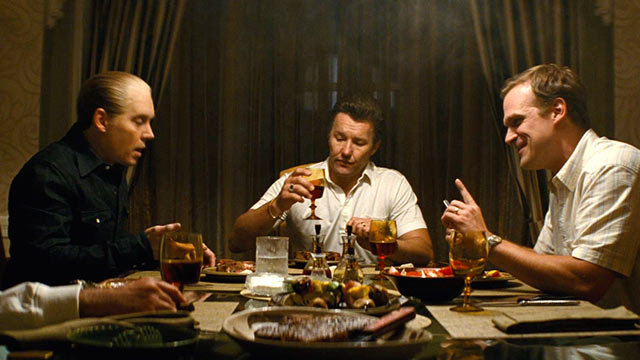
“Black Mass” is essentially a traditional rise and fall gangster drama within the aesthetic of the American gothic experience. Director Scott Cooper tries to subvert the film’s familiar trappings by setting in place a tension within the story where I we know the two main characters are damned to failure from the first scene.  Considering the clever set-up and the movie’s all-star cast, the fact that the story almost broods to a complete stop by the second act is as befuddling as it is a jaw-dropping disappointment.  

Johnny Depp plays James “Whitey” Bulger, the Boston crime-lord who inspired Jack Nicholson’s Frank Costello character from Martin Scorsese’s 2006 Oscar-winning film “The Departed.” And while Depp is every bit as unhinged and deranged here, the portrayal is decidedly less animated. Joel Edgerton plays opposite as John Connolly, a shady FBI agent who lets Bulger does as he pleases, so long as he continues to sell out the Italian Mafioso that’s moving in to the Boston streets. With his brother Billy Bulger (Benedict Cumberbatch) in a position of local political power, Whitey is given a legal hall-pass by both the state and federal authorities to become one of the most powerful and dangerous east-coast gangsters of 70s and 80s.  Nevertheless, Bulger’s paranoia gets the best of him and both his criminal brethren and the cooperating agents of the FBI are in constant fear of triggering his scorn.

Cooper’s vision of this story is interested in investigating the interiority of the characters and exploring how they click within their world of broken rules and the hypocrisy of their familial street-code. This means on a genre-level things tend to skew more towards “The Godfather” side of the gangster spectrum than it does “Goodfellas.” Given this approach, there are far too many story and production choices that orient things toward the broad surfaces. The all-star ensemble and the constant walk-ons by known character-actors like Corey Stoll, Adam Scott, Rory Cochrane, Peter Sarsgaard and Juno Temple spread the story too thin to effectively delve into the tense relationship between Depp and Edgerton as the leads. With a timeline that spans decades and multiple character perspectives to shift to and from, the movie never becomes the deep character study it thinks it is.

Despite this structural flaw, Depp’s performance is nuanced and appropriately pitched to the tone of the film, and in many sequences he is quite engaging without defaulting to his usual post-Pirates affections, but his Dracula-esq make-up design becomes so distracting that it often blocks whatever subtly there is to appreciate in his delivery.  Off and on the rest of the cast have their moments to shine and individual scenes of conversation work well on their own when Cooper is afforded to do what he does best - zeroing in on performance and dialogue. When it comes to the overall big-picture and the execution of the screenplay, the movie unfortunately fails to drum up enough drama to fuel the narrative.

Emotionally “Black Mass” doesn’t work like it should, but the movie isn’t a total wash either. It was nice to see Depp given something juicy to bite into as an actor and to play to his actual age, but Cooper seems out of step with many elements of the film as a director and often conflicts with the base genre elements of the story.


Grade: C-

Originally Published in the Idaho State Journal/Oct-2015

Sunday, August 23, 2015

Straight Outta Compton review

 NWA were a raw force in the music industry and helped popularize what would later be known as ‘gangster rap.’ The band’s break-up also resulted in the influential and successful solo-careers of Ice Cube, Dr. Dre, and Eazy-E.  With “Straight Outta Compton,” director F. Gary Gray makes a statement about the plight of underprivileged African Americans through the gauze of a traditional rock and roll biopic, and manages to do so with a certain amount of style and competence. 

One could say history repeats itself or one might prefer to say that there’s never really been a break in the depressingly familiar pattern of police brutality and the unfair treatment minorities are given by law enforcement. Either way, without having to make broad or obvious symbolic gestures to draw the connection, this movie mirrors the history of what was happening in South-Central LA  in the late-80s and the early 90s, with how  these modern tensions with police have expressed themselves today.

In what is probably the best sequence of the film, Gray introduces us to each character by their surroundings and their lives in the hood. Dre (Corey Hawkins) is a struggling DJ at a club, looking to further his own career in hip-hop, while Ice Cube (O’Shea Jackson Jr.) is a fresh talent and an ambitious lyricist who’s also trying to find a comfortable fit. Eazy (Jason Mitchell), on the other hand, is the only member of the group who actually lived the life of hustling and dope dealing to survive on the streets, but is looking for a way out.  When the three find each other in Dre’s studio, magic is almost instantaneous as their message and their aggressive attitude reflects the frustration within culture they represent. 

Their independently produced album sells well beyond expectations, their tour becomes a growing success, and their explicit messages about the police and the world of violence they come from attracts a ill-informed warning from the FBI. Yet, things only become complicated when their local manager, Jerry Heller (Paul Giamatti), begins to play favorites among the group and refuses to share contractual information with all the members. 

The movie’s strengths come from its world-building and its authentic sense of time and place. Gray and his wonderful production designers do a great job of keeping things period; down to the cars, the real south-central locations and the now-embarrassing jerry-curl hairdos.  All of these details play into the narrative to help a modern rap-friendly, suburban audience understand the genuine sense of shock and surprise white-America had towards the group’s assaultive artistic approach.  The cast of mostly unknowns are totally believable and commit fully to the personas of their real-life counterparts, especially O’Shea Jackson Jr. who fearlessly takes on the risky task of accurately playing his movie-star father.

The film falls short during its extended second act, where it feels the need to include all the West-Coast’s greatest hits before coming back to the heart of the story. After the events of the LA riots, the script’s political drive is simmered. In its place we get a tangential story about the Dr. Dre’s successful solo career and his struggle to run Death Row Records with his intimidating manager Suge Knight (R. Marcos Taylor).  This plot builds in the wrong direction and causes a fifteen to twenty minute lag that seems more concerned with salacious Behind the Music gossip than it does the history and legacy of NWA.

Nevertheless, “Straight Outta Compton” is a must-see this summer and contains a contagious passion and vigor to get its story out there. Very few biopics have as much energy and youthful appeal as this one does and even when it delves into pandering references or easy TV-Movie story-telling, the strength if its performances and the weight of its cultural relevance insists a sense of vitality upon the piece as a whole. 

Grade: B+

Originally Published in the Idaho State Journal - Aug/2015

Mission: Impossible - Rogue Nation review

The “Mission: Impossible” franchise has become low-stakes cannon of summer-fluff films, and I mean that in a good way. Unlike the Bond franchise, which means a lot of different things to a lot of different people, or the superhero movies that always come with an unfair amount of fan-pressure and canonical expectations, nobody is that invested in the integrity of Ethan Hunt’s continued misadventures in espionage. With that in mind, filmmakers are now allowed a certain amount of freedom to let the movies exist for their own sake and to reinterpret their appeal for newer generations, as most younger fans have not seen the earlier films and practically none of them have watched the 60s TV show in which they’re based.

The last two films in particular have become less about characters realizing anything new about themselves and more about setting up a loose framework for directors to show-off their set-piece skills, upping the ante with new exotic locations and complicated stunt coordination. 

In the first scene of “Mission: Impossible - Rogue Nation,” Ethan Hunt (Tom Cruise) is framed for the murder of a fellow agent and forced to go into hiding from his own network. While on the lam, he discovers a shadow cell of spies known as The Syndicate who are organizing global terrorist acts, using trained spy techniques. Hunt must then clear his name and convince his friends to help him take down the mysterious Syndicate leader known as Solomon Kane (Sean Harris). On the way Hunt runs into another British spy named Isla Faust (Rebecca Ferguson) who may or may not be working for or against Kane, and he is forced to decide if he trusts her enough to get close to the core of The Syndicate or to keep her at a careful distance.

As this series has progressed Ethan Hunt has become less and less interesting on an emotional or psychological level. Cruise plays him with confidence and still performs the stunts in a way that looks deceptively effortless, but we are no longer expected to follow hunt as a hero with wants and needs that reflect our own--and sometimes that’s okay. Christopher McQuarrie, who wrote and directed this installment, gives all the movie’s needed humanity to Cruise’s costars like Simon Pegg’s Benji who gets to deliver the best dialogue and Jeremy Renner’s William Brandt who’s slowly transitioning into becoming the franchise’s new lead. With the charisma now in place by the satellite cast, McQuary can concentrate on wowing the audience with gracefully shot and delicately edited sequences of spy verses spy.

In one of the finest pieces of visceral filmmaking all year, McQuary sets an extended set-piece in an opera house, cross cutting between Hunt on the lookout for a group of saboteurs while he is also unknowingly being followed by the cat-like Faust, all while Benji is working behind the scenes in the electrical room. Not unlike Michael Powell’s complicated sequences in films such as “Tales of Hoffman” or the “The Red Shoes”—yes, I really am making this comparison—this scene is beautifully composed to the diegetic opera being performed in the background and reminds us that a good action scene structurally has more in common with the classic movie-musical than some fans might care to acknowledge. We’re also treated to a very thrilling underwater sequence and a smoothly edited motor-cycle chase that’s largely shot from the first-person point-of-view.

I can’t say that I ever cared about the film’s story because most of the plot points are unforgivably lazy and familiar, but “Mission: Impossible - Rogue Nation” proves that some films can coast on stock genre tropes and skeletal character motifs, so long as the visual filmmaking is as skillfully executed as it is here.


Grade B -

Originally Published in the Idaho State Journal Aug/2015

Trainwreck review

Amy Schumer has become the unlikely voice of a new generation in stand-up and sketch comedy. Her work is thoughtful, brazen and cleverly funny, taking on all kinds of relevant subjects like feminism, ageism, body-shaming and race, while still retaining just enough gleeful locker-room filth to make it palatable to the masses.  After receiving awards attention and praise for her ambitious and subversive sketch comedy show, Schumer has teamed with producer/director Judd Apatow to tell a more personal story that exists somewhere between the detachment of her ironic wit and the pain that it masks.  “Trainwreck” is a conflicted and sometimes frustrating film where Amy shines as a performer and a burgeoning writer, but lacks the narrative consistency and the truth of convictions that we have come to expect from her point of view.

Amy’s character Amy is a hard drinking, sex-starved city girl who enjoys her life the way it is, much to the displeasure of her family and her pro-wrestler boy-friend (John Cena) who breaks up with her after discovering her multiple hookups. Later, after her magazine editor boss (Tilda Swinton) has her interview a sports doctor named Aaron (Bill Hader), the two develop a wholesome relationship and Amy finds herself unable to reconcile her fear of commitment with her newfound fondness for the nice-guy surgeon. This personal struggle is augmented by the mounting tension between her and her sister played by Brie Larson and their father played by Colin Quinn who’s struggling with the early stages of Parkinson’s disease and needs to be put into an affordable facility.

Every actor here has their moment to shine, including, and especially, Amy Schumer. Because much of the comedy derives from her stand-up as well as her real life issues, there’s definitely a vulnerability presented in this film that Schumer usually tries to avoid on stage, which is refreshing and revelatory too see from her. Compared to the broad characters he’s become known for playing on Saturday Night Live, Bill Hader dials things way down and functions more as a graceful support for Amy’s louder screen persona and the movie’s surprisingly conventional romantic comedy plot.  Side characters and cameo performances such as Tilda Swinton as the venomous editor, Ezra Miller as the weird-quiet intern, Dave Attell as the friendly bum, and Labron James playing himself to great affect keep every scene activated and entertaining even if the movie as a whole runs about 20 minutes too long—a typical Apatow problem. 

As I’ve alluded to already, “Trainwreck” suffers from a strange double standard. When it comes to how women who openly enjoy sex are viewed in society, Amy uses her persona as an outspoken satirist to build her character and set up the movie’s sense of unexpected laughs. This is then contradicted when the story reinforces the traditional rom-com values of waiting for ‘the one’ to come in and set her straight. It’s clear that her character is irresponsible with other people’s feelings and for dramatic purposes she would need to express some sort of change , but the choice to have that change occur through a familiar Hollywood romance is somewhat disappointing, if only because it’s coming from her.  The gender roles of this romance are swapped and the film makes a point to show how it changes the perspective of the archetypal narrative structure, but turning a male sports doctor into a white-knight cure for promiscuity undercuts the entire point of the experiment.

All that aside, this movie’s funny. Schumer’s comedic voice is present throughout and the satellite performances constantly jolt the audience with a surprise laugh. Directorially, this is also one of the stronger efforts from Apatow in a while, even if he’s too generous with his actors and still doesn’t know when to say cut. If the worst thing we can say about “Trainwreck” is that it’s traditional, then I suppose we can chock that up as a moderate win for Schumer as a first time screenwriter.

Grade: B

Originally Published in the Idaho State Journal/Jul-2015

Monday, July 27, 2015

Ant Man review

Marvel’s latest entree “Ant Man” is a curious bobble of a film that dares a non-comic-initiated audience to hold on to the general appeal of charismatic actors bouncing around in CGI environments without the comfort or ease of John Wayne approved heroic posturing to get them through. What I’m trying to say is this movie is unabashedly geeky, in way that Marvel Studios might have underestimated a regular movie going audience to roll with without noticing. And good for it! “Guardians of the Galaxy” was definitely weird—what with talking trees and smart-alecky raccoons and what-not—but it was also nestled in a space-opera/fantasy trope that the average beer-drinking, football-throwing American’s can recognize from their childhoods as far back as “Star Wars.”  “Ant Man,” on the other hand, is a little more niche.

Michael Douglas plays Hank Pym, a scientist who learned how to shrink himself down while still having the ability to fight with the strength of ten men. He was forced to leave his secret government agency, where he fought as a spy, after he learned that the wrong developers wanted to use his tech for dangerous, military purposes. Fast-forward thirty years into the future and a younger protégée of Pym named Darren Cross (“Corey Stoll) has seemed to develop a similar enough technology that Pym feels the need to interject.  Enter a white-caller cat-burgler and hacker named Scott Lange (“Paul Rudd”), who’s trying to get his life and family together after finally being released from prison. He’s tricked by Pym into breaking his parole to steal the Ant Man shrinking suit, and after some light blackmail he  agrees to help the older inventor break into Cross’s facility to destroy the progress of the dangerous Yellowjacket.

Despite scenes of Paul Rudd learning how to telepathically control ants into sugaring his coffee or flying on the back of harnessed insects, this is basically a heist movie at its core, with a mark, a plan of action, and the booty that needs to be retrieved. What director Peyton Reed does well with this material is he brings us into this idiosyncratic world through the eyes of the affable Rudd as he bumbles his way into becoming a passive hero. Though maybe he’s a bit too passive at times - to the point of almost having no agency within the plot. Nevertheless, he’s charming to watch and he knows how to hit the comedic beats that’s laced throughout the narrative.  Moments between him and his street-wise, criminal friends—Michael Pena almost steals the entire movie away with only a handful of scenes—keep you smiling in good spirits, even when you get the feeling that the movie isn’t entirely invested in its own brand.

Things don’t work quite as well when the story shifts into more character driven territories, particularly anything involving the vague sub-plot dealing with Pym and his estranged daughter Hope (Evangeline Lilly) who is working within the offices of her father’s enemy, while secretly bringing back useful intelligence. When it came to their emotional arc, the revelation of how Pym lost his wife, or even Lang’s difficult relationship with his ex-wife and the daughter he’s barely allowed to visit, I never cared quite as much as the movie wanted me to. It’s clear that the writers wanted to ground the superhero pulp and the comedy with a thematic parallel between Lang and Pym about what it means to be a responsible and present father, but these underwritten moments register more as plot motivators than they do real character builders.

Still, “Ant Man” is a fun and unassuming summer blockbuster that’s refreshingly low-stakes and casual for Marvel action movie. The set pieces are creative and occasionally there’s stylistic flashes of a better movie that might have been possible had the studio let things bake a little longer. As it stands the heist plot could have paid off more satisfyingly and characters could have been more clearly defined, but overall this was a totally inoffensive offering, if not somewhat banal.

Grade: B -

Originally Published in the Idaho State Journal/Jul-2015