Showing posts with label horror. Show all posts

Sunday, October 29, 2017

The Babysitter review

Netflix’s “The Babysitter” is a horror-tinged action-comedy with a surprising amount of charisma and charm. Surprising because it's directed by McG, best known for hacky schlock like “This Means War,” “Terminator Salvation” and the “Charlies Angels” movies, Here he scales down his budget and the broad scope of his desired audience, and in doing so manages to helm something that feels specific and personal, while also retaining enough visceral hijinks and well-intended snark to keep things entertaining.

The film centers on the relationship between a nerdy twelve year old named Cole (Judah Lewis) and his babysitter Bee (Samara Weaving). Cole is getting old enough to know that he’s probably too old for a babysitter, but Bee is everything a bullied brain needs in middle-school; she’s smart, she listens, she gives great advice and she’s smoking-hot. The only downside is she also happens to be the leader of a teenage devil-worshipers cult. One night, while Cole’s parents are away, he stays up late to see what Bee and her friends are up to, only to disrupt a murderous death ceremony, which kicks off a night-long game of cat and mouse between our worry-wort protagonist and this group of sinister high schoolers. 

This movie mostly works because of the well-established dynamic between Lewis and Weaving. We have to fall in love with Bee just as Cole does, so that when the story reveals her for what she is, we feel the same kind of betrayal. To the director’s credit, he does the proper leg-work with these characters so that the drama is informed and the action stakes are energized. Samara Weaving gives what would normally be a star-making performance as Bee--she’s confident, funny and powerfully sexy, without ever leaning into vacuous objectification. The versatility she displays with this wildly audacious role is better than any acting reel one could hope to cobble together.  Judah Lewis is also good at portraying believable innocents in a film that revels in poppy ultra-violence and subversive fun.  It’s for this reason that the other teens, played by Bella Thorne, Hanna Mae Lee, Robbie Amell and Andrew Bachelor feel all the more underwritten in comparison.

While Weaving and Lewis are fully realized and complicated from the page to their performances, these other roles are far more comfortable existing as basic teen horror archetypes, often spouting sophomoric, unfunny dialogue. But despite the quality imbalance between all the characterizations, “The Babysitter” still knows how to build small-scale action set-pieces with creative kills and effective moments of splattering slapstick.

Besides working well as a violent dark comedy, Brian Duffield’s screenplay also remembers to root everything within the context of an effective coming-of-age arc. As a result, this left-of-center project is without a doubt the most original and heartfelt film to come out of McG’s spotty catalog, and that’s saying something for a picture littered with satanic blood rituals, hangings and indoor car crashes.

Grade: B-

Originally Published in the Idaho State Journal/Oct-2017

Listen to this week's episode of Jabber and the Drone to hear more conversation about " The Babysitter."

Sunday, October 22, 2017

Happy Death Day review

There was a time, not too long ago, when horror movies used to be made for teenagers.  The 80s was full of populist scary flicks that catered to the 11-24 marked, with films such as “Friday the 13th,” “Fright Night,” “Slumber Party Massacre,” “Night of the Comet,” “The Lost Boys” and many more. Wes Craven’s first “Scream,” and its subsequent sequels and rip-offs, might have been the last era of that tradition. In its absence, we’ve seen grim supernatural chillers, cheap found-footage shocks and a small splattering of gore films, derisively labeled ‘torture porn.’  Christopher Landon’s “Happy Death Day,” released by Blumhouse Productions, tries to find that sweet spot between made-for-TV tween-age Halloween movies and the slightly more sophisticated slashers of the 1980s.

Jessica Rothe stars as Tree Gelbman, a young sorority girl who, on her birthday, finds herself waking in a strange boy’s dorm room after a hard night of partying. Quickly gathering her things and leaving, she’s goes about her day with smeared eye-liner and a short fuse, pissing off everyone she encounters, including Carter, the boy she presumably spent the night with (Israel Broussard), her college roommate (Ruby Modine) and the professor with whom she’s currently having an extra-marital affair (Charles Aitken). Her night ends at the end of knife held by a masked killer, and after she's murdered, she awakes on the same day, in the same bed, only to relive these encounters over and over until she’s able to outsmart her attacker.

The fun of this “Groundhog’s Day” premise is that Landon and his screenwriter Scott Lobdell can fully explore the geography of their set-pieces and they can tease the mystery element with a gimmick that allows the audience to play along with the protagonist. In this way, the movie succeeds in its slumber party ambitions, but it excels in its layered character work. Tree begins the film as a terrible person who has little to no regard for anyone other than herself. Her journey, by reliving a horrible death over and over again, is to explore who she’s wronged and what their motivations might be. In doing so, she is forced to think about the feelings of others and she is also forced to come to terms with her own past trauma that made her become so cold to begin with. This Scrooge-ish character arc might not be the most revolutionary angle to go with, but there’s at least an emotionally rooted purpose for it’s the screenplay’s high-concept.

All the performances are strong. Rothe has the most do, as she learns to become a better person throughout the runtime, but her eventual partnership with Broussard is also a highlight, as we watch them plan and scheme together like the Hardy Boys. The film only slips when it over plays its red herrings. An element is introduced near the mid-point that steps too far away from what was carefully established in the first third. This plot point is eventually dealt with in a way that’s satisfying and still rooted in character, but given the obvious mechanics of the plot, the placement of this story element is the only thing that registers as labored and forced.

“Happy Death Day” is a love letter to a simpler time in horror. It uses post-modern techniques to explore these simpler, somewhat optimistic themes, but in doing so, manages to cleverly deconstruct the slasher genre in way that isn’t too ponderous or academic.  It’s probably not as scary as it could have been but this is the type of horror date-movie that was made to enjoy some popcorn with, and sometimes that’s okay.

Grade: B

Originally Published in the Idaho State Journal/Oct-2017

Listen to this week's episode of Jabber and the Drone to hear more conversation about "Happy Death Day."

Sunday, June 18, 2017

It Comes At Night review

Trey Edward Shults’ meditation on paranoia “It Comes at Night” is a creeping thriller, about a family held together by fear.  Many filmmakers and storytellers have mined numerous post-apocalyptic scenarios to further explore the darkest corners of the human experience, and in that regard this picture prides itself in starring deeply into the abyss without blinking.

The film centers on a small family played by Joel Edgerton and Carmen Ejogo as the parents Paul and Sarah and Kelvin Harrison Jr. as their 17 year old son Travis. Only a few days after having to quarantine Sarah’s elderly father from the house,  later killing him and burning his body in the backwoods to insure that the deadly disease he contracted can’t be further spread, a stranger from a few miles away named Will (Christopher Abbott) begs the family for food and refuge for himself and wife and toddler. After arguing with his hopeful wife and sternly vetting the newcomer, Paul decides to aid in this rescue effort. Will and his young wife Kim (Riley Keough) are grateful for the food and sanctuary but the specter of tribalism and tragedy looms large over this stressful new dynamic.

Shults does a good job at establishing the emotional stakes of this story early on so that when even the smallest disturbances are breached, we are made as hyper cautious as our worried protagonists. Like John Carpenter’s 1982 meditation on paranoia “The Thing,” this film puts the characters in a position where common decency is not the rational choice in close quarters. The overarching themes about stubborn masculinity and loss of humanity in the face of panic are not new to this socially conscious sci-fi sub-genre, but it’s the directorial precision and complicated performances that set this film apart from the mountains of forgettable virus/zombie movies that precede it.

Some have complained that the film’s marketing campaign by distributor A24 has been misleading. The titl, as well as the jumpy trailer that focuses more on the viscera and eerie imagery  than it does the movie’s core family drama, have lead some disappointed viewers to believe that this was supposed to be more conventional horror film. While this experience is thoroughly entrenched in bleak tragedy and the implications of the plot are fairly horrific, the movie doesn’t ramp up every scene towards a jump scare and there aren’t any monsters or cannibals scratching on the outside doors of the protagonists secluded home. What that said, there is a strange omniscient point of view that hangs over the drama as it unfolds and it sometimes feels like a demonic hex that’s been put upon this sensitive circumstance.

“It Comes at Night” may not be the traditional horror programmer that people thought they were getting but it is a very dark film that’s meant to challenge our views on human empathy and familial loyalties. Cinematographer Drew Daniels uses minimal lighting schemes to sculpt his subjects out of ink-black darkness, and his slow push-ins on red doors and elongated hallways recalls the nightmarish imagination of David Lynch and monumental intimidation of Stanley Kubrick.  I can’t say that the sci-fi subject matter presented here is all together new or innovative and as a thriller the movie’s reveals are somewhat predicted, but the filmic craft exemplified and the actor’s dedication to their character’s emotional motivations elevate the stock premise into being a taught exercise in suspicion.

Grade: B+

Originally Published in the Idaho State Journal/Jun-2017 

Listen to this week's episode of Jabber and the Drone to hear more conversation about "It Comes At Night." 

Sunday, May 28, 2017

Alien Covenant review


Ridley Scott returned to the “Alien” franchise with his 2012 prequel “Prometheus,”  showing  that the veteran Hollywood director still had a love for monumental science fiction storytelling and an eye for evocative imagery. Yet the viewers who were waiting decades to know more about the origins of 1979’s “Alien” were left with a handsome production undercut by a messy screenplay by writer Damon Lindelof that only teased an explanation, while leaving more questions to be answered.  Hopes that this year’s “Alien Covenant” would finally tie the narrative threads together are hopes to be had in vain, as this latest installment ventures down another lateral tangent that further broadens the mythology.

Much like the first third of the original “Alien,” “Covenant” sends another crew of explorers to an uncharted planet after receiving a fuzzed-out message by Elizabeth Shaw (Noomi Rapace), the lost survivor of the Prometheus ship. This traveling colony, having recently suffered from an electrical storm that killed many of their inhabitants in hyper-sleep, decides to change course to see if this mysterious planet can support human life. Aboard the vessel is their self-doubting, proudly religious Captain Oram (Billy Crudup), who’s insisting they take the risk to save time, while second-in-command officer Daniels (Katherine Waterston) has just lost her husband in the devastating accident and wants the Covenant to stay on course.  Once a pod of explorers is sent down to investigate the earth-like sphere, the crew discovers a biological terror they weren’t prepared to deal with.

Rounding out the cast is Danny McBride as red-neck pilot Tennessee, Amy Seimets as his wife Faris, Damian Birchir as Lope, and Michael Fassbender as the group’s resident android Walter.  They’re many other smaller performances in the picture and characters to be named, including an oddly short James Franco cameo, but John Logan and Dante Harper’s screenplay relegates most of these roles to serving the story as faceless creature-feature fodder and these extra crew members barely peak out of the movie’s larger obsession with awkwardly-paced, talky scenes of needless exposition.

While the initial introduction to this crew in mourning is an interesting place to begin a darker more sorrowful tone, the movie ultimately lacks the humanity and soul it needs to inform this choice. Instead, the film abandons this set-up and moves on to other concerns. The final moments of “Alien Covenant” contains a traditional attack sequence that feels tired and familiar by the time we get there and superfluous after an hour and forty minutes of exhausting scenes of cave-dwelling, interspersed with mindless attempts at shock

Longtime fans that are curious to see how Scott expands the Alien mythos will likely be divided on the Covenant’s retroactive continuity, as it seems to disregard a lot of speciation rules from the previous installments that followed writer Dan O’Bannon’s original “Alien.” In its place, we are introduced to various forms of alien spores, white monkey-looking creatures that burst out of people’s backs and early forms of the classic eggs and face-huggers. People new to the franchise will and should be totally lost in this minutia and those trying to follow along may need to create a complicated flow-chart to connect all the disparate creatures into one lineage. Whereas the original alien-lifecycle was once elegant and believable, O’Bannon’s simple mythology has now been muddied by two prequels that let the overarching thematic concerns and a handful of bad ideas overtake the storytelling.  This installment in particular is somehow both overreaching and lazy in its execution.

Like “Prometheus,” Michael Fassbender’s duel performance as the androids Walter and David steal the show; though within these scenes, the film’s divergence into highfalutin discussions about life, grief, religion, creation, obsession and flute playing loosens the necessary narrative tension for the movie to work as an effective thriller. Most of the monster attack scenes are only sprinkled in to remind us that this pre-sequel is still related to the known franchise, but the overall structure of the picture is compromised by wasted performances by otherwise good actors, under-rendered CGI, moments of ponderous meditation on themes that are never fully realized and rushed sequences of unearned gore.  

Grade: D+

Originally Published in the Idaho State Journal/May-2017\

Listen to this week's episode of Jabber and the Drone to hear more conversation about "Alien Covenant"

Monday, March 6, 2017

Get Out review

Keagan Michael Key and Jordan Peele rose to prominence by using their comedic platform to discuss issues of race, sociology and identity, but Peele’s treatment of these topics as the basis of a mostly-serious horror film has added an urgency and anger that wasn’t always present in their Comedy Central show. With the election coming fresh off the outrage surrounding the Black Lives Matter movement and having recently seen many young black men killed by the authorities, churches burned down and minority voting rights being compromised, this retrograde of civil rights has had an emotional and psychological impact on many non-white communities. 

“Get Out” takes the basic structure of the 1967 Sidney Poitier film “Guess Who’s Coming to Dinner” and subverts it with the sci-fi-horror paranoia of classics such as “Rosemary’s Baby,” “The Stepford Wives” and “Invasion of the Body Snatchers.” 

Daniel Kaluuya plays Chris Washington, the young African American boyfriend of Rose Armitage, played “Girls” star Allison Williams. They’ve been dating for five months and Chris has decided travel with his gal to upstate New York to meet her white, affluent, town-and-country family for the first time. While nervous about the encounter, everything seems to be relatively normal. Rose’s neurosurgeon dad (Bradley Whitford) clumsily tries to code-switch, speaking in what he thinks of as ‘street’ lingo, and is perhaps too quick to assure Chris that if he could have voted for Obama for a third term, he would have.  And while Rose’s hypnotherapist mother (Catherine Keener) is a little too insistent on helping Chris shed his smoking habits with a free session, basically, the two parents seem warm and accommodating. On the other hand, Rose’s MMA-obsessed brother (Caleb Landry Jones) displays an intensity that’s a little less predictable.

Things only begin to get especially strange when Chris approaches the family’s African American hired help, Walter and Georgina (Marcus Henderson, Betty Gabriel). They’re awake and active at weird hours of the night, they walk around dazed and unresponsive and they’re hostile or defensive whenever Chris tries to engage them in conversation. As the story unfolds and plot points are later revealed, Peele’s script continues to take bigger, wilder risks and digs deep into the overt social commentary that permeates the film’s subtext.

It might have been very tempting to portray the devious whites here as post-colonial, traditional conservatives from the south, but the movie instead chooses to tap into a much less obvious stereotype; upper-middle-class, educated neo-liberals. Peele examines the often-parasitic relationship between the races, and how some classes of whites will co-opt the struggle of the black experience for their own political or monetary gain, without ever giving back to the communities they exploit to successfully take power.

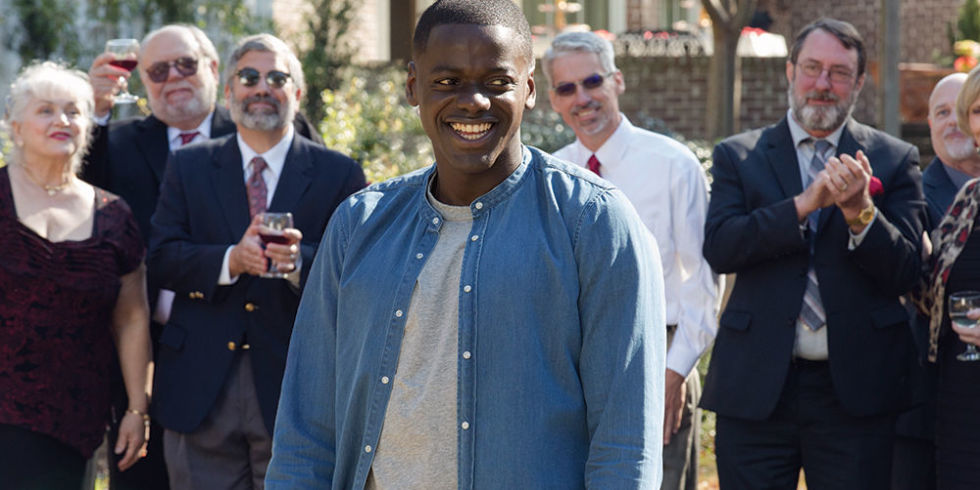
The movie brilliantly and thoroughly eases the audience into Chris’s perspective so that we are looking at every white character with as much suspicion as he is. When the privileged guests off the parent’s snooty garden party ask stupid questions like “what’s the African American experience been like for you,” even a white audience can feel the sting of condescension in that moment. Peele’s immersive subjective direction along with Kaluuya’s nuanced performance helps to sell what, stripped away from its political context, could come off as fairly goofy genre material.

“Get Out” is a step further away from the broad sketch comedy of “Key and Peele,” but it also provides many well-earned laughs of its own. LilRey Howery is cleverly placed as Chris’s best friend character Rod, working within the story as the audience’s cipher. Through jokey conversations with the protagonist, this character points out the inherent pulpiness of the plot and reminds us that this director understands and has a sense of humor regarding the horror/thriller traditions he’s working in. Nevertheless, when the rubber needs to hit the road Peele fully commits to his thought provoking thesis and allows his racial allegories to approach their brutal conclusions.

Grade: A 

Originally Published in the Idaho State Journal/March-2017

Sunday, September 4, 2016

Don't Breathe review

“Don’t Breathe” is exactly the kick in the neck that extreme horror needs right now. Fede Alvarez’s new thriller cleverly plays with expectations and tropes within the home-invader genre but it never loses sight of its own momentum, creating a vivid cinematic world of its own within a deliberately designed, claustrophobic setting.  The movie makes a lot of allusions to classic shockers of the past, such as Wes Craven’s “Last House on the Left” and Sam Peckinpah’s “Straw Dogs,” as well as scene elements and direct imagery from “Silence of the Lambs,” and “Cujo.” Conceptually, this film is basically a reverse version of the 1967 Audrey Hepburn, Alan Arkin thriller “Wait Until Dark.” But even as those obvious sign posts are visible for the cinefiles in the audience “Don’t Breathe” slams around with enough of its own moves and creative WTF moments to justify its many obvious appropriations.

The story’s set-up is pretty simple; three up-to-no-good, Detroit 20-somethings stake out the home of a blind ex-military man (Stephen Lang) who’s sitting on 300,000 dollars of settlement money after losing his only daughter in a car accident. Rocky (Jane Levy), Alex (Dylan Minnette) and their gun-toting gangster-wannabe frenemy Money (Daniel Zovatto) all hope to use this small fortune to give up their criminal lives and move out west to California, where they can escape their family problems and the general angst of Midwestern, industrial poverty.  Of course, once they break into the house of their mark things don’t go as they had planned.  As it turns out, the blind veteran and his vicious Rottweiler are much more prepared for the occasion than our delinquent protagonists had originally anticipated.

Those with a weak stomach and mild psychological constitution should be warned that this movie serves a pretty strong cup of coffee. Alvarez knows how to wait the appropriate time to strike and he patiently earns his gore, but when the rubber hits the road he doesn’t hold back when it comes to his depictions of blunt violence and seat-squirming shock sequences. In fact, half of the picture’s strength comes from its build up and anticipation towards these moments. This director also never forgets how to structure a scene and uses his wandering camera to layout the architecture of each set-piece so the audience can get a true sense of where everyone is and how hard or easy it should be for them to escape. The best cat and mouse films know that good chase scenes are most effective when they fully incorporate their setting, and in that sense, Lang’s creaky, three-level home becomes another character in the film.

As the movie’s introduces its principle players the dialogue can be stiff and some of the characterizations are at times too broad and archetypal but the actors usually are able pick up the screenplay’s slack in those departments. Things get significantly better once we get into the meat of the break-in. Alvarez revels in the mechanics of his suspense and the cinematic elements of horror as pop entertainment. He loves to pull the strings tight on his scenes and loves to pull the rug out from under the audience, and though the film’s use of sound is especially important here—given that the antagonist is blind—the movie never defaults to the overuse of cheap, quiet-quiet-loud jack in the box scares.

After a summer of misfiring popcorn fare, “Don’t Breathe” is the perfect mean-spirited antidote to start the fall season. It’s unpretentious and unencumbered, and more importantly, it understands the appeal of the genre it’s playing in and knows how to confidently execute it with practical style and craftsmanship.

Grade: B+

Originally Published in the Idaho State Journal-Sep/2016

Listen to this week's episode of Jabber and the Drone to hear more conversation about "Don't Breathe."

Saturday, February 27, 2016

The Witch review

Robert Eggers debut horror film “The Witch” is one of those rare tour de force first features that spotlights a true talent to look out for.  This black metal folk tale is a near-perfect study in tone and immersive tension, with a keen sense of setting and period that boasts a handful of completely credible performances. It not only uses the macabre to sell its aesthetics as a horror film but it embraces a true sense of darkness and slithering evil that will stay in your consciousness long after the initial shock of its deranged third act.

Even more astonishing, “The Witch” has finally broken the hex that dictates that movies starring actors from “Game of Thrones” must suck (“Pompeii,” “The Other Woman,” “Terminator: Genisys”). Ralph Ineson and Kate Dickie play the mother and father of a 1630 puritan family who decide to leave their New England pilgrim community to settle their own property in the middle of a nearby gloomy forest. There they hope to build a purer relationship with God, away from the noise of regular society. Their eldest daughter Thomasin (Anya Taylor-Joy) has begun to question the logic of her parents, their son Caleb (Harvey Scrimshaw) is coming to terms with his difficult puberty, their two young twins may or may not be talking to evil spirits through the family's farm goats and their unbaptized newborn has just gone missing. After the kidnapping, the family begins to find themselves crushed with religious guilt, exposing each member’s personal struggles with sin. Soon internal battles with lust, pride and dishonesty manifests themselves into real or perceived oppressions from the dark forces lurking within the shrouded forest.

What makes this film more narratively enriching than your average cabin in the woods shocker is that the screenplay, laced with biblical, old-English dialogue, is just as committed to the drama and the interior lives of the characters as it is with hitting all the intended genre beats as a thriller. The performances by the mostly-unknown cast are realistic and heartbreaking, especially by lead actress Taylor-Joy whose emotional and symbolic arc within the film is both complex and challenging. Rather than lacing the plot with empty boo-scares and gotchya moments, every character is tormented by their own guilt and their own fears, with the titular Witch preying on the family’s vulnerabilities in ways that are visually creative and truly horrific.  

The sets look lived in and the grim 1600's period imagery is never played for theatrical camp. Because of the intense attention to the film's cosmetic details, Eggers portrayal of pagan magic is strangely believable within the context of this satanic melodrama. Cinematographer Jarin Blaschke uses single-source lighting-schemes with metaphoric intent, etching the characters and subjects out of the natural darkness, while never defaulting to flat desaturation or an overuse of digital color-correction.

Some might search for a contemporary message within the story and when talking about dangerous accusations of witchcraft, feminism rises to the surface, and if you’re looking for it, that’s certainly in there. But the picture’s more prevalent theme is of man’s relationship with sin and the unhealthy consequences of repression. 

Given the character’s conflicts with their own faith alongside the high-contrast imagery that's obscured by spindly tree-branches, Swedish art-house auteur Ingmar Bergman would have been proud of this film's relative mainstream success.

“The Witch” was released wide and is being sold as a casual winter horror programmer but unlike the seemingly generic title, this movie is anything but a lazy and predictable experience. The pace is deliberately slow and not unlike Kubrick’s “The Shining,” its taught sense of dread moves closer to you as each sequence pulls the cord a little tighter. There’s certainly entertainment to be had in all its artful spookiness, but this is not really a popcorn film. Rather, this is a masterful study in atmosphere, history and religious philosophy that deserves as much discussion as it deserves your gasps and nightmares.


Grade: A+

Originally Published in the Idaho State Journal/Feb-2016

Listen to more discussion about "The VVitch" on this week's Jabber and the Drone Podcast.

Sunday, September 20, 2015

The Visit review

M. Knight Shyamalan is a name that’s hard to live-down for a lot movie-goers these days. After reviving the supernatural-thriller in 1999 with his Oscar-nominated film “The Sixth Sense” and solidifying his brand with a few notable follow-ups, his career hit an irrevocable downward slide, and over the last decade he’s been bumbling into mistake after another.  Films like “Lady in the Water” and “The Happening” revealed a tendency towards half-baked concepts, overwritten screenplays, and lack of directorial sense of self-awareness that’s burdened the bulk of his later work. Even taking-on for-hire projects like the “The Last Airbender,” adapted from the popular Nickelodeon cartoon, as well as the awkward Will and Jayden Smith vehicle “After Earth,” couldn’t refocus the floundering filmmaker, despite relying less on his own ideas.

 Shyamalan has now teamed with the successful horror production factory Blumehouse (“Paranormal Activity,” “Insidious,” “Sinister,” etc...) to get back to nuts and bolts of suspense directing. With this ninety minute, found-footage B-movie, he has no sights set on prestige or deliberately paced auteur ambitions, but even with nothing to prove and his toolbox taken away from him, his ego and writerly obsessions get in the way of this uneven and problematic popcorn thriller.

Olivia Dolange and Ed Oxenbould play Becca and Tyler, two suburban tweens who have been sent on a week-long trip to visit their distant grandparents for the first time. Their single mother (Kathryn Hahn) is up-front about the tense relationship she has with her parents, with whom she hasn’t spoken with in many years, but is rather cagey about the specifics of their estrangement. To uncovering the mystery about what happened the night her mother left her parent’s house, Becca has decided to film this trip as a documentary about reconciliation. Her younger brother Tyler, a wannabee hip-hop lyricist, is more interested in figuring out why their newly acquainted grandparents are acting so strange; Nana (Deanna Dunagan) wandering the halls nude in the middle of night, scratching at the walls like an animal, and pop pop (Peter McRobbie) taking many private trips to a locked shed in the back yard of their country property.

Conceptually “The Visit” is promising enough, tapping into the societal strain of generation gaps, the paranoia of isolation from familiarity, and the universal fear of growing old and losing your physical and mental capabilities. All the ingredients are present for a Hitchcockian Hansel and Gretel tale, but Shyamalan peppers the entire experience with derailing creative choices. In framing the narrative as a found-footage video project, the film is allowed to move quickly with a sudden cuts and time-hops, which admittedly streamlines M. Knight’s penchant for dimly-lit, slow-burning ponderousness, but it also constipates the picture’s aesthetics, deadening much of the suspense in justifying and limiting camera placement and shot set-ups.

 This conceit also feeds into the director’s weakness in defaulting to expository dialogue whenever he needs to reveal more about the characters or the world he’s building. After all, if we are viewing a diegetic documentary in the works, then characters are in the position to say what they are feeling and thinking and are given the opportunity to explain any other necessary back-story directly to the camera. As a result, the story is largely told instead of shown, which is bummer because most of the performances are either misdirected, hammy, or flat-out bad. Dolange has a spark of sincerity underneath her achingly affected cineaste dialogue about framing and mis-en-scene but Oxenbould’s bright-eyed audition-face, combined with the choice to have him spitting out bratty one-liners and battle raps, grates in way that’s almost as if the director is deliberately trying to cut our sympathies with the protagonists.

Occasionally the best version of this movie peaks through the tone-deaf fog that shrouds the majority of its run-time. Dunagan and McRobbie are fully committed to their bizarre performances and, by the third act, a shreiky, camp quality, combined with a twisted sense of dark humor, gels together in a way that’s entertainingly misanthropic. But these moments are too few and infrequent and clang quite abrasively against Shyamalan’s ham-fisted themes about broken-homes and forgiveness.  I really wish I could join the sizable chorus calling this a return to form for the troubled filmmaker, but I simply don’t see much here that’s effective, evocative or even scary enough to give it a pass.

Grade: D+

Originally Published in the Idaho State Journal/Sep-2015

Sunday, April 26, 2015

Unfriended review

          One of the reasons I am continually interested in horror films, despite its poorly skewed attempt-to-success ratio, is that it’s a genre that's always encouraged to experiment and can do so in way that is fun and poppy. Sixteen years ago mainstream audiences were caught off guard by “The Blair Witch Project” because of its rough production and the then-untitled ‘found footage’ conceit. Today--five "Paranormal Activities" later--what was once considered risky and forward thinking now feels pretty standard and taken for granted. With“Unfriended,” director Levan Gabriadze takes an even more minimal approach in making a feature film that plays in real-time, entirely on an active computer screen.
        The majority of the movie is from the perspective of teenager Blair Lily (Shelley Hennig). As she clicks through her multiple browsers and computer aps, she soon joins a group Skype call with her high school boyfriend Mitch (Moses Storm) and a handful of other classmates (Matthew Bohrer, Courtney Halverson, Will Peltz, Jacob Wysocki, Renee Olstead). They spend the first few minutes of their digital hangout discussing regular teenage gossip until a mysterious source, claiming to be an old friend of theirs named Laura who videoed her own suicide the year before. This source then begins to post embarrassing pictures to Facebook accounts, airing-out group secrets and systematically persuading the friends to casually off themselves.
       The set-up of a betrayed friend from the past coming back to haunt a group of narcissistic teenagers is nothing new to the genre but it's also something that doesn't have to feel old. In the internet age, where the past is literally never forgotten, now that everything always digitally documented, the film’s symbolism about old decisions coming back to haunt you later is undoubtedly relevant. Unfortunately these ideas play more incidentally than intentional and are never fully explored or mined in way that’s particularly scary.
       The idea to confine the entire film to the visible actions of a computer screen, never allowing for a cut-away or any other kind of cheat to open up the scene, is a lofty experimental goal and I commend Gabriadze for sticking to his guns and staying committed to the gimmick all the way through. To the film's credit, it’s surprising how much character definition we are able to access by viewing the way our protagonist frantically googles, fact-checks or chats, but this minimal POV also keeps us from really learning anything useful about the other characters that we're only seeing through the tiny windows of the movie's open Skype call. The performances by the mostly-unknown young cast are convincing enough but are these actors are given almost no breathing room to develop their characters beyond the base-reactions they have to sell to punctuate each plot point. What results is an 83 minute viewing experience that feels a lot longer than it is. 
                 As a horror movie it's not scary enough and every jump-scare is lazily provided by a sudden shriek or thud. Visually the movie fails to work as basic cinema. In fact, I’m not even sure if we can really call “Unfriended” a movie, in the most technical sense of the word. I suppose it uses a video element to tell a narrative but there’s no actual film language to speak of. A part of me appreciates this anti-aesthetic as something potentially interesting and modern, while another part of me thinks it’s reductive the point of formal disintegration. Regardless, the movie, if that’s what we choose to call it, isn't very good and its idiosyncratic presentation both overwhelms and undersells the story.

Grade: D+

Originally Published in the Idaho State Journal/April-2015

Sunday, April 5, 2015

It Follows review

               David Robert Mitchell’s supernatural stalker film “It Follows” evokes the tropes and trappings of many culturally recognizable horror movies, but does so in a way that showcases his unique filmic point of view and pays homage without succumbing to lazy fanboy pastiche. Not unlike recent independent horror films such as Ti West’s “House of the Devil” or Adam Winegard’s “You’re Next,” viewers of a certain age will be reminded of the babysitter slashers of the late 70s and early 80s--particularly John Carpenter’s genre-defining “Halloween”—but here, the message about teenage sexuality is treated with more complexity and compassion than the Reagan-era morality massacres.
               Jay Height (Maika Monrow) is a high-school girl secretly dating an older guy (Jake Weary), who after rushing them out of a movie theater seduces her into a passionate parked car encounter.  Their bliss quickly turns to dread once he informs her that their union will enact a curse in the form of a shapeshifting, immortal entity that will follow her until she either dies or passes it on to someone else. After the two making a run for it, Jay’s dropped off back home, still stunned from a complete sense of bodily betrayal and with the new emotional and psychological burden of convincing her younger sister (Lili Sepe) and her friends (Keir Gilchrest, Olivia Luccardi) of the ghostly presence that’s on its way to kill her.
                Clearly this movie wants us to think about the consequences of hasty hanky-panky, but to call it a simple condemnation or cautionary tale would also be underplaying the greater depth of this discussion. Jay as a young female protagonist is faced with a sexual reality that follows her after an encounter she was tricked into participating. The trauma of this event is so impossible to describe that she is left without many she can comfortably confide in besides her peer’s, two of whom volunteer themselves to relieve her of the curse. Once her body becomes a plot point her relation to every male character is loaded with difficult consequences and choices to make.  Many will probably read an STD metaphor in all of this and that’s a valid enough interpretation, but we should also consider the drastic differences in sexual power and vulnerability expressed in the gender dynamics of these teenage characters, especially given the noticeable and purposeful lack of parental or adult representation in the film.
                Beyond the layers of interesting subtext to sift through, this film also delivers the goods as an effective horror thriller. Mitchell manipulates the audience with lingering establishing shots and subverts the use of subjective camera with Hitchcockian delight. The artful lighting and blocking of each scene also keeps things stylish and moody without divorcing the film from a realistic and tangible atmosphere, but it isn’t so tethered to reality that it forgets to enjoy being a movie. This is best expressed in the synthy score by electronic artist Disasterpeice, who soaks each creeping build-up in horror movie nostalgia, bringing to mind the Casio background music of John Carpenter and the dreamy scores of Italian director Dario Argento’s band The Goblins.
                Occasionally, Mitchell feels the need to pay off the mystery and defuse the building tension with clumsy attack scenes. Minor special-effect moments don’t work quite as well as the film deserves and somewhat demystifies the overall ambiance. The potential for more disorientation and deeper scares are available but these elements are diluted by more character interactions and metaphorical allusions—a respectable, if somewhat lamentable creative choice.
              “It Follows” celebrates its throwback appeal to the teen-driven drive-in classics, but it also has something to say about its characters and its target demographic: Sex isn’t simple for anyone, especially teenagers, and it can’t be treated as a curse to hide from everyone or a game to play with just anyone. David Robert Mitchell does a wonderful job exploring the lasting effects our formative experiences have on the rest of our lives.


Grade: A-

Originally Published in the Idaho State Journal/April-2015

Sunday, September 7, 2014

As Above, So Below review


                 In what’s perhaps the weirdest not-sequel to “Lara-Croft: Tomb Raider,” found footage horror oddity “As Above, So Below” manages to continually up the ante of its premise while continually failing to deliver on it.  It’s a gimmicky movie obsessed with nodding to genre tropes—both from horror-films and adventure pulp—but lacks any sense of cathartic pay-off. Accidentally, the film does occasionally slip into an anarchic absurdity that keeps things moving but ultimately fumbles its B-movie aspirations.
                Scarlett (Perdita Weeks) is an academic explorer continuing her father’s life-long research of the mysterious sorcerer known as Nicolas Flemel, on the search for the Philosopher’s Stone.  After deducing the location of the stone, hundreds of feet within the catacombs under the streets Paris, she convinces her old friend and colleague George (Ben Feldman) and her nervous camera man Benji (Edwin Hodge) to aid in her discovery.  A group of street-wise Parisians show the bullheaded anthropologists the quick ways through the dark corridors and the secret passages with the hopes of splitting the ancient treasure amongst themselves, but after getting lost and scared they decide to break through a forbidden tunnel, later finding themselves circling back on their path, passing occultists and suffering strange hallucinations tied to the darkest moments of their personal hells.
                Despite a general sense of ineptitude with its material, this film does have the benefit of great natural location, ripe for horror potential. The caves and catacombs, some of which are a set, some of which are not, certainly create a building sense of claustrophobia and chaos, especially when the perspective shifts between each member of the team—all of which are recording with camera headsets.  The ‘found-footage’ conceit, now beyond over-played, actually has a dramatic purpose here, as the limited camera placement allows for effective build-up and surprise when our characters are unable to see ten feet ahead in any direction.  However, when we do finally creep around the corner to see the boogie men or the Satanists or the mysterious apparitions the accumulated dread exhales in disappointingly pedestrian horror imagery.  Never mind the internal logic of this film as the character’s run headfirst into further danger after getting picked off one by one, viewing multiple forms unexplainable terror, but somehow manage to avoid it once they need to backtrack to retrace their steps.
                The first-person perspective combined with the constant puzzle-solving to advance from one set-piece to another quickly starts to resemble the storytelling mechanics a survival-oriented videogame, to the point where I began to reach out to the screen with my hands clasped around an invisible controller, leaning in my seat and toggling left and right to avoid the spooks.  But, in this regard, I have to say that with your expectations placed appropriately low “As Above, So Below” is the kind of Sunday matinée schlock that has a base-level (though not entirely intentional) entertainment value.  It isn’t terribly committed to being scary, and you might wish that “Quarantine” director John Erick Dowell would have utilized his unique location with a better screenplay, but as a grown-up Goonies-like adventure or virtual haunted-house ride it almost, just barely, works.

Grade: C-

Originally published in the Idaho State Journal/Sep-2014

Sunday, July 27, 2014

The Purge: Anarchy review


               It’s difficult to enjoy a genre movie about government-sanctioned annual murder sprees when every three weeks or so our news is treated to another mass shooting or a real-life tragedy, but horror films and thrillers have occasionally been able to make poetic sense from of a senseless time.  In this regard, writer/director James DeMonaco’s  “The Purge: Anarchy”  at least tries to contextualize his brand of schlock alongside easy metaphors and well-worn, occupy-era allegory.
                While last summer’s surprise horror-hit “The Purge” only hinted at its dystopian sci-fi conceits, settling closer within the intimate, home-invader sub-genre, this sequel opens up DeMonaco’s futuristic setting. Rather than being locked into one location, we travel through the murderous streets, following a handful of frightened survivors as they look for temporary refuge from the bloody holiday. Pair number one consists of an inner-city mother and teenage daughter (Eva Sanchez and Zoe Soul) whose apartment door is kicked in by their sexually frustrated slumlord. After barely escaping his attack, they run into pair number two, a young disgruntled couple (Zach Gilford and Kiele Sanchez) whose car dies in the wrong side of town just before a city-wide alarm sets off the lawless free-for-all. The only thing keeping these four alive is a stoic police Sergeant (Frank Grillo) who’s on a path of vengeance, as he stalks the roads in his armored car.
                It’s clear that DeMonaco grew up on movies like John Carpenter’s “Escape from New York” and Walter Hill’s “The Warriors” and tries to bring the same sense of unflinching bleakness alongside a broad satire of our current social landscape. But like other throwbacky horror directors such as Eli Roth and Rob Zombie, DeMonaco’s films live and die within the borders of their pastiche. As a fan, he can come up with an exploitation premise that sounds great as a one paragraph synopsis on the back of a DVD. As a director, he seems to struggle when it comes to telling an engaging story with characters you might care about.
                Neither Purge is particular memorable or entertaining, given their anarchic concepts, and unlike the Carpenter film’s they endlessly reference, their dower tone makes it uncomfortable to revel in the mindless popcorn violence. Likewise, the ripped-from-the-headlines soapboxing about class wars and wealth disparity lacks the depth or insight for the film to really work as a think-piece. Instead, we are treated to a competent TV-level cast wandering around an aimless plot as they jump from one scenario to another—some of which are mildly rousing, most of which are poorly staged and severely devoid of the necessary filmic discipline to garner adequate thrills.
                At best, “The Purge:  Anarchy” is a fanboy wish fulfillment that will make you nostalgic for Regan-era paranoia, at worst, it’s a philosophically muddy piece of trash-cinema that juxtaposes awkwardly and flippantly against the kinds of real-world terror and random acts of violence reported nightly on CNN. Perhaps only time and distance can illuminate the appropriate perspective to really understand what these movies are trying to say and what they might be doing effectively. Regardless, in a contextual vacuum, they tease more than they satisfy.

Grade: C-

Originally published in the Idaho State Journal/July-2014