Showing posts with label Chris Hemsworth. Show all posts

Sunday, November 19, 2017

Thor: Ragnarok review

Marvel’s “Thor: Ragnarok” sits neatly into the newest phase of the post-millennial cinematic superhero boom; the ironic, smart-aleck phase. After years of sincere, emotionally grounded superhero films and a couple years of gritty, nihilistic superhero films, with the focus mostly on charismatic, reluctant savior archetypes, it would appear that the genre is now in a self-reflexive, experimental mood, no-longer interested in retelling the same tired Campbellian origin stories. This is best exemplified with the success of Marvel’s quirky “Guardians of the Galaxy” films, Fox’s snarky “Deadpool” movie and Warner’s recut and confused “Suicide Squad.” We’ve seen referential superhero comedies before, like Mathew Vaughn’s “Kick-Ass” and James Gunn’s pre-Guardians indie film “Super,” but it’s that these new films are made within the established cannon of their respective cinematic universes that their tonal risks are all the more pronounced.

Chris Hemsworth as Thor returns to the magic realm of Asgard, only to discover that his father Odin (Anthony Hopkins) has failed to keep away his long lost sister Hela (Cate Blanchett), who was banished from the kingdom centuries ago for being a murderous war monger. Having returned stronger than ever, she pushes Thor and his trickster brother Loki (Tom Hiddleston) into a junk-yard planet that is ruled by a flaky aristocrat (Jeff Goldblum) who keeps his subjugated people entertained with gladiatorial battles. Thor is eventually captured by a binge-drinking ex-Valkyrie (Tessa Thompson) and forced to fight his fellow Avenger, Bruce Banner/Hulk (Mark Ruffalo). Meanwhile, Hela has reclaimed the Asgardian throne and is making her plans to invade neighboring realms.

“Thor: Ragnarok” separates itself from the previous two entrees in the franchise by embracing this new shift into broader storytelling and wilder myth-making. The movie’s aesthetic is knowingly campy and filled with flashy, colorful visuals that zip through every frame. Along with Mark Mothersbaugh’s synth-laden score, this new look and approach—very much informed by “Guardians of the Galaxy”—taps into a pinball arcade peppiness that activates every artistic choice New Zealand director Tiaka Waititi commits to. Unlike the first two Thor films, which were beholden to some earth-bound characters and natural settings to help fit the character into the norms of the conventional superhero mold, Ragnarok has untethered its earthly concerns and introduces us to a host of new space-ships, aliens, mythic monsters and ancient prophecies.

There are times when Ragnarok’s ties to the other Marvel films is cumbersome. Many plot points refers back to the other adventures by the Avengers and many of the movie’s in-jokes refer to what we have come to know about these characters over the last six years. As such, I’m not sure how well this installment stands on its own. The wild joy-ride this story takes us on is unpredictable and refreshing in its full embrace of silliness but there are also moments when the movie is throwing so much at us all at once, that things get momentarily cluttered and borderline incoherent. Waititi keeps all the moving pieces connected just enough that the narrative doesn’t split at the seams, but Blanchett’s darker Asgardian takeover plot is largely pushed away by the lighter gladiatorial stuff, with Jeff Goldblum looking like an extra from the 1980 disco cult-film “The Apple.” This isn’t a detriment to a movie that wants to be funnier and louder in its aesthetic approach, but it does leave the mechanics of the storytelling noticeably uneven.

Waititi took this material, which by 2013’s dower “Thor: The Dark World” had overstayed its welcome, and injected new life into it by strategically stepping away from superhero formulas. Everyone here is having a good time, and you should too. This is a wild, messy space-opera buffet, and as such, feel free to bring a bib and dig in. While there isn’t much here in the way nutritious substance beyond the simple joys of its creative surfaces,  but “Thor: Ragnarok” certainly lives up to its objective as being a spectacle with it's own comedic personality.

Grade: B+

Originally Published in the Idaho State Journal/Nov-2017

Listen to this week's episode of Jabber and the Drone to hear more conversation about "Thor: Ragnarok."

Sunday, December 20, 2015

In the Heart of the Sea review

Ron Howard’s “In the Heart of the Sea” is a 3D, special effects reimagining of Herman Melville’s “Moby Dick” that’s oddly bashful about its source material. The conceit is that this film is based on the true story that “Moby Dick” was inspired by, but given the level of artifice involved in the movie’s production, truth and authenticity hardly feels like the Howard's cinematic goal with this project. It’s also a special effects film in which the last 30 minutes primarily focuses on a group of starving men floating around in still waters.

Perhaps we need a new word for year-end, awards-baiting 3D films like “Gravity” and “Life of Pi”; not quite blockbuster, but not quite prestige film either. They exist somewhere in the middle, attempting to draw people in with the promise of spectacle, boasting a well-regarded cast and director and expressing just enough dramatic oomph to suggest a deeper regard for story than the summer’s brand of overblown toy commercials and comic book properties--or at least that’s the intended impression.

The story here is wrapped around a distracting framing device in which Brendan Gleeson recounts his time at sea as the youngest passenger aboard the movie’s nautical whaling adventure. As he tells this story to a young Herman Melville with writers-block (Ben Wishaw), we go back to the early 19th century when whale-oil was a huge political and economic commodity.  Gleeson’s character is now played by future-Spider-Man Tom Holland, who looks up to the handsome and masculine Owen Chase, played by Chris Hemsworth. Chase is upset because, though he is more qualified and experienced, he is made second in command of his whaling ship to George Pollard (Benjamin Walker), who was hastily made captain through nepotism. After spending months at sea with little to show for it, the crew is told that there is a stretch of ocean a few thousand miles off the shores of Argentina lousy with whales, so long as they can survive a monstrous, vengeful sea-demon known as…well, not Moby Dick, because this isn’t that story…exactly.

Out of the gate this film is hobbled by the story within a story about a story concept, and with the narrator’s timeline intermittently weaving in and out of the film’s primary narrative, a lot of dramatic tension is broken to serve the movie’s and the tension that exists between it’s want to relish in lush production and its perceived ‘truthiness.’ Besides the whale attack money shots and the occasionally impressive vista, Anthony Dod Mantle’s cinematography is beholden to the 3D moments and blandly color-corrected with an aqua-marine tinge that actually flattens the dynamics of every shot.

That said, I can’t deny that the film eventually wormed its way into my psyche as the third act delved deeper into its characters and raised the stakes of their personal sense of humanity. Though the movie slows down to a crawl and essentially abandon’s its high-concept effects-ride premise, I could appreciate some of the narrative risks it was willing to take. Of course these risks are somewhat undercut by the need to have Wishaw and Gleeson explicate the movie’s themes every time the movie felt the need to cut back to the framing device.


“In the Heart of the Sea” is a gaudy, noble failure that mostly doesn’t work, but it’s also not entirely unentertaining. A lot of the movie is undeniably hokey. The performances are a little over-mannered, even by seasoned pros like Hemsworth and the great Irish actor Cillian Murphy, and with their old-American costumes and warbled accents much of it plays like an expensive episode of Comedy Central’s “Drunk History.” Which isn’t to say that there isn’t some inherent fun to be had in that aesthetic. Thematically, the movie struggles to tie together its semi-environmental ideas about the oil industrial complex with its sub-“Jaws” competition of masculinity themes and by the end of the film audiences are likely to feel bait-and-switched by how slow and dark the movie allows itself to get.

Grade: C-

Originally Printed in the Idaho State Journal/Dec-2015

Listen to more discussion about "In the Heart of the Sea" on this week's "Jabber and the Drone" Podcast.

Sunday, February 1, 2015

Blackhat review

          Micheal Mann's male heroes were never as simple or as ideologically set as the muscle-bound Rambo types of the 80s, nor as damaged or doomed as the Travis Bickle types from the decade before. Characters like Al Pachino in “Heat” or William Peterson in “Manhunter” or James Caan in Mann's first feature “Theif” were masculine, morally ambiguous, and darkly sexual all at the same time. Taking his cues from classic film noir and the burgeoning popularity of MTV, Mann pretty much invented this archetype and up until recently had successfully reinterpreted it for three decades in a row.
          In his post-911 hacker-espionage film “Blackhat,” Mann tries to return to his sexy crime-thriller style and somehow drops the ball completely. Given the recent hacking scandals at Sony Pictures, the leaking of private celebrities iPhone pics, or the reveal of NSA intelligence breaches by cyber-savvy whistle-blowers, this film had all the potential to be a timely and intelligent genre movie, but as it would happen, none of that was incorporated or considered and what we have instead is an underwritten, uneven deodorant commercial that looks as though it were shot by armature film students doing a Michael Mann study.
         After an unknown cyber-terrorist manages to hack the hydraulic systems of a nuclear power plant and causes a near-meltdown, the CIA enlists prisoner and former super-hacker Nick Hathaway (Chris Hemsworth) to help them beat the bad guys at their own game. It's a simple enough action movie plot structure to satisfy without complicating the formula, but once you add a superfluous love story with the tag-a-long Chinese sister of another hacker (Wei Tang and Leehom Wang) along with crudely executed, digital shaky-cam action sequences, you're left with a haggard headache of a movie. Even Oscar nominated Viola Davis as the apprehensive CIA operative who agrees to let Hathaway out of prison, so long as he wears an electronic anklet, doesn't help to bring any depth or originality to this drab disappointment.
         The script leaves no room for character exploration or pathos and instead uses most of it's dialogue to go over needless exposition. Hemsworth has nothing to do here, and, looking not unlike Don Johnson in “Miami Vice,” is comically miscast as the computer genius criminal. More frustrating, because his role is so underdeveloped we never actually see how any of his coding or techniques are realistically accomplished. Instead Mann visualizes the hack-attacks and retaliations through goofy CGI explorations of the inner-workings of computer circuitry; a strange and obnoxious crutch. As previously mentioned, the tormented love story between Tang and Hemsworth is uninformed and unmotivated and eats up more than third of the movie's run-time.
         The one element that should be able to save a bad screenplay, the action, is so miss-handled by the visually jarring transitions to cheap looking digi-cam single-takes that the film simply toggles between being depressingly ordinary and embarrassingly inept. There is the occasional flourish of style, as best exemplified in the final showdown between Hemsworth and the baddies as he tries to sneak up on them during a ceremonial parade in Jakarta, but unfortunately these moments of clear and steady direction are few and far between. Lastly, with it's awkward integration of Chinese celebrities and locations, the film's desperate attempt to pander to the Chinese market only proves that Mann's faith in his own project was compromised from conception with lazy and vulgar business choices, reflected in every aesthetic decision on screen.


Grade: D

Originally published in the Idaho State Journal/Feb-2015

Sunday, November 17, 2013

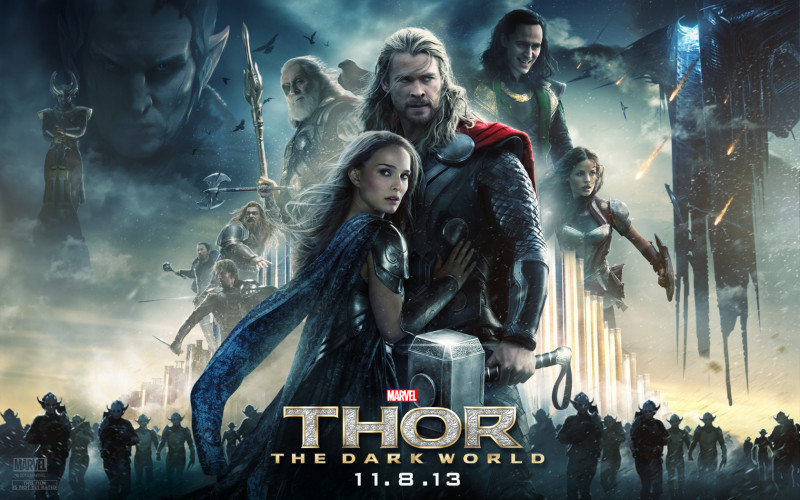
Thor: The Dark World review


              I think it’s fair to say that Marvel’s “Thor”, released in 2011, was nobody’s favorite predecessor to Joss Whedon’s “The Avengers”. This isn’t to say that nobody loved it at all. In fact, despite the overall silliness and camp that comes with rainbow roads, frost giants, and Natalie Portman playing an astrophysicist, the first “Thor” is a totally digestible, zero-calorie, superhero meal. Also, if nothing else, we got Chris Hemsworth and Tom Hiddleston out it.
                With that said, I wish I could I share the same kind of tepid enthusiasm for the recently released sequel. “Thor: The Dark World” is a decidedly slower, longer, and darker follow-up, that mistakenly shrouds the first film’s bright-eyed simplicity within a cocoon of narrative padding.
                After the cataclysmic events of “The Avengers”, Thor’s deceitful brother Loki (Tom Hiddleston) is captured and imprisoned back from wince he came on Asgard. While there, a fleet of dark space elves—just go with me—come to attack Odin’s throne to reclaim the power of a mystical red goo called The Ether, that has recently taken shelter in the body of Dr. Jane Foster (Natalie Portman). In order to keep the nine realms of the universe from being overtaken by darkness, Thor (Chris Hemsworth) must break his mischievous brother out of jail, and learn to trust him long enough fight together, side by side.
                Let me first say that, technically speaking, there isn’t anything ‘wrong’ with this movie. The special effects are big and expensive looking, the London location change is welcomed, the space-fantasy production design is inventive and imposing, and the action structure of the plot pays off in exactly the way it promises to from the opening prologue. My problems with this sequel lie within its vagueness, its self-seriousness, and its overall I-can’t-believe-we’re-getting-away-with-this-again safeness.
                The ruggedly handsome Hemsworth is half asleep in this reprise and even though this is supposedly his showcase, the film seems far more interested in Hiddleston’s sneering Loki character. The interplay between these two actors is occasionally engaging when the movie is remembers to be character-centric, but unfortunately the majority of the running time is devoted to red floating liquids, space battles, and overcomplicated conceits about intergalactic, warping car-keys.  There is some genuine fun to be had in the last half hour, but the cumbersome plot is so large and looming that whatever levity and charm saved the first film has now been shoved aside, in favor of the usual epic, action money-shots.
                I will commend the new screenwriters for finding a better way to integrate the human, non-super, characters (Portman, Kat Dennings, and Stellan Skarsgard) into the story, but even though they are given more to do, it doesn’t keep them from feeling any less like a mechanical writing device.
                I don’t know, this is all starting to feel like tired roadshow act on the last leg of a lengthy tour. I guess if you walk into this film wanting to like it you probably will. It’s been carefully designed to be placeholder until the Disney/Marvel factory spits out another one of these in five months.  However, when we’re living in a time with four or more superhero movies released every year, I refuse to simply excuse a film like this for being merely ‘fine’.

Grade: C-

Originally published in the Idaho State Journal/Nov-2013

Sunday, October 6, 2013

Rush review


             Two years ago, before he was introduced to the world as the superhero god Thor, the blonde Australian known as Chris Hemsworth was an unknown actor. Around the same time,well-vetted, ginger director, Ron Howard, made a failed buddy comedy staring Kevin James and Vince Vaughn.  Now, in 2013, with their newest film “Rush”, they are both in a much better place, pairing together for this historical biopic about Formula-One racing and clashing egos. Nothing here is astonishingly new,  astonishingly original, or even all that astonishing in general, but like a well-oiled machine, everything moves the way it’s supposed to and the film manages gets from point A to point B, with everything still intact.
                Perhaps playing on the ultra-masculine, god-like demeanor of his Marvel Thor persona, Hemsworth plays a cocky British car-racer named James Hunt, a real life, champion driver from the 1970s’. Along the way, while graduating from Formula Two buggies to Formula One speedsters, he meets an Austrian brat from a family of wealth a privilege named Niki Lauda, played by “Inglourius Basterds” actor, Daniel Bruhl.  While Hunt wins his way into the big-leagues, Louda buys his ticket in, starting an instant rivalry between the two talented drivers. Not making anything easier, they are also complete philosophical opposites, both on and off the road. Louda likes to live simply and race carefully, within the strict parameters of the race-track rules.  Hunt, on the other hand, seems more interested in reveling in his wealth and celebrity with anyone who is willing to show him a good time, especially beautiful women like the young Suzy Miller (Olivia Wilde), who he eventually--but not faithfully--marries out of pressure from his family and friends.
                Much of the film follows these two as they separately race their way to the top, knowing that at some point they will eventually have to show down against each other for the top prize. It’s an easy sports-movie formula, but this film pads that tired structure with a sense of tobacco stained, gritty 70s’ realism and two lead performances that are well-managed and well-rehearsed. 
                 In fact, most aspects of this film are thoughtfully conceived and executed. It has strong central performances, the tone is consistent, the world looks convincingly period, and the drama is handled in a way that feels honest and heartfelt, without drifting into sentimental melodrama. Both the direction and the camera work are also very nice and the sense of speed during some of the racing scenes creates a palpable tension and excitement. Other times, however, some of these scenes are over-edited and somewhat choppy and occasionally this tends to muddle the action or disorient the set-pieces.  More single takes or longer held shots on the track itself might have let these races breathe a little and given the audience a better sense of the length of each lap, but this is a minor quibble for otherwise quality offering.  
                I liked “Rush” but I can’t say that I fell in love with it. In part, this was because of the formulaic plot structure, and in some ways, because of the telegraphed emotional arc between Bruhl and Hemsworth. But as a character piece it doesn’t have to be too complicated and as a sports movie it doesn’t need to do much more than give you someone to root for. It’s better than average and in fact, it’s pretty good, but as a would-be prestige film there seems to be layer of textual gratification that just keeps it from reaching greatness.

Grade: B+

Originally published in the Idaho State Journal/Oct-2013