Sunday, November 1, 2015

Steve Jobs review

Writer Aaron Sorkin (“The West Wing”) and director Danny Boyle (“Trainspotting”) have teamed up to tell the story of Apple CEO and proto-Ted-Talker “Steve Jobs.” Given the success Sorkin had with his previous techie biopic “The Social Network,” in which he won an Oscar for his adapted screenplay about the creator of Facebook Mark Zuckerberg, his connection to this project makes a lot of sense. Perhaps it’s not the boldest or the most unconventional move for the writer to make at this point in his career, but you can always guarantee that if Sorkin is going to tread water he’ll do so with the grace and agility of an Olympic swimmer.

Like David Fincher, who was considered an edgier genre auteur at the time he agreed to direct “The Social Network,” Boyle’s involvement with this subject matter exists a little farther outside of his comfort zone. His hyper-kinetic visual choices and the psychologically subjective character portraits that have generally defined his style are sheathed to service a very dialogue-centric screenplay, where characters often say everything they’re thinking and feeling before the camera has time to imply it.

The structure of this movie is the most interesting thing about it. Each act of the film takes place during a different launch of Apple technology; starting with the Macintosh 128k in 1984, the NeXT in 88 and finally the iMac in 1998, that helped pull the company out of dire straits after failing to compete with Microsoft for a significant stint of time. Each of these launches play out like separate one-act stage performances where Steve Jobs, played fantastically by the enigmatic Michael Fassbender, is forced to deal with the stresses of his life and consequences of his career achievements, only moments before he’s supposed to unveil his company’s latest gamble. Each time, we are introduced to the same set of personalities that circle Jobs’ world.

Like his Zuckerberg, Sorkin’s take on Steve Jobs is that of a man who is haunted by own hubris, leaving a pile of smoldering bridges behind him as he blazes down the path of his own ambition. In repeating the same beats, revealing these moments of frustration before every new unveiling, the movie is instantly charged with a sense of nervous anticipation. 

All the actors are working hard for supper here, delivering the hyper-verbose Sorkinese dialogue like they don’t have time to get it wrong. Seth Rogen plays the humble but frustrated Apple Co-creator and engineer Steve Wozniac, who wants, and cannot get, a measly shout-out for his team’s Apple II contributions. Michael Stuhlbarg plays an approval-starved engineer who tried to stand in for Steve’s conscience and Kate Winslet plays a type-A work-wife named Joanna Hoffman, who’s desperately trying to keep the world from crumbling under her boss’s feet, even as he stomps through people’s sensitives in defiance.  Jeff Daniels steps in as a financier who also doubles as a father-figure for the so-called genius, all while, at the same time, Jobs carries on an arms-length relationship with his daughter, whom he initially refused to call his own.

Believe it or not, the bigger of a jerk the character of “Steve Jobs” is, the more interesting he is to watch. The movie only stumbles when it tries to humanize him too much, including a final ten minutes that tries to cowardly soften the blow of the two hours of shrewd and uncompromising self-assurance exhibited before it. The moments of dramatic weight come from a tension that exists between the high-stakes of Jobs’ vision to see his products perform well and the emotionally drained lives around the character that are begging for the same level of attention. This unfortunate cop-out of an epilogue is somewhat destabilizing, but not a big enough knock on the film to ruin it completely. 

Everything we see here—the writing, the directing and the performances—should be expected from the high level of talent involved and perhaps the fact that the movie doesn’t exceed expectations makes it feel as though it’s less accomplished. That notion is a mirage based on the unfair reality that this project was released after “The Social Network,” but a silver metal is nothing to be ashamed of.


Grade: B+

Originally Printed in the Idaho State Journal/Oct-2015

Tuesday, October 27, 2015

Crimson Peak review

Guillermo del Toro’s “Crimson Peak” was released in October to attract an audience looking for some chills on their way out of the mall, and given that there are fewer and fewer scary-movie options, outside of the realms of direct-to-second-run shlock and/or “Paranormal Activity” clones, it’s nice to a see a large-budget, effects-driven period-horror that’s trying to compete in the mainstream. In fact, del Toro treats this project just as he would any of his other features, combining the gloss and bombast of his 2013 giant-robot spectacle “Pacific Rim” and the gothic elegance of his Spanish-language fantasy-thrillers” and “The Devil’s Backbone” and “Pan’s Labyrinth.”

Visually and conceptually “Crimson Peak” is a dense genre-hybrid that marries the traditional narrative structure of nineteenth century, Victorian romantic literature with a blockbuster update of a Hammer-Studio styled haunted house ride—it bares mentioning del Toro was once attached to direct a “Haunted Mansion” reboot for Disney. What results is an uneven and some-what rigid film that, while ambitious and handsome in terms of its production, is rather empty and tepid as a story.

Mia Wasikowska plays Edith, the daughter of a wealthy American industrialist. Though she wishes to one day be a successful writer, after meeting a fledgling British inventor named Thomas Sharpe played by Tom Hiddleston, and his disapproving sister played by Jessica Chastain, Edith decides, against her father’s wishes, to marry the struggling aristocrat and follow him to his decaying mansion in England. the newly-wed Edith begins to feel less and less welcomed by the creaking house as the months goes by, and her marriage begins to strain under the constant supervision of her overbearing sister in law.

To the movie’s detriment, the most interesting character here is the mansion itself. As the plot slogs from scene to scene it’s clear to see that this living, breathing set seems to be the only thing in the film that del Toro bothered to give any real dimension. The production of this multi-segmented mansion is fully realized and designed with many swirling arches, ornate moldings, and antique trinkets filling every consciously arranged shot. This decorative flair is then brought to life though many practical and CGI effects, including walls that bleed crimson clay and moving shadows that cast down long hallways. And yet, the production is so costumed and ornamental that it often overwhelms the performances and constipates the drama. 

Many of the special effects are unsupported by the weak and conventional script and thus left with a surprising lack of tension within the traditionally set-up sequences of horror. CGI ghosts are rarely scary and even less so when, by the end of the film, you realize their inclusion in the plot is mostly superfluous. This might also have to do with the overall tonal problems the film suffers by wanting to appeal to the masses as too many things at once, a Victorian costume drama, a gothic fairy-tale, and a perverse murder mystery—all of which are wrapped up in a slick, over-lit production that’s far more concerned with its surfaces than it is with its emotional or psychological connection with the audience.

Struggling to find a balance between chaste and polite and guarded and mysterious, Wasikowska and Hiddleston’s performances come off somewhat bland and stagey. The same or worse could be said about “Sons of Anarchy” actor Charlie Hunnam who conveniently drifts in and out of the movie as a plot device.  Chastain, on the hand, revels in her character’s complete lack of subtext and subtlety and instead leans into a knowing sense of camp as the film escalates into face-stabbing hysteria, mixing into her performance two parts Mrs. Danvers from Hitchcock’s “Rebecca” and one part “Mommy Dearest.”

Despite mostly failing as an involving story or as an effective thriller, nobody can fault the film for its lack of trying. Del Toro deserves to be commended for his creativity and his willingness to take risks, even when working from a script as predictable and tired as this one. His love for the genre is undeniably contagious and like a familiar theme-park adventure, there’s always something interesting to look at and admire as you pass through the plodding set-pieces.


Grade: C

Originally published in the Idaho State Journal/Oct-2015

Tuesday, October 13, 2015

Sicario review

There’s been a long tradition of southwest, boarder-town noirs that reach as far back as Anthony Mann’s 1949 film “Boarder Incident” and as recent as the Coen brother’s “No Country For Old Men,” as well as television’s “Breaking Bad.” Surprisingly, as worn as this genre may be, Denis Villeneuve’s “Sicario” still manages to find new life underneath old tropes and effectively tightens the screws with tense, Hitchcockian set-ups.

Emily Blunt plays Kate Macer, a moral FBI agent who’s hired by a government special operations unit to take down a powerful cartel leader who’s responsible for a number of indiscriminate killings and mutilations. In hopes of doing the right thing to get to the worst evils of society, she realizes that the deeper she gets involved the less her convictions and her morals will help her with the job at hand.

From the opening sequence when we see Blunt and her fellow agents break into a remotely located drug-house, with gunmen behind every corner and dead-bodies shrink-wrapped behind the dry-wall, Villeneuve establishes a Dante-like hell that increasingly challenges our hero as she descends deeper into each circle of its depravity. Josh Brolin plays her duplicitous guide into this journey named Matt Graver, a man who smugly wears flip-flops to office meetings and hides his elusive motives behind a casual smile. Benicio Del Toro’s Alejandro is an even tougher nut to crack, as he seems to be able to brutally operate outside of the strict confines of the law with complete immunity. Blunt serves as the audience’s surrogate but also as the movie’s moral center and its heart. To her credit, given the mechanical function of her character, she manages to breath in sync with the camera and effectively embodies Villeneuve’s tone of paranoia.

As with the director’s last film “Prisoners,” this feature was shot by the much-celebrated cinematographer Roger Deakins, and like his past work—including “No Country for Old Men”—every shot is precisely considered and milks each frame for ominous drama. Deakins’ artful approach to photography, along with the film’s doom-laden score by Jóhann Jóhannsson perfectly accents the movie’s many apocalyptic establishing shots and creates a malevolent sense of dread within the world these characters inhabit.

Luckily “Sicario” understands that aesthetics alone doesn’t make a movie without an assured story to tell and a confident director at the helm. Taylor Sheridan’s hard-boiled screenplay examines the war on drugs as a complicated parable with a “Chinatown” sense of pessimism. Villeneuve perfectly captures this with his nightmarish vision of violence as the last form of communication between the law and lawless.


This certainly isn’t a happy film and if you’re not inclined to watch a crime story that stares deep into the abyss without any tangible hope to keep from falling directly into it, then this might not be your ideal Saturday night. I, however, can’t recommend this movie highly enough. The performances across the board are fantastic—perhaps the best I’ve seen from all the leads in years—and it’s great to see a mainstream movie that’s isn’t satisfied with simply fulfilling its genre conventions.  Instead “Sicario” digs its familiar premise deeper for existential conflict and a darker tonal ambiance. 

Grade: A

Originally Published in the Idaho State Journal/Oct-2015

Sunday, October 4, 2015

Black Mass review

“Black Mass” is essentially a traditional rise and fall gangster drama within the aesthetic of the American gothic experience. Director Scott Cooper tries to subvert the film’s familiar trappings by setting in place a tension within the story where I we know the two main characters are damned to failure from the first scene.  Considering the clever set-up and the movie’s all-star cast, the fact that the story almost broods to a complete stop by the second act is as befuddling as it is a jaw-dropping disappointment.  

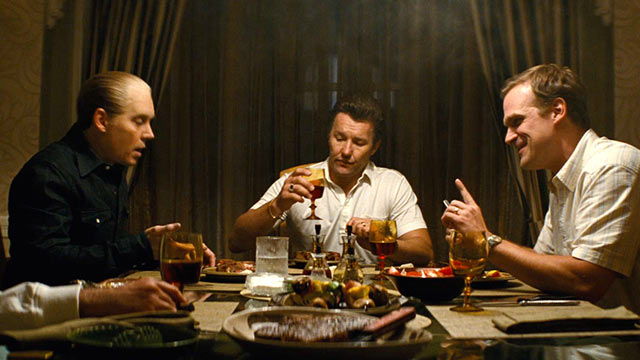
Johnny Depp plays James “Whitey” Bulger, the Boston crime-lord who inspired Jack Nicholson’s Frank Costello character from Martin Scorsese’s 2006 Oscar-winning film “The Departed.” And while Depp is every bit as unhinged and deranged here, the portrayal is decidedly less animated. Joel Edgerton plays opposite as John Connolly, a shady FBI agent who lets Bulger does as he pleases, so long as he continues to sell out the Italian Mafioso that’s moving in to the Boston streets. With his brother Billy Bulger (Benedict Cumberbatch) in a position of local political power, Whitey is given a legal hall-pass by both the state and federal authorities to become one of the most powerful and dangerous east-coast gangsters of 70s and 80s.  Nevertheless, Bulger’s paranoia gets the best of him and both his criminal brethren and the cooperating agents of the FBI are in constant fear of triggering his scorn.

Cooper’s vision of this story is interested in investigating the interiority of the characters and exploring how they click within their world of broken rules and the hypocrisy of their familial street-code. This means on a genre-level things tend to skew more towards “The Godfather” side of the gangster spectrum than it does “Goodfellas.” Given this approach, there are far too many story and production choices that orient things toward the broad surfaces. The all-star ensemble and the constant walk-ons by known character-actors like Corey Stoll, Adam Scott, Rory Cochrane, Peter Sarsgaard and Juno Temple spread the story too thin to effectively delve into the tense relationship between Depp and Edgerton as the leads. With a timeline that spans decades and multiple character perspectives to shift to and from, the movie never becomes the deep character study it thinks it is.

Despite this structural flaw, Depp’s performance is nuanced and appropriately pitched to the tone of the film, and in many sequences he is quite engaging without defaulting to his usual post-Pirates affections, but his Dracula-esq make-up design becomes so distracting that it often blocks whatever subtly there is to appreciate in his delivery.  Off and on the rest of the cast have their moments to shine and individual scenes of conversation work well on their own when Cooper is afforded to do what he does best - zeroing in on performance and dialogue. When it comes to the overall big-picture and the execution of the screenplay, the movie unfortunately fails to drum up enough drama to fuel the narrative.

Emotionally “Black Mass” doesn’t work like it should, but the movie isn’t a total wash either. It was nice to see Depp given something juicy to bite into as an actor and to play to his actual age, but Cooper seems out of step with many elements of the film as a director and often conflicts with the base genre elements of the story.


Grade: C-

Originally Published in the Idaho State Journal/Oct-2015
Sunday, September 20, 2015

The Visit review

M. Knight Shyamalan is a name that’s hard to live-down for a lot movie-goers these days. After reviving the supernatural-thriller in 1999 with his Oscar-nominated film “The Sixth Sense” and solidifying his brand with a few notable follow-ups, his career hit an irrevocable downward slide, and over the last decade he’s been bumbling into mistake after another.  Films like “Lady in the Water” and “The Happening” revealed a tendency towards half-baked concepts, overwritten screenplays, and lack of directorial sense of self-awareness that’s burdened the bulk of his later work. Even taking-on for-hire projects like the “The Last Airbender,” adapted from the popular Nickelodeon cartoon, as well as the awkward Will and Jayden Smith vehicle “After Earth,” couldn’t refocus the floundering filmmaker, despite relying less on his own ideas.

 Shyamalan has now teamed with the successful horror production factory Blumehouse (“Paranormal Activity,” “Insidious,” “Sinister,” etc...) to get back to nuts and bolts of suspense directing. With this ninety minute, found-footage B-movie, he has no sights set on prestige or deliberately paced auteur ambitions, but even with nothing to prove and his toolbox taken away from him, his ego and writerly obsessions get in the way of this uneven and problematic popcorn thriller.

Olivia Dolange and Ed Oxenbould play Becca and Tyler, two suburban tweens who have been sent on a week-long trip to visit their distant grandparents for the first time. Their single mother (Kathryn Hahn) is up-front about the tense relationship she has with her parents, with whom she hasn’t spoken with in many years, but is rather cagey about the specifics of their estrangement. To uncovering the mystery about what happened the night her mother left her parent’s house, Becca has decided to film this trip as a documentary about reconciliation. Her younger brother Tyler, a wannabee hip-hop lyricist, is more interested in figuring out why their newly acquainted grandparents are acting so strange; Nana (Deanna Dunagan) wandering the halls nude in the middle of night, scratching at the walls like an animal, and pop pop (Peter McRobbie) taking many private trips to a locked shed in the back yard of their country property.

Conceptually “The Visit” is promising enough, tapping into the societal strain of generation gaps, the paranoia of isolation from familiarity, and the universal fear of growing old and losing your physical and mental capabilities. All the ingredients are present for a Hitchcockian Hansel and Gretel tale, but Shyamalan peppers the entire experience with derailing creative choices. In framing the narrative as a found-footage video project, the film is allowed to move quickly with a sudden cuts and time-hops, which admittedly streamlines M. Knight’s penchant for dimly-lit, slow-burning ponderousness, but it also constipates the picture’s aesthetics, deadening much of the suspense in justifying and limiting camera placement and shot set-ups.

 This conceit also feeds into the director’s weakness in defaulting to expository dialogue whenever he needs to reveal more about the characters or the world he’s building. After all, if we are viewing a diegetic documentary in the works, then characters are in the position to say what they are feeling and thinking and are given the opportunity to explain any other necessary back-story directly to the camera. As a result, the story is largely told instead of shown, which is bummer because most of the performances are either misdirected, hammy, or flat-out bad. Dolange has a spark of sincerity underneath her achingly affected cineaste dialogue about framing and mis-en-scene but Oxenbould’s bright-eyed audition-face, combined with the choice to have him spitting out bratty one-liners and battle raps, grates in way that’s almost as if the director is deliberately trying to cut our sympathies with the protagonists.

Occasionally the best version of this movie peaks through the tone-deaf fog that shrouds the majority of its run-time. Dunagan and McRobbie are fully committed to their bizarre performances and, by the third act, a shreiky, camp quality, combined with a twisted sense of dark humor, gels together in a way that’s entertainingly misanthropic. But these moments are too few and infrequent and clang quite abrasively against Shyamalan’s ham-fisted themes about broken-homes and forgiveness.  I really wish I could join the sizable chorus calling this a return to form for the troubled filmmaker, but I simply don’t see much here that’s effective, evocative or even scary enough to give it a pass.

Grade: D+

Originally Published in the Idaho State Journal/Sep-2015

American Ultra review


“American Ultra” is a moody action-dramedy that attempts a difficult balancing act between tone and genre expectation. Not only does it showcase two somewhat misunderstood actors in Jesse Eisenberg and Kristen Stewart as the leads—rekindling their indie-romance appeal from “Adventureland”—but it also wants to be taken seriously as a savage action-thriller and a hysterical satire.  The fact that it manages to hit these disparate targets fifty percent of the time speaks to the strength of Max Landis’ overly ambitious script and the earnestness of Eisenberg and Stewart’s slightly out-of-tune performances.

Eisenberg plays Mike Howell, a nervous stoner who’s in love with his layabout girlfriend Phoebe (Stewart), but can’t stomach the commitment it takes to move even slightly forward with their relationship.  After purposely postponing the vacation where he planned to pop the question, a mysterious woman approaches the counter of the convenience store where he works and activates a code in Mike’s brain that reveals years of spy training he received before having his mind wiped by the government. This proves to become helpful because, as it turns out, he’s been declared classified evidence of a failed program by the CIA.  As he’s being hunted down by psychotic operatives, and the media is covering up the trail of bodies behind him, he’s left with only his wits and his untapped physical skills to protect himself and his lover.

Like Landis’ debut screenplay “Chronicle,” this is a genre movie that deconstructs the tropes of genre movies through the ironic lens of millennial pop-culture curation. The way the plot is set up and moves forward is clearly drawing on video game mechanics, that’s complete with boss-battles and a princess to save at the end. The classic reluctant hero’s journey, combined with a Kevin-Smith-y smirkiness about the story tradition in which it’s engaging, speaks to Landis’ knowledge and appreciation of post-modern, alternative comic book meta-narratives.  All of this is interesting and plays out in surprising bursts of violence and scenes of real emotional weight, but never in a way that feels fully intergraded or cohesive.

Director Nima Nourizadeh, who previously helmed the teenage party movie “Project X,” is out of sync with the complicated material and the motivations of his actors. Nourizadeh is clearly making a darker action film with brutal fight choreography, the script is concerned with the nuance of the genre and the actors are concerned with the relatability of their performances. With three distinct drivers behind the wheel, the comedy and the satire that should have moved things along, was left on the side of the road and out of breath to keep up with the competing tones of the film.

John Leguizamo as a tweaked out drug dealer who has a neon basement and a rocker van is perhaps the only performer in the cast who understands what movie he’s actually in. Topher Grace as the CIA, yuppie bad-guy is tuned so unpleasant and mean-spirited that he comes off as genuinely hateful and shrill in way that better direction and editing should have protected him from stepping into.

Whether you love it or hate it, or are simply too confused to commit to an opinion, “American Ultra” is an original curiosity in which the things about it that are most compelling are very things that are obstructing its success as a movie. The central love story and emotions behind the film are surprisingly sensitive and effecting but ultimately exhausted in mitigating the heavy-metal direction and the screenplay’s allusive attitude.


Grade: C

Originally Published in the Idaho State Journal/Sep-2015

Z for Zachariah review


The post-apocalyptic genre is officially back in vogue. This year alone we have seen the return of “Mad Max,” a “Walking Dead” spin-off series and there’s still one more “Hunger Games” before that franchise comes to a close. It’s the end of the world and not only do we feel fine, we want more. But unlike the studded leather jackets, crossbows and sandstorm car-chases that usually occupy the genre, Craig Zobel’s “Z for Zachariah” is a slow-burn melodrama, using the setup of the post-apocalypse as a way to tell a deeply intimate and small-scale parable that reflects the larger complications of society as we know it today.

“Wolf of Wall Street” actress Margot Robbie plays Ann, a bright-eyed survivor who lives in a mystical valley in the woods that’s somehow been spared from the nuclear fallout and radiation that has poisoned the rest of the world. After what was left of her religious family took to road find other survivors, she spent the better part of a year keeping the crops growing and preparing for the rough winter ahead, with only her dog at her side. This all changes when she meets Loomis (Chiwetal Ejiofor), a wandering civil-engineer who she decides takes in and nurse back to health after he nearly dies from radiation poisoning.

Together Ann and Loomis try to rebuild their lives and ration their food supply, and after sharing meals and memories together, they begin to develop an emotional connection. Enter Caleb (Chris Pine): a cocky young coalminer with piercing blue eyes and a GQ smile. As it turns out, three’s a crowd and with two men now in the house, Ann is forced to mitigate the bubbling competition between one man who’s charming and who shares her down-home Christian values and another who’s fatherly and practical but a spiritual skeptic.

With “Twilight” fresh in our rear-view, the love-triangle aspect of the film might seem trite and tired but Zobel doesn’t allow this familiar dynamic to sit on the surface as a simple fantasy born of sexually frustration. Instead he uses this trope to create a quiet and subtle chamber piece that alludes to much bigger questions about faith, skepticism and racial familiarity, all with feminist undertones.

At one point Loomis sees the budding attraction between Caleb and his would-be life-partner and quietly informs Ann that she can make whatever decision she wants—as if she needed his permission. Nevertheless Ann is then forced to feel pressure and guilt over an unfair choice that has been thrust upon her. Without realizing or asking for it, she is then put the touchy position of possibly being chastised by the men in her life, including the deified memory her father who’s hand-built church must be torn down to create a water combine to restore energy to the house.

“Z for Zachariah” is a film that stands back and lets the performances and the characters guide the bigger picture. As such, some might find the veiled motivations of the three leads, and the ambiguous nature of their actions to hold little dramatic traction as a science-fiction premise. I myself become entranced by the Garden of Eden/Cane and Able metaphor that plays out and the subverting of their original moral purpose.  Robbie, Ejiofor and Pine carry the whole the thing effortlessly and explore the quiet intensity of their character’s repressed conflicts. Though the movie might seem minimal in form, the nuanced performances and expressive camera work hints a world of mythic and political complexity that exists just underneath the love story.

Grade: B+

Originally Published in the Idaho State Journal/Sep-2015