Showing posts with label Blumhouse Productions. Show all posts

Sunday, October 22, 2017

Happy Death Day review

There was a time, not too long ago, when horror movies used to be made for teenagers.  The 80s was full of populist scary flicks that catered to the 11-24 marked, with films such as “Friday the 13th,” “Fright Night,” “Slumber Party Massacre,” “Night of the Comet,” “The Lost Boys” and many more. Wes Craven’s first “Scream,” and its subsequent sequels and rip-offs, might have been the last era of that tradition. In its absence, we’ve seen grim supernatural chillers, cheap found-footage shocks and a small splattering of gore films, derisively labeled ‘torture porn.’  Christopher Landon’s “Happy Death Day,” released by Blumhouse Productions, tries to find that sweet spot between made-for-TV tween-age Halloween movies and the slightly more sophisticated slashers of the 1980s.

Jessica Rothe stars as Tree Gelbman, a young sorority girl who, on her birthday, finds herself waking in a strange boy’s dorm room after a hard night of partying. Quickly gathering her things and leaving, she’s goes about her day with smeared eye-liner and a short fuse, pissing off everyone she encounters, including Carter, the boy she presumably spent the night with (Israel Broussard), her college roommate (Ruby Modine) and the professor with whom she’s currently having an extra-marital affair (Charles Aitken). Her night ends at the end of knife held by a masked killer, and after she's murdered, she awakes on the same day, in the same bed, only to relive these encounters over and over until she’s able to outsmart her attacker.

The fun of this “Groundhog’s Day” premise is that Landon and his screenwriter Scott Lobdell can fully explore the geography of their set-pieces and they can tease the mystery element with a gimmick that allows the audience to play along with the protagonist. In this way, the movie succeeds in its slumber party ambitions, but it excels in its layered character work. Tree begins the film as a terrible person who has little to no regard for anyone other than herself. Her journey, by reliving a horrible death over and over again, is to explore who she’s wronged and what their motivations might be. In doing so, she is forced to think about the feelings of others and she is also forced to come to terms with her own past trauma that made her become so cold to begin with. This Scrooge-ish character arc might not be the most revolutionary angle to go with, but there’s at least an emotionally rooted purpose for it’s the screenplay’s high-concept.

All the performances are strong. Rothe has the most do, as she learns to become a better person throughout the runtime, but her eventual partnership with Broussard is also a highlight, as we watch them plan and scheme together like the Hardy Boys. The film only slips when it over plays its red herrings. An element is introduced near the mid-point that steps too far away from what was carefully established in the first third. This plot point is eventually dealt with in a way that’s satisfying and still rooted in character, but given the obvious mechanics of the plot, the placement of this story element is the only thing that registers as labored and forced.

“Happy Death Day” is a love letter to a simpler time in horror. It uses post-modern techniques to explore these simpler, somewhat optimistic themes, but in doing so, manages to cleverly deconstruct the slasher genre in way that isn’t too ponderous or academic.  It’s probably not as scary as it could have been but this is the type of horror date-movie that was made to enjoy some popcorn with, and sometimes that’s okay.

Grade: B

Originally Published in the Idaho State Journal/Oct-2017

Listen to this week's episode of Jabber and the Drone to hear more conversation about "Happy Death Day."

Sunday, May 22, 2016

The Darkness review

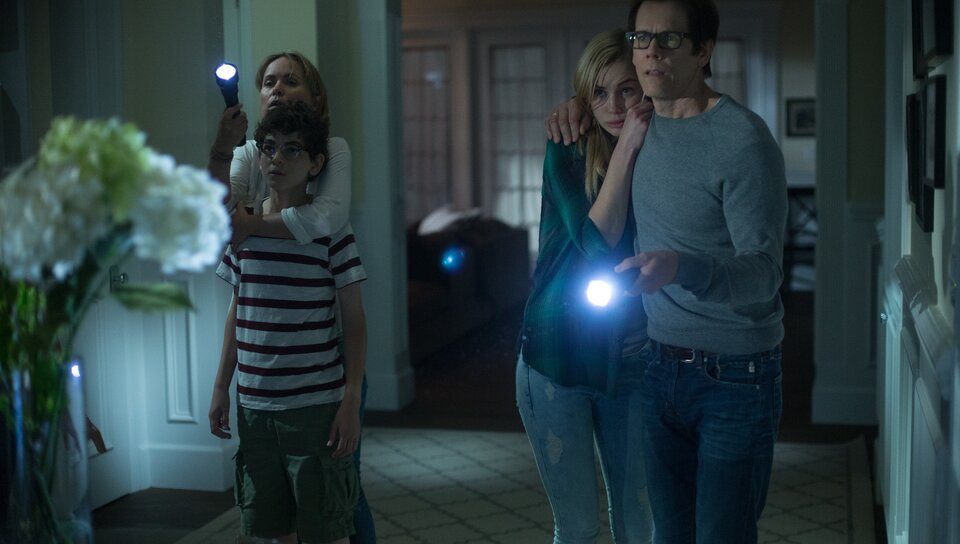
Blumhouse Productions has defined their brand by creating low to mid budget haunted house thrillers that essentially combine the same elements from “The Shining,” “The Poltergeist” and “The Exorcist.” James Wan, so far, has embraced this style of pop horror filmmaking most successfully with his “Insidious” pairing and the “The Conjuring.”  Scott Derrickson’s “Sinister” had its moments as well and “The Purge” films seem to have a consistent draw that perplexes me. Most of Blumhouse’s other output has been spotty and it’s become all the more apparent that their formula is rapidly becoming stale. Their latest “Poltergeist” rip off, “The Darkness,” is just as lazy and bland as the title suggests.

Kevin Bacon and Radha Mitchell play Peter and Bronny Taylor, the parents of a dysfunctional American family—Mitchell is a recovered alcoholic and Bacon once had an affair. Their children consist of a pre-teen boy named Michael (David Mazouz) who lives with a form low-functioning autism and their seventeen-year-old daughter Stephany (Lucy Fry) has body image issues.  Shortly after a trip to the Grand Canyon, where Michael found and secretly brought home some ancient Anasazi artifacts, the family is slowly tormented by a dark presence in their home. Michael’s idiosyncrasies have become more violent and disturbing as everyone else in the house has experienced the psychological terror of strange noises, dirty hand prints, weird smells, barking dogs and self-starting water faucets.  

Forget for a moment that the movie’s handling of Native American culture and the subject of autism is surprisingly regressive, it’s also presented in a way that’s painfully boring and completely without entertainment value. It’s becomes clear that the filmmakers struggled to find any real moments of tension or fear in this lifeless slog and instead tried to make up for its lack of real scares with an annoyingly manipulative score, full of random jolts and ineffective moodiness. Bacon and Mitchell are trying their best to take this insipid, underwritten material seriously and guest star Paul Reiser, as Bacon’s misogynist boss, is trying his hardest to not take it seriously, but even when the character moments occasionally slips into “When a Man Loves a Woman” it’s undercut by the hapless shlock of the rest of the movie and transformed into unintentional Lifetime melodrama.  

Mazous, known by most as young Bruce Wayne on television’s “Gotham,” is given nothing to do here and his performance of a person with a real and complex condition is played with the seriousness of an after-school special. Hell, even the blatant transphobia of the first “Sleepaway Camp,” was at least shocking and audacious, even if a bit dated by today’s standards. Both the story’s autism angle—how are parents supposed to tell the difference between normal-weird and possessed by ancient Native spirts-weird—as well as the production’s Anasazi stylistics are never exploited in way that registers above cliché and tired.

At one point a large dog suddenly attacks the daughter in her bed. That was kind of cool.

It’s hard to say what went wrong here. Director Greg McLean made of my favorite modern horror films with the Aussie serial killer thriller “Wolfe Creek” but none of the style or the simmering tension of that project is transferred into this PG-13, overblown “Goosebumps” book. The shoddy screenplay isn’t helping anyone and the movie’s clear and direct influences loom large in sullen judgement. 

Grade - D

Originally Published in the Idaho State Journal/May-2016

Listen to this week's episode of Jabber and the Drone to hear more conversation about "The Darkness."

Sunday, September 20, 2015

The Visit review

M. Knight Shyamalan is a name that’s hard to live-down for a lot movie-goers these days. After reviving the supernatural-thriller in 1999 with his Oscar-nominated film “The Sixth Sense” and solidifying his brand with a few notable follow-ups, his career hit an irrevocable downward slide, and over the last decade he’s been bumbling into mistake after another.  Films like “Lady in the Water” and “The Happening” revealed a tendency towards half-baked concepts, overwritten screenplays, and lack of directorial sense of self-awareness that’s burdened the bulk of his later work. Even taking-on for-hire projects like the “The Last Airbender,” adapted from the popular Nickelodeon cartoon, as well as the awkward Will and Jayden Smith vehicle “After Earth,” couldn’t refocus the floundering filmmaker, despite relying less on his own ideas.

 Shyamalan has now teamed with the successful horror production factory Blumehouse (“Paranormal Activity,” “Insidious,” “Sinister,” etc...) to get back to nuts and bolts of suspense directing. With this ninety minute, found-footage B-movie, he has no sights set on prestige or deliberately paced auteur ambitions, but even with nothing to prove and his toolbox taken away from him, his ego and writerly obsessions get in the way of this uneven and problematic popcorn thriller.

Olivia Dolange and Ed Oxenbould play Becca and Tyler, two suburban tweens who have been sent on a week-long trip to visit their distant grandparents for the first time. Their single mother (Kathryn Hahn) is up-front about the tense relationship she has with her parents, with whom she hasn’t spoken with in many years, but is rather cagey about the specifics of their estrangement. To uncovering the mystery about what happened the night her mother left her parent’s house, Becca has decided to film this trip as a documentary about reconciliation. Her younger brother Tyler, a wannabee hip-hop lyricist, is more interested in figuring out why their newly acquainted grandparents are acting so strange; Nana (Deanna Dunagan) wandering the halls nude in the middle of night, scratching at the walls like an animal, and pop pop (Peter McRobbie) taking many private trips to a locked shed in the back yard of their country property.

Conceptually “The Visit” is promising enough, tapping into the societal strain of generation gaps, the paranoia of isolation from familiarity, and the universal fear of growing old and losing your physical and mental capabilities. All the ingredients are present for a Hitchcockian Hansel and Gretel tale, but Shyamalan peppers the entire experience with derailing creative choices. In framing the narrative as a found-footage video project, the film is allowed to move quickly with a sudden cuts and time-hops, which admittedly streamlines M. Knight’s penchant for dimly-lit, slow-burning ponderousness, but it also constipates the picture’s aesthetics, deadening much of the suspense in justifying and limiting camera placement and shot set-ups.

 This conceit also feeds into the director’s weakness in defaulting to expository dialogue whenever he needs to reveal more about the characters or the world he’s building. After all, if we are viewing a diegetic documentary in the works, then characters are in the position to say what they are feeling and thinking and are given the opportunity to explain any other necessary back-story directly to the camera. As a result, the story is largely told instead of shown, which is bummer because most of the performances are either misdirected, hammy, or flat-out bad. Dolange has a spark of sincerity underneath her achingly affected cineaste dialogue about framing and mis-en-scene but Oxenbould’s bright-eyed audition-face, combined with the choice to have him spitting out bratty one-liners and battle raps, grates in way that’s almost as if the director is deliberately trying to cut our sympathies with the protagonists.

Occasionally the best version of this movie peaks through the tone-deaf fog that shrouds the majority of its run-time. Dunagan and McRobbie are fully committed to their bizarre performances and, by the third act, a shreiky, camp quality, combined with a twisted sense of dark humor, gels together in a way that’s entertainingly misanthropic. But these moments are too few and infrequent and clang quite abrasively against Shyamalan’s ham-fisted themes about broken-homes and forgiveness.  I really wish I could join the sizable chorus calling this a return to form for the troubled filmmaker, but I simply don’t see much here that’s effective, evocative or even scary enough to give it a pass.

Grade: D+

Originally Published in the Idaho State Journal/Sep-2015