Showing posts with label Seth Rogen. Show all posts

Sunday, August 21, 2016

Sausage Party review

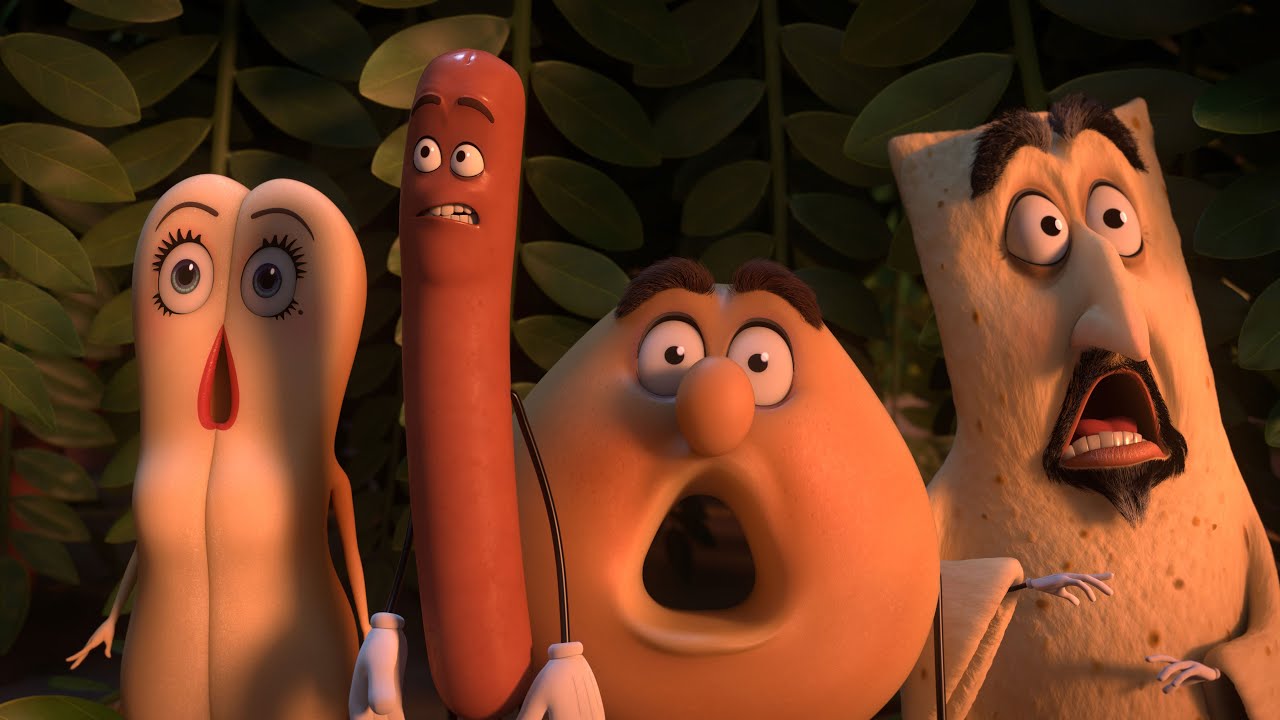
Seth Rogen and Evan Goldberg’s raunchy animated feature “Sausage Party” certainly doesn’t lack audaciousness when it comes to pushing technical boundaries. While it’s not the first of its kind in terms of feature length animated films with adult humor, it is the first to utilize the size and scope of Dreamworks and Pixar’s three-dimensional style. Directors Greg Tiernan and Conrad Vernon both come from animation backgrounds, and that certainly helps to facilitate Rogen and Goldberg’s vision of a colorful grocery store where food items learn the harsh realities of their place in the circle of life. The ambition of this project is impossible to ignore, and with an over-saturation of talking animal cartoons released every year, a parody was ripe for the making. That is why “Sausage Party” feels like even more of a deflating as missed opportunity. This creative team could have really done something spectacular and sharp, but the film lacks both subtlety and wit and leans on lowest common denominator gags and empty vulgarity.

Rogen voices Frank, a hot dog who is looking forward to being chosen by one of the human “gods” so that he may finally copulate with a bun named Brenda (Kristin Wiig), his across-the-shelf girlfriend. When they finally make it into a shopping cart, an accident separates Frank from his package of hotdog friends voiced by Jonah Hill and Michael Cera. Frank and Brenda must then travel back through the many aisles of the store to regroup. Joining their odyssey is a neurotic Jewish bagel named Sammy (Edward Norton), and an angry, pious flat-bread wrap named Lavash (David Krumholtz). Along the way Frank discovers that their purpose in the lives of their gods may not be the heaven they had in mind.

Lavash and Sammy’s contentious relationship underlines the movie’s more shocking sources of comedy; a total surrender to outdated racial and cultural stereotypes. The food in the store is segregated into ethnicities (Mexican, German, Middle Eastern, Asian…etc), and while the film tries to justify their reductive depictions through the script’s themes of cultural unity in the face of blind faith and superstition, the glee it exudes from exploiting these stereotypes cannot be removed from its comedic premise.


For all of its bombast and expensive production values, this movie just isn’t funny enough. The dialogue is riddled with expletives and filthy innuendo from the first frame, and while South Park creators Matt Stone and Trey Parker have made an art out of profane satire in animation, this screenplay is far lazier in its execution. The writers seemed to believe that to show a cartoon character cursing is funny enough on its own without properly set-up jokes or subversive insight to support each scene. What results is a series of unfunny conversation set-pieces that sound transcribed from preteen boy’s locker room. Case in point; Nick Kroll voices the villain of the story, a feminine product who calls himself “The Douche.”


The movie works best when it explores the violent, darker places within its premise. After escaping the clutches of death from a human, Michael Cera’s character, Barry, leads us into unpredictable and absurdly macabre situations when he ties to make it back to the store to warn his friends of certain doom. These moments are based more on vivid imagery that properly utilizing its animated context--unlike the bumbling primary plot, which relies too heavily on hard-R raunch and Rogen's obligatory pot jokes.

The film has an interesting message about how religious interpretations can divide us in this life while we worry too much about what's in the next, but as a comedy “Sausage Party” is largely a one-trick pony. While its tone-deaf racial humor is supposed to be boldly irreverent, much of it is cringe inducing, and with this much time and effort put into the animation process there is no excuse for the comedy be this tired.

Grade: C-

Originally Published in the Idaho State Journal/Aug-2016

Listen to this week's episode of Jabber and the Drone to hear more conversation about "Sausage Party."

Sunday, November 1, 2015

Steve Jobs review

Writer Aaron Sorkin (“The West Wing”) and director Danny Boyle (“Trainspotting”) have teamed up to tell the story of Apple CEO and proto-Ted-Talker “Steve Jobs.” Given the success Sorkin had with his previous techie biopic “The Social Network,” in which he won an Oscar for his adapted screenplay about the creator of Facebook Mark Zuckerberg, his connection to this project makes a lot of sense. Perhaps it’s not the boldest or the most unconventional move for the writer to make at this point in his career, but you can always guarantee that if Sorkin is going to tread water he’ll do so with the grace and agility of an Olympic swimmer.

Like David Fincher, who was considered an edgier genre auteur at the time he agreed to direct “The Social Network,” Boyle’s involvement with this subject matter exists a little farther outside of his comfort zone. His hyper-kinetic visual choices and the psychologically subjective character portraits that have generally defined his style are sheathed to service a very dialogue-centric screenplay, where characters often say everything they’re thinking and feeling before the camera has time to imply it.

The structure of this movie is the most interesting thing about it. Each act of the film takes place during a different launch of Apple technology; starting with the Macintosh 128k in 1984, the NeXT in 88 and finally the iMac in 1998, that helped pull the company out of dire straits after failing to compete with Microsoft for a significant stint of time. Each of these launches play out like separate one-act stage performances where Steve Jobs, played fantastically by the enigmatic Michael Fassbender, is forced to deal with the stresses of his life and consequences of his career achievements, only moments before he’s supposed to unveil his company’s latest gamble. Each time, we are introduced to the same set of personalities that circle Jobs’ world.

Like his Zuckerberg, Sorkin’s take on Steve Jobs is that of a man who is haunted by own hubris, leaving a pile of smoldering bridges behind him as he blazes down the path of his own ambition. In repeating the same beats, revealing these moments of frustration before every new unveiling, the movie is instantly charged with a sense of nervous anticipation. 

All the actors are working hard for supper here, delivering the hyper-verbose Sorkinese dialogue like they don’t have time to get it wrong. Seth Rogen plays the humble but frustrated Apple Co-creator and engineer Steve Wozniac, who wants, and cannot get, a measly shout-out for his team’s Apple II contributions. Michael Stuhlbarg plays an approval-starved engineer who tried to stand in for Steve’s conscience and Kate Winslet plays a type-A work-wife named Joanna Hoffman, who’s desperately trying to keep the world from crumbling under her boss’s feet, even as he stomps through people’s sensitives in defiance.  Jeff Daniels steps in as a financier who also doubles as a father-figure for the so-called genius, all while, at the same time, Jobs carries on an arms-length relationship with his daughter, whom he initially refused to call his own.

Believe it or not, the bigger of a jerk the character of “Steve Jobs” is, the more interesting he is to watch. The movie only stumbles when it tries to humanize him too much, including a final ten minutes that tries to cowardly soften the blow of the two hours of shrewd and uncompromising self-assurance exhibited before it. The moments of dramatic weight come from a tension that exists between the high-stakes of Jobs’ vision to see his products perform well and the emotionally drained lives around the character that are begging for the same level of attention. This unfortunate cop-out of an epilogue is somewhat destabilizing, but not a big enough knock on the film to ruin it completely. 

Everything we see here—the writing, the directing and the performances—should be expected from the high level of talent involved and perhaps the fact that the movie doesn’t exceed expectations makes it feel as though it’s less accomplished. That notion is a mirage based on the unfair reality that this project was released after “The Social Network,” but a silver metal is nothing to be ashamed of.


Grade: B+

Originally Printed in the Idaho State Journal/Oct-2015