Sunday, December 8, 2013

Frozen review


               Despite the fact that Disney is still remembered for its quality family entertainment, it has been some time since their primary animation studio has produced anything of lasting relevance. Sure, Pixar, their digital-animation sister company, has occasionally been able to approximate the glory days when  Disney could so perfectly balance sentimentality with  sincerity, in a narratively compelling way, but with the expansion of their ever-splintering markets, the studio’s proper animation department has been on a steady decline for last 20 years.
                “Frozen”, a 3D reworking of Hans Christian Anderson’s “The Snow Queen”, cleverly plays on the nostalgia of the classic Disney musical by simulating the Broadway infected melodrama of films like “Beauty and the Beast” and  “The Little Mermaid”, as well as the visual aesthetics of older selections from their repertoire like “Cinderella”.  But does “Frozen” manage to carve out a niche for itself among the pantheon of Disney standards or is it simply an empty pastiche?
                This loose adaptation of Anderson’s fairytale tells the story of two sisters who are emotionally separated after the enchanted snow-bender Elsa (Idina Menzel) almost kills her younger sister Anna (Kristen Bell) in a childhood accident. Years later, after Anna's been healed and her memory of Elsa’s powers have been wiped, they are reunited at Elsa’s coronation. When Anna announces her hasty engagement to the young Hans (Santino Fontana), Elsa again reveals her hidden powers in an argument, causing her to leave the kingdom in embarrassment, unintentionally cursing the land to fall into a summertime snowpocalypse.  With the help of a burly traveler named Kristoff (Jonathan Groff) and an enchanted snowman named Olaf (Josh Gad), Anna must find where her sister is hiding and convince her to end the oppressive cold weather and come back home.
                Many elements of the trademarked Disney magic is recognizable in this digitally animated princess story. The characters motivations are clear, the animation is visually impressive but never too busy or over-designed, and the musical numbers, though tinted in modern-pop, occasionally reach the emotional heights of the Alan Menken/Howard Ashman collaborations of the early 90s. Without out a doubt, there is no shortage of charm in this movie.  Where the film does lack is in its plot construction and storytelling.
                Much of movie’s conflict has to do with finding mechanical ways to separate or main characters and bring them back together. Because Elsa isn’t the actual villain in this peace, and her character is as distant to us as she is to her sister, we neither fear her nor strive for Anna’s yearning to reconnect. When the final act starts and the true antagonist is revealed it’s already too little too late to properly build adequate tension into the story. The side characters introduced in the middle of the film are cute enough, fun to watch and they keep things light, but the film could have definitely benefited with a more substantial B-plot following Elsa as she is snowbound in her ice castle, away from everyone else.
                As captured in any of the behind the scenes footage of how the old Disney masterpieces were made, you can see that every screenplay was closely scrutinized and subject to multiple drafts and storyboard sessions before they were approved by Walt or any of his fruitful successors. For all of the nostalgic posturing and magical evocation in “Frozen” it ends up feeling more like Disney’s greatest hits than an original piece unto itself. But that isn’t to say that the experience, as surface-oriented as it may be, isn’t totally enjoyable while you’re in the moment.
                What’s important about the success of this film is that people want to like it even if it isn’t nearly as timeless as the movies it’s trying to be.  Though “Frozen” doesn’t totally put Disney back on track it’s at least an admirable step in the right direction.
               
Grade: B -

Originally published in the Idaho State Journal/Dec-2013

Wednesday, December 4, 2013

The Hunger Games: Catching Fire review


                Suzanne Collin’s “The Hunger Games”, both the book series and the film adaptations, have become a massive cultural touchstone, but what separates this phenomenon from other young-adult fiction successes is the fact that the protagonist is a strong and empowered female and the story surrounding her is considerably bleak and brutal, considering the readership. Science fiction of this dystopian type isn’t anything new or particularly original but it is certainly new to see a movie about institutionalized murder, genocide, government oppression, and fascistic propaganda presented in  such a tween-friendly, mall-theater way . Unfortunately this unique quality is both the most interesting and the most problematic thing about this franchise.
                Though this sequel, “The Hunger Games: Catching Fire”, does manage to address the suggested violence in a more meaningful way than its flaccid and poorly photographed predecessor, the limitations behind its marketing goals still hobbles the thematic reality behind the tale. More problematic, in order to maintain its soft-PG-13 rating, these films can never clearly decide when violence is ugly, when violence is justified, and when violence is just a plot device… And not to sound like a finger-wagging grown-up, but it disturbs me to know that the children watching these movies, who are being guided through the heroes journey in the safest narrative ways possible, will be subconsciously rooting for which kids they want to live and which kids they hope will die, not realizing that the story is about the pointlessness of all violence and the perversity of power.
                Picking right up where the last one left off, Katniss Everdeen (Jennifer Lawrence) and Peeta Mellark (Josh Hutcherson) are touring the twelve impoverished districts as the newly promoted winners of the annual Hunger Games; you know, that most dangerous game where twenty four teenage contestants are forced to kill each other on camera until one survivor comes out on top as the lord of the flies
                After pretending to be lovers, in order to cheat their way into having a duel sponsorship by their evil government, President Snow (Donald Southerland) puts them back in the arena along with a selection of other past game winners, in order to destabilize their subversive victory and to reinstall fear within the viewing community.
                Director Frances Lawrence takes over this franchise with a sharp sense of where to augment or enhance the aesthetic example set by Gary Ross’s previous film. The camera work is much more confident, the sense of danger and urgency is increased, and the films political subtext about wealth disparity and revolution is treated more directly instead of incidentally. These attributes alone makes this sequel much better than the lackluster original from two years back.
                Yet, as a story, this film suffers greatly from middle-movie-syndrome. The plot begins at an awkward jumping on point and ends without any resolution or pay off. What we get instead is an overlong first and second act and a short battle before a twist is revealed and whole thing cuts off at an unsatisfying moment. I understand that there will be upcoming installments where these plot-points will eventually get ironed out but this isn’t a television show and films shouldn’t exist only to be transitional pieces. 
                So, like the first film, I suppose “Catching Fire” is a mixed bag. As a work of cinematic art, it’s more successful in some ways, but as a piece of storytelling it’s not as rewarding. Lawrence and the rest of the cast are serviceable—if not somewhat dampened by the overall joylessness of this mythology—and newcomers like Phillip Seymour Hoffman as the shady game technician and Jena Malone as a disgruntled ex-player are welcomed additions. Nevertheless, I can’t help but focus on what these films are never allowed to be and how that diminishes the overall power of its purpose.

Grade: C+


Originally published in the Idaho State Journal/Dec-2013

Sunday, November 24, 2013

About Time review


                Richard Curtis has the ability to spin high-concept romantic comedy conceits into something that’s casual, breezy, and most of the time funny. A large part of this comes from the fact that he has  spent much of his earlier career working on British television. Films like “Four Weddings and a Funeral”, “Notting Hill” and “Love Actually” are modest and friendly enough to keep us from faulting their middling intentions. However, what’s remarkable about these pictures is that they contain ideas that would be cringe-worthy eye-rollers had they been produced in the states. But with Curtis’ charm and whit these films manage to float by suitably as long as everything stays light and breezy. Where things fall apart for Curtis is when he feels the need to sink into dreary, melancholic waters, as is the case with his most recent fantasy rom-com “About Time”.

                Domhnall Gleeson plays Tim, a young timid Brit who rarely has the guts to make bold choices when it comes to his love life. This all changes the day his father (Bill Nighy) lets him in on an old family secret: all of the men in his bloodline are able to time travel, no machine required. Tim then decides to go back and make all the right choices he should have made the first time around, using his newly found talent to engineer a relationship with an American dream girl named Mary (Rachel McAdams). Years after, Tim realizes that this rewriting of his life has unintentionally created some dangerous and heartbreaking outcomes.

                This movie knows what it’s doing when it’s more concerned with how to use its ridiculous premise in the service making you laugh. The matter-of-fact father-son exchanges between Gleeson and Nighy are giggle-worthy, in that dry Richard Curtis-y way, and side characters like Tom Hollander as the grouchy, foul-mouthed playwright and Joshua McGuier as Tim’s nerdy co-worker often steal the scenes they are in. Likewise, McAdams and Gleeson have decent screen chemistry, and as a couple their love is easy to root for.

                What’s not as easy to swallow is when this film switches its tracks and tries to become a tear-jerker. In taking huge leaps with its characters and the time-line, the movie asks us to drift along well past the logical climax of the story, from a clipped second act into the an extended third and an unnecessary fourth act that feels like it’s making itself up as it goes. During this stretch the screenplay stacks up tragedy after tragedy, gradually dimming the bright tone previously established in the much funnier opening half.

                “About Time” managed to make me laugh and care enough about the characters to ignore the fact the plot doesn’t make any sense and that a lot of it is very stupid. In turn, it’s because of it’s pleasant stupidity that I felt somewhat betrayed by the film when it transformed from an amiable British farce, into a soppy, weepy mess, mining the Lifetime Channel’s worst kind of emotional manipulation tactics.


Grade: C-

Originally published in the Idaho State Journal/Feb-2013

Sunday, November 17, 2013

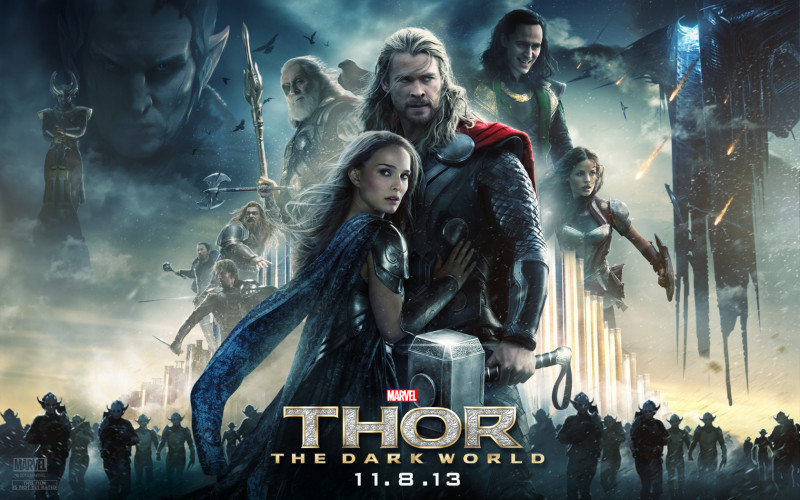
Thor: The Dark World review


              I think it’s fair to say that Marvel’s “Thor”, released in 2011, was nobody’s favorite predecessor to Joss Whedon’s “The Avengers”. This isn’t to say that nobody loved it at all. In fact, despite the overall silliness and camp that comes with rainbow roads, frost giants, and Natalie Portman playing an astrophysicist, the first “Thor” is a totally digestible, zero-calorie, superhero meal. Also, if nothing else, we got Chris Hemsworth and Tom Hiddleston out it.
                With that said, I wish I could I share the same kind of tepid enthusiasm for the recently released sequel. “Thor: The Dark World” is a decidedly slower, longer, and darker follow-up, that mistakenly shrouds the first film’s bright-eyed simplicity within a cocoon of narrative padding.
                After the cataclysmic events of “The Avengers”, Thor’s deceitful brother Loki (Tom Hiddleston) is captured and imprisoned back from wince he came on Asgard. While there, a fleet of dark space elves—just go with me—come to attack Odin’s throne to reclaim the power of a mystical red goo called The Ether, that has recently taken shelter in the body of Dr. Jane Foster (Natalie Portman). In order to keep the nine realms of the universe from being overtaken by darkness, Thor (Chris Hemsworth) must break his mischievous brother out of jail, and learn to trust him long enough fight together, side by side.
                Let me first say that, technically speaking, there isn’t anything ‘wrong’ with this movie. The special effects are big and expensive looking, the London location change is welcomed, the space-fantasy production design is inventive and imposing, and the action structure of the plot pays off in exactly the way it promises to from the opening prologue. My problems with this sequel lie within its vagueness, its self-seriousness, and its overall I-can’t-believe-we’re-getting-away-with-this-again safeness.
                The ruggedly handsome Hemsworth is half asleep in this reprise and even though this is supposedly his showcase, the film seems far more interested in Hiddleston’s sneering Loki character. The interplay between these two actors is occasionally engaging when the movie is remembers to be character-centric, but unfortunately the majority of the running time is devoted to red floating liquids, space battles, and overcomplicated conceits about intergalactic, warping car-keys.  There is some genuine fun to be had in the last half hour, but the cumbersome plot is so large and looming that whatever levity and charm saved the first film has now been shoved aside, in favor of the usual epic, action money-shots.
                I will commend the new screenwriters for finding a better way to integrate the human, non-super, characters (Portman, Kat Dennings, and Stellan Skarsgard) into the story, but even though they are given more to do, it doesn’t keep them from feeling any less like a mechanical writing device.
                I don’t know, this is all starting to feel like tired roadshow act on the last leg of a lengthy tour. I guess if you walk into this film wanting to like it you probably will. It’s been carefully designed to be placeholder until the Disney/Marvel factory spits out another one of these in five months.  However, when we’re living in a time with four or more superhero movies released every year, I refuse to simply excuse a film like this for being merely ‘fine’.

Grade: C-

Originally published in the Idaho State Journal/Nov-2013

Monday, November 11, 2013

Enders Game review


               Science fiction writer Orson Scott Card has made it difficult to objectively review the film adaptation of his most popular novel, despite the fact that as a fan of the source material I have wanted to see this story on the big screen ever since I was a teenager. However, I would be lying if I said that Card’s vocal homophobia and public prejudices hasn’t somewhat soured my memory of “Enders Game”.  But even with my personal morals and sensitivities in the contextual air, I tried to walk into this film with an open mind. And with that loaded caveat aside, I am happy to say that this is an absolutely enjoyable science fiction adventure, in spite of the narrow mind who conceived it.
                Many of the details from this book have since left my memory, so luckily I was not burdened with the fanboy comparison complex—perhaps aiding in my overall enjoyment of this movie. What I can say is that it certainly captures the idealistic spirit and the innocent curiosity of the novel, vividly recreating the key moments of the drama that I remembered from the text.  
                In the distant future, after the earth’s population is greatly depleted by a brutal alien invasion, humanity’s finest military gears up for a second wave of attack, sending forces of jarhead teenagers to the enemy planet before they can strike again.  Ender Wiggins (Asa Butterfeild), a scarily intelligent, pre-teen loner, is drafted in to study and train at an out-of-orbit military academy, where he is told by his commanding officers (Harrison Ford and Viola Davis) that he will eventually lead the other children in earth’s victor.
                “Enders Game” has the advantage of coming out after a wave of successful adaptations of young-adult fiction. With “Harry Potter” and “Twilight” still in our rear view, and “Hunger Games”  working hard to fill the void, this classy, unassuming  heroes’ tale successfully projects its narrative ambitions onto the tried and tested formulas that precede it without it feeling like a rip-off or an off-brand.  Yes it’s another ‘chosen-one’ myth, and yes it involves a silly looking, made-up sport with complicated rules, but director Gavin Hood knows exactly how to pitch its tone and, more crucially, he and his writers understand that just because they’re making a film for a younger audience it doesn’t mean that kids aren’t smart or patient enough to understand complex characters or sophisticated themes.
                Asa Butterfeild, the young lead who viewers might remember from Martin Scorsese’s “Hugo”, has a lot working against him as an actor. Given that his character could be read as a noble know-it-all or a dull cypher, both the script and his sensitive performance allows the character to have enough inner conflict and personality to let Ender to breath and change within the story. The side performances by the other children—Hailey Steinfeld as Petra and Aramis Knight as Bean—lacks the same amount of depth or definition, but their role within the plot functions efficiently and without distraction nonetheless.
                One could complain that as an effects-driven film not every green-screen or CGI moment is well camouflaged or invisibly integrated. Yet, because of the consistent art direction and the deliberate, symmetrical cinematography the special effects never feel out of place or showy for their own sake.  With that said, there is certainly enough wow and wonder in the visual execution to keep both the kids and their parents anxiously chewing on their pop-corn.
                “Enders Game” may not be a perfect film, but it’s about as perfect of an adaptation of its novel as we could have hoped for.  And what’s more, it actually tells a story about something Mr. Card has seemed to have forgotten; sympathy, tolerance, and dangers of demonizing ‘the other’.

Grade: B+

Originally published in the Idaho State Journal/Nov-2013

Sunday, November 3, 2013

The Counselor review


             It’s a shame about Ridley Scott. He is, without a doubt, a very talented filmmaker and you can’t deny his skill as a stylist. In fact, I dare say that as far as visual aesthetics go, film for film, he is almost unparalleled.  Unfortunately, within the last 10 years or so, his work has been marred by bad screenplays and theatrical assemblies that edit his films to the point of incoherence.  “The Counselor”, another south-west noir penned by novelist Cormack McCarthy, suffers greatly from an overwritten screenplay and campy performances that overshadow the obvious talent that Scott tries to bring to the film.
                It’s hard not to watch this and compare it to Cormack’s near-perfect adaptation in the Coen Brother’s Oscar winning “No Country for Old Men”.  The set-up is similar and the pay off—though not effectively delivered in “The Counselor”—aims to please and depress the audience in the same way. But whereas the Coens were able to reduce the source novel to its essentials and tell the story in hauntingly sparse visual terms—choosing only key scenes to include McCarthy’s elusive prose—in this film, with Cormack now in charge of his first screenplay, a power imbalance muddles the storytelling, where his words and murky themes dominate the screen.
                The unnamed Counselor, played by the always watchable Michael Fassbender, is a lawyer who has recently become engaged to his dutiful girlfriend Laura (Penelope Cruz). To help fulfill her fantasies of wealth, the counselor decides to aid in an across-the-border drug deal with a flamboyant dealer (Javier Bardem) and his lethal cat-like lover (Cameron Diaz). In doing so, the lawyer gets lost  in a shadowy maze of deceit and murder and--as is usually the case--learns that crime never pays. Somewhere in all of this, Brad Pitt stops by to recite pages of uninteresting metaphors, Rosie Perez has a psychic link with her motorcycling drug-mule son and Cameron Diaz does an X-rated reenactment of Tawny Kitaen’s hood-of-the-car dance from Whitesnake’s “Here I Go Again” music video.
                In trying to fit a novel's worth of information in a two hour film, though not based on any of his previous work, McCarthy fills this script with endless dialogue set-pieces that weigh the movie down so much that it never seems to budge from scene to scene. The actors are all there to present their best work and it's clear in every scene that everyone is certainly trying. However, with Cameron as the vampy femme fatale—complete with pet cheetahs and silver claw-like fingernails—and with Bardem turning in another one of his crazy hair-cut performances, these pulpy elements jarringly clang against the dower moralizing of the plot and Scott's vista-laden visual design.
                I really wanted to like this film and I don’t fault it for being too weird or arty, but, in the end, this well-intentioned thriller is an insufferable snooze.  Michael Fassbender and Brad Pit, two of Hollywood’s most interesting actors, share several scenes together and yet here they couldn’t be more boring. The dialogue is stylized to the point of droning into a fuzzy static and McCarthy’s themes are somehow clumsily obvious and frustrating unclear at the same time. 
                Ridley Scott directs the hell out of this film and successfully makes a junky B-movie look and feel like a portentous A-picture. But even with a few creative decapitations and soft-core sex scenes sprinkled in, he still couldn’t save this inert, convoluted, lukewarm mess of a movie.

Grade: D+

Originally published in the Idaho State Journal/Nov-2013