Showing posts with label Sally Hawkins. Show all posts

Sunday, February 4, 2018

Paddington 2 review

Many adults were pleasantly surprised when 2014’s live-action adaptation of "Paddington" turned out to be watchable. Given that most of the animated properties of our past that are revamped into live action/animation hybrids (ala  "Smurfs,” “Garfield,” “Chipmunks") are usually mind-numbingly obnoxious, the warmth and wit of Paul King’s "Paddington" films have become a healthy change in the kid-vid diet. “Paddington 2” manages to improve on the previous entry by grounding the visual gags more effectively in storytelling while also managing to be even more ambitious when it comes to its many Rube Goldberg-esque action sequences.

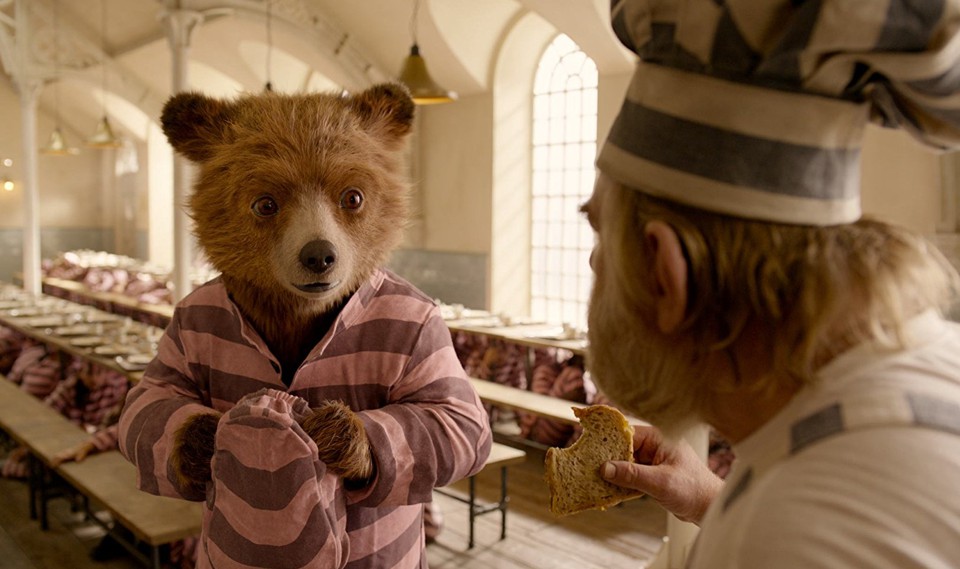
Here King and his co-writer Simon Farnaby simplify the plot by focusing on a few tangible goals for the characters. Paddington (voiced by Ben Wishaw) wants to buy an antique pop-up book about London for his dear aunt Lucy who’s still living as a cultured bear in Peru. Things go wrong when our cuddly protagonist is framed for the robbery of the book by an actor/vaudevillian/magician named Phoenix Buchanan (Hugh Grant), who happens lives down the street from Paddington’s adopted family. After the polite and naive bear is sent to prison, he has to convince his family to prove his innocents while also doing his best to make friends with the other hardened inmates.

Paddington is a believable character because the animation that brings him to life is surrounded by terrific actors who are as naturally animated in their expressions. Irish tough-guy Brendan Gleeson as the prison chef Knuckles pulls faces in the camera that shouldn’t work as broadly applied as they are, but somehow they do. Hugh Bonneville and Sally Hawkins are given more to do in the plot this time other than arguing whether or not they want to keep a clumsy bear in their attic, and by giving them more proactive roles they have more weight in the plot. Grant as the vein and foppish villain is camping it up with zero abandon, but King’s control of the movie's tone keeps every wild gesture and zippy one-liner contained in the context of our hero’s journey.

This installment of weaves together the title character’s mission through a series of creative and wildly visual set-pieces, such as the robbery of the antique store, a window washing montage and the many exploits of Hugh Grant’s master-of-disguise sleuthing. The film also indulges many beautiful sequences that imagines Paddington’s London as a flipbook come to life.  This is 3D cinema accomplished without the need for the annoying glasses and these sequences successfully welds together the CGI character with his modern, live-action environments. There are a few set-pieces that register as stock or somewhat familiar, such as a prison escape sequence that involves a laundry hamper and a final battle on a steam train. Neither of these scenes is executed poorly, though they lean into their clichés rather than subverting them. But hey, this is a picture about a talking bear that’s obsessed orange marmalade, so…

King obviously has a vision for this silly franchise and his ear for dry comedic dialogue, combined with a creative visual sense and big heart for his characters elevates this experience beyond its base expectations as an electric babysitter.  It’s only a shame that content geared towards children has become so dumbed down and so cynical that a movie as effortlessly positive and crowd-pleasing as "Paddington 2" has become the exception to the rule.

Grade: B+

Originally Published in the Idaho State Journal/Jan-2018

Sunday, December 17, 2017

The Shape of Water review

Mexican born filmmaker Guillermo Del Toro is fascinated by the idea that people are often drawn to what initially scares them, usually only because they fundamentally misunderstand themselves and the greater context of their own fears. As such, his films--both indie darlings like “Pan’s Labyrinth” and “The Devil’s Backbone,” as well as studio blockbusters like “Pacific Rim” and “Hellboy"--are chock full of interesting and intricately designed monsters. As a visual artist and a storyteller Del Toro loves his monsters and for him, they always represent a complex emotional truth about the nature of humanity. With his latest film, “The Shape of Water,” the balance between his directorial compassion and his genre obsessions is blended delicately into a contemporary “Beauty and Beast” style narrative, with a central focus on diversity, tolerance, and equality.

The story is set in the cold-war 1960s at the height of the red scare. Sally Hawkins plays Elisa Esposito, a mute janitor who cleans a secret government science compound. Things get interesting when an amphibious humanoid merman is captured from his underwater home in South America and brought into the facility to be studied. Some of the scientists wish to keep him alive to understand his capability to learn, and others, like the stone-faced, military-minded Richard Strickland (Michael Shannon), plan to dissect the creature to develop new science to use against their Russian enemies. Hawkins secret friendship and eventual romance with the amphibious man leads to a rescue effort that involves co-worker Zelda (Octavia Spencer), the sympathetic Dr. Hoffstetler (Michael Stuhlbarg), and her graphic designer neighbor Giles (Richard Jenkins).

Given the time period this movie is set and the basic structure of the plot, it would have been easy to allow a story of this kind of coast of genre expectations alone. What makes the film stand out from being yet another high-concept take on “E.T” or “Free Willy” is Del Toro’s willingness to dig deep into a psychology of his characters and their worldview. The film's theme of what it is to be ostracized as a minority dominates and naturalizes the fantasy.  Hawkins’ character is mute, Spencer is black, and they both work as women in a government-industry dominated by white men. Likewise, Jenkins plays a closeted gay man, and it’s the unified ‘other-ness’ of this grouping of minorities that is manifested through the struggle of this abused and imprisoned merman. As we see the civil rights struggle in the background of this story, it becomes all the more evident that the creature's rescue becomes their rescue. 

The central love story between Elisa and this mysterious being, played with wonderful physicality by Doug Jones, takes risks and goes beyond the usual slow build to acceptance and eventual affection. Hawkins’ wordless performance strips away the possibility for coyness or coded language when it comes to all of her emotions and as the story progresses their love is expressed both emotionally and physically. This, along with Guillermo’s biting sense of humor, and the occasional jolts of visceral violence may alienate some audience members, but even if this is too weird for you to swallow, it’s difficult to deny the movie’s bold commitment to its premise.

Everyone already knows that Del Toro is Hollywood's current king of creature design and art direction. “The Shape of Water” is no exception. However, by putting his focus on one central creature, instead of a smorgasbord of weird looking monsters we are usually treated to in one of his previous films, he is able to dig deeper into the wider human world his characters inhabit. The 60s sets are well lit and creatively designed and the “Creature From The Black Lagoon” inspired look of Jones’ costume is textured and utterly believable, but it's Del Toro’s capacity to empathize with these characters and ground this world into an emotional reality that elevates this movie beyond its fairytale tropes and trappings.

Grade: A

Originally Published in the Idaho State Journal/Dec-2017

Listen to this episode of Jabber and the Drone to hear more conversation about "The Shape of Water"