Monday, June 3, 2013

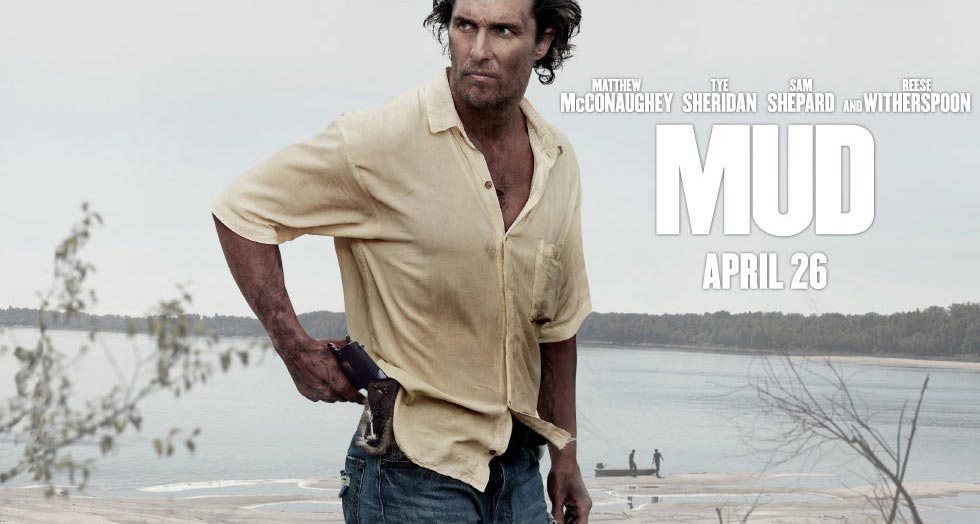
Mud review


             It wasn’t that long ago when Mathew McConaughey was that bottle-tanned, oiled up, slick-back-haired, smug asshole in all of those bad romantic comedies. He was easy to hate. His acting was lazy, his accent was obnoxious, and his movies were terrible. But even at his worst, when he was always seen leaning against his female co-stars in the posters of those soul-sucking rom-coms, we had to remember that first performance in “Dazed in Confused”,  where he practically stole the entire movie as a stoned, post-high school graduate, who was equally sleazy and charming. There was something there and part of us knew that he should and probably could be much better than he was allowing himself to be.
                Some actors aren’t meant to universally liked and in the case of McConauhey, he seems to support a story better when he is either transgressing his rugged good looks or using them to mask his character’s true motivations. In the last few years we have seen him really go against the grain of his People-Magazine-Sexiest-Man-of-the-Year phase in favor of playing smaller, darker, more challenging roles in artist driven movies like “Magic Mike” as the pathetic aging strip-club owner,  the sexually dangerous hit-man in the NC-17 “Killer Joe” and now as a hobo with a shrouded past in “Mud”.
                Not unlike a modern day Huck Fin story, this film tells the tale of two southern fourteen year olds who live in the rural riverside of small-town Arkansas.  Even though Ellis (Tye Sheridan) is the more passive of the two, it is his personal journey that is used to tell this coming of age tale. When his best friend Neckbone (Jacob Lofland) takes him out to a small piece of river-island to show him an abandoned fishing boat in a tree, it doesn’t take long for them to both realize that someone else is occupying their would-be fort.
                McConaughey shows up as Mud, a friendly but nonetheless intimidating hobo. With plans to get back in contact with his ex-girlfriend Juniper (Reese Witherspoon), he ropes both kids into bringing him some food and supplies while he dodges the law in the wilderness.
                As Ellis works on getting Mud and Juniper to reconcile, he is also dealing with his parents’ divorce, losing his childhood home, and experiencing his own teenage flirtations with a local girl, a few grades above him. What I love about this film and what makes it a truly involving story is that it’s essentially a tale of what love means to the eyes of the impressionable—reminding us that first loves are also followed by first disappointments. It’s a moody picture full of dark suggestions and shady undercurrents—as experienced through the bathless underprivileged of the south—but at its core it is an unabashedly romantic film about the best intentions of humanity and it proudly wears it’s broken heart on its sleeve.
                The warm and tender tone established by writer/director Jeff Nichols, serves to support his actors and their performances with a somewhat detached but sympathetic camera style. Sheridan and Lofland, the two unknown teenage actors who play the leads in this film, are both outstanding. Like the children portrayed in older post-Spielberg movies such as “Stand by Me”, “Goonies”, and “The Sandlot”, these characters talk and reason like real pre-teens; they curse, they hyperbolize and they lie when they think it’s for a good cause or when they’re trying to get out of tight spot.  
                McCongauhey as the title character again finds a difficult balance to strike, as he must present himself as sketchy, amiable, funny, and possibly violent all at the same time. Because he has now played both extremes in the spectrum of his skillsets—everything from psychotically scary to scarily uncharismatic—he knows exactly where to place this character, by drawing the audience on his side with healthy reservations.
                “Mud” isn’t perfect but it’s pretty damn close. Sure, it’s about fifteen minutes too long and the third act stumbles into preposterous shoot-outs and some disappointing culminations in the plot but even those things can’t detract from how subtly powerful, thoughtfully written and skillfully made this movie usually is.  

Grade: B+

Originally published in The Basic Alternative/June-2013

Sunday, May 26, 2013

Star Trek Into Darkness review


               Back in 2009, when popular television producer J.J. Abrams rebooted “Star Trek”, he simultaneously did what many have never been able do before; successfully make “Star Trek” relevant to the youthful uninitiated again, tie in the original franchise in a clever way that kept his film from feeling like a cynical wiping of the slate, and most of all, he was able to bridge the lifelong chasm between the Trekkies and “Star Wars” fans.
                Of course not everyone was happy with J.J’s vision of Gene Roddenberry’s sci-fi dream of the future. The action was ramped up, the actors were cast to be younger and better looking, and the focus was now shifted from socio-political ideas to character quirks and their humorous interactions. These changes were not unnoticed and not only have some die-hard fans turned their backs on this reboot, but it has also been recently announced that Abrams will be helming the upcoming “Star Wars” semi-sequel.
                With this year's release of “Star Trek into Darkness” Abrams returns without reservation to the world he established in 2009 and the minority of fans who have been cursing his involvement—probably in Klingon—won’t find any reason  to be interested in this film either, as it is even more exciting and risk taking than it’s predecessor.
                Following the events of the first film, James T. Kirk (Chris Pine) who has been hastily demoted from Captain of the Enterprise, due to his unorthodox methods, is awaiting confirmation of a five year exploration mission, when he is told that he can only join again under the supervision of his superiors. Before they even take off, a mysterious terrorist (Benedict Cumberbatch) begins to enacts random bombings at Starfleet headquarters.  Kirk and his crew are then sent out to capture or kill this man as he is hiding in enemy territory.  All the while, Spock (Zachary Quinto) and Uhura (Zoe Saldana) are having relationship issues and Kirk has to prove himself to be a responsible Captain.
                Like I have already stated, this is a very consistent sequel with what Abrams has put into motion four years ago. In fact it is so consistent that I found it hard to believe it had been that long since the last movie came out.  The actors comfortably slide right back into position and their chemistry is never obscured or lost. Considering how much of this film is wall to wall action spectacle, Abrams knows when the slow things down and breathe with his cast and let them charm the audience on their side.  Because we care so much for these guys, when they are later put into amazing feats of peril, we clench the arms of our seats, totally invested in their outcome.  
                More so than any other Trek movie in cannon, this is an action film through and through. The construction of the plot is designed for flashy, effects-driven, set –pieces and the plot reveals push the drama into tighter situations that the crew has to get themselves out of. Sometimes these scenes have a tendency to over-climax, but never to the point of seriously compromising the movie as a whole.
                 In some ways, the form of this film seems to be a response to the colossal success of recent superhero stuff. In fact, Cumberbatch as the villain is not unlike The Joker, Loki in “The Avengers” or even Ben Kingsley’s Mandarin in  “Iron Man 3”.
                I guess I can sympathize a little with the aged Trekkies who have to come to terms with the fact that Abrams has infused “Star Trek” with something that is tonally closer to its space-fantasy competitors—which leads one to wonder; how he will be able to do “Star Wars” better than he has already done here?  Regardless, whatever it is, “Star Trek into Darkness” sets the bar commendably high for genre entertainment this summer.

Grade: A-

Originally published in the Idaho State Journal/May-2013

Sunday, May 19, 2013

The Great Gatsby review


               After almost 20 years, Baz Luhrmann, the Australian director of poppy, post-modern mash-ups like “Romeo + Juliet” and “Moulin Rouge”, has now reteamed with Leonardo DiCaprio, who was essentially rocketed to stardom after playing Romeo in 1995. Here, DiCaprio plays another obsessive idealist who just doesn’t know when to butt out of other peoples relationships. Also, like Baz’s previous work, this 3D adaptation of F. Scott Fitzgeral’s beloved novel “The Great Gatsby”, is a big and brassy statement that includes this director’s usual hyperactive camera work, anachronistic music choices and lots and lots of glitter.
                Toby McGuier plays the film’s narrator Nick Carraway. As an obvious framing device his character is encouraged to type the story as a therapeutic way of dealing with his past. Through him we see the story develop from his perspective. We see how he befriends the mysterious Jay Gatsby (Leo DiCaprio) and how he tries to help him reconnect with his past-lover Daisy (Carey Mulligan), who is now married to be macho Tom Buchanan (Joel Edgerton). Within his gaze we see how Carraway looks up to Gatsby; how he admires his wealth, his adventurous life, his bacchanalian parties and even his masculine beauty. Of course once he manages to get Gatsby and Daisy together things don’t quite go as well as planned and tensions rise within the group.
                Like usual, Baz Luhrmann decides to go with a more -is-more stylistic approach to the source material. Tapping into the mythic roaring 20’s of its time period, Luhrmann draws connections between the pre-depression debaucheries of the upper-class with the more current, flamboyant hip-hop projections of wealth. Jay-Z, hired to produce the soundtrack, adds a lot of rap and dance music to the background score. Some might see this as a problem, but weirdly, with the rags to riches story of the central character and the mo-money-mo-problems message of the film, the soundtrack makes odd sense. 
                Visually this film is audacious and aggressive. The sets are big, the cinematography is bold, and the colors are crisp and consciously used. The early party scenes in particular are wildly shot and with the bizarre soundtrack accompanying, there’s almost a hypnotic quality to first half of this pop-art movie. Unfortunately, when the story has to come back up for air and the characters begin to talk to each other and the melodrama takes center stage, the fissures in Luhrmann’s abilities begin to widen.
                Much of the second half of the movie never quite lives up to the brash promise made in the establishing scenes. Leo is great as Gatsby (sorry for that pun) as he can interchange from mysterious, to surprised, to impassioned and pathetic, all at the same time. However, nobody else seems to be taking their parts as seriously. Mulligan and Edgerton, who are usually much better than this, are both distractingly over-affected and one dimensional.  McGuire, as the avatar for the audience to enter this story, is especially flat and underdeveloped. His part in particular is much more crucial towards the overall effectiveness of the movie and that ends up being the ball that’s dropped the hardest.  
                This movie looks great and as a piece of visual art it’s worth the money spent to see it blown up on the big screen. It is made from a singular creative viewpoint and like a hip-hop song, Luhrmann knows how to mix and sample ideas like Jazz culture, burlesque, 3D, and Mtv music videos. But because he is more interested in conceptual surfaces than he is his actors the emotional impact of Fitzgerald’s story never really hits as hard as we know it should.

Grade: C+

Originally published in the Idaho State Journal/May-2013

Sunday, May 12, 2013

Iron Man 3 review


                It’s finally summer! You want to know how I can tell? It's not because the trees are blooming, not because the flowers have blossomed, and not even because everyone is firing up their barbeques. Within the last five or six years we have been able to accurately mark the beginning of summertime with the first big superhero blockbuster release of the year. Kicking off this season, we have just been treated to the newest addition of the Marvel production line, “Iron Man 3”.
                Generating a gazillion dollars with last year’s “The Avengers”,  Marvel Studios –now owned in part by Disney—is ready to begin what they are calling phase-two of their machine. By creating a multi-stranded franchise universe, they have been able to release films like they would with separate issues of their comic books. We have the origin stories, sequel adventures, and one very profitable crossover event. This strange and ambitious model has been made possible because of the initial success and appeal of the first “Iron Man” movie back in 2008. And in part, that film—based on a lesser-known, B-hero at best—may have not been the game-changer it was had it not been for the brilliant casting of everyone’s favorite recovery story, Robert Downy Jr.
                Following the events of “The Avengers”, Tony Start/Iron Man (Downy Jr.), is now dealing with post-traumatic stress disorder due to of his near-death, world saving experiences. Because he can’t sleep he spends his nights awake modifying his high tech armors and building new ones; even some he can control without wearing. Meanwhile a new terrorist called The Mandarin (Sir. Ben Kingsley), has been bombing isolated targets and when Tony’s bodyguard gets caught in the crossfire, he invites the villain to take part in an all-out war on his turf.  Meanwhile, meanwhile, an old science colleague of our hero named Aldrich Killian (Guy Peirce) is working on a regenerative technology that may a may not be shady.  
                …Oh and also, Stark’s lover Pepper Pots (Gwyneth Paltrow) gets kidnapped, Don Cheadle as War Machine has now become a government owned mercenary called the Iron Patriot, and for some reason it all takes place during Christmas.
                Unlike the other two “Iron Man” films, this addition is a lot less afraid to adhere to the traditional superhero framework.  Tony spends much of the picture out of costume and without the tech that gives him his powers. Perhaps inspired some by the tortured, reluctant hero motifs of Christopher Nolan’s “Dark Knight” movies, “Iron Man 3” seems to be much more interested in pushing this character into new emotional and procedural obstacles by taking everything away from him and seeing how he is able to build himself back up. This makes for a very original and idiosyncratic hero flick but one that might confuse or frustrate the usual Marvel fanboys.
                With three too many side characters, two too many subplots and an overlong, sagging middle act, at two hours and twenty minutes the movie can’t help but feel more than a little labored and unwieldy.  In trading director John Favreau for “Lethal Weapon” writer Shane Black, this sequel seems to shove the big action spectacle aside for a more actor-friendly, performance oriented movie. But because Disney paid big bucks for this thing, it still has to ring all those superhero bells too, and what results is a sometimes exciting, sometimes quite funny, but ultimately muddled experience. 
                Of course, even while the storytelling is episodic, the pacing is inconsistent, and the reveals are deflating—or in some cases, just flat-out lame— what keeps you going is the fact that Tony Stark is an interesting character and with the addition of Shane Black’s fantastic dialogue, performed by the always entertaining Robert Downy Jr., you don’t mind walking the meandering trail from point-A to point-B.

Grade: B - 

Originally published in the Idaho State Journal/May-2013

Sunday, May 5, 2013

Pain and Gain review


                Is it possible to almost hate and love a movie at the same time? Apparently it is because when I came home from “Pain and Gain”, I felt altogether entertained, disgusted, shocked, and offended. But I definitely got my money’s worth.
                Like many other movie goers, I was surprised to hear—after releasing a succession of massively over-budgeted blockbusters like “Pearl Harbor”,  “Armageddon”,  and “Transformers”—that director Michael Bay was going to release a relatively lower budget crime-comedy that’s R rated and not necessarily aiming for the widest possible audience. Having been burned in the past by his particular brand of assaultive, arrogant, cash-grabbing nonsense, Bay’s hyper-edited, pixie-sticks-and-gun-powder aesthetic has left me cautious of whatever else he might inflict. However, I am comfortable enough in my tastes to admit that he has entertained me before (“The Rock”) and it looked like this new movie was exactly the kind of enema he needed after squandering the last decade with soulless giant robot pictures.
                Supposedly based on a 1995 true story, “Pain and Gain” stars Mark Wahlberg as a Daniel Lugo, an ambitious Miami bodybuilder, who after getting fed up with his average life, decides to bring in his two muscleheaded friends (Dwayne Johnson, and Anthony Mackie) to kidnap and extort a well-to-do deli franchise owner (Monk’s Tony Shalhoub).  When the plan goes horribly wrong and a police investigation gives way, the plot then begins to splinter into progressively darker, aggressive, and morbidly twisted avenues—including cocaine, Christianity, plastic surgery, and dismemberment.
                There has always been an underlying nastiness in much of Michael Bay’s previous work.  Often his movies seem to breezily embrace out of touch racial stereotypes, unsettling homophobia, and overt misogyny. Whereas before this sneering tone was always in the undercurrent of his all-ages fare, in this hard-R rated crime caper, it becomes set and center of the moral stage in which the characters inhabit. The hate and cynicism of this movie burns through every scene, with every female shot and dressed to look like a stripper, unfunny fat-shaming, startling anti-Semitism, and reoccurring gay-bashing—curiously juxtaposed with (unintentional?) homoerotic imagery. All of this is inexcusable…But…
                There is something refreshingly pure and unfiltered about the deliberate offensive nature of this movie. Because this story is told through the revolving voice overs of its unsympathetic and unreliable narrators, Bay’s usual distasteful behavior twists into a kind of mirror for him to look and reflect on his past attitudes and what they are really about. I can’t say that any of those contradictions are ever resolved and the movie is still thematically suspect at best, but it makes for an honest and interesting self-realized, almost-satire that deserves to be closely observed by both its director and the audience.
                Logistically the narrative suffers a bit from over-stylization and incomprehensible editing. The constant change-over between interior monologues get distracting, the timeline is rushed in places where the story would serve to simmer and refocus, and the character’s motivations seem more dictated by structural shifts in the plot and the comedic beats that need to be hit. Without a doubt, this movie is a mess. However, it’s the imperfections and sloppiness of “Pain and Gain” that kind of gives it the scrappy personality I admire. Dwayne Johnson and Wahlberg both give very charismatic performances and the whole things moves with a lot of primitive energy.
                With a sense of raggedy punk-rock expression, Bay throws everything and the kitchen sink at the wall and when something doesn’t stick, he nails it in place. Though I can’t say with total honestly that I liked everything in “Pain and Gain” I can say that for the first time ever this filmmaker has finally made something from his rotten heart.


Grade: C

Originally published in the Idaho State Journal/May-2013