Friday, June 1, 2012

Men In Black III review


                 How many weekends does it take to displace “The Avengers” from the box-office top spot? It takes three apparently. It would seem that everyone has now seen Marvels mightiest superheroes defend the world enough times and are actively seeking something (maybe anything) else. Could “Men in Black 3” have won its weekend due to any real anticipation or public interest? Sure people like Will Smith, but “MIB” is a largely forgotten franchise, and director Barry Sonnenfeld really hasn’t had a memorable hit since the first installment back in 1997. The following sequel in 2002 did well enough commercially, but was largely seen as a disappointment. Ever since, Sonnenfeld has been slumming around in the worlds of television production and middling comedies like “RV” and “Big Trouble”.   Regardless, here we are in 2012 and we have yet another galaxy defending crusade, led by the unlikely duo of Will Smith as Agent-J and Tommy Lee Jones (kind of) as Agent-K.
                The plot of “Men In Black 3” (or cubed) deals mainly with the conceit of time travel and alternate paradoxical realities, not too unlike the plot of “Back to the Future II” or basically anything from television’s “Doctor Who”. After a violent alien criminal known as Boris the Animal escapes from a moon prison, he immediately seeks revenge on Agent-K. After an initial battle where Boris, played by “Flight of the Conchords” actor/musician/comedian Jermaine Clement, eludes the MIB, Agent-J wakes up to find that he now lives in an alternate reality in which K was defeated by Boris back in 1969--when before the paradox, he was originally imprisoned.  J then embarks on a secret mission to travel back to 1969, where he must find and kill Boris before he terminates the 29 year old K, now played by Josh Brolin.
                As with many of these late-in-the-game franchise re-launch’s, this feels less like a sincere creative effort and more like a frantic studio cash-grab. The first half of the movie is introducing us to everything we remember from the first two; the characters, the gizmo’s and of course the aliens, but unlike the first installment where there was a true sense of wonder and enthusiasm, this sequel feels a bit desperate, overreaching and ultimately over-polished. The second half rewards a bit more but not without a hefty amount eye rolling and flat attempts at hackneyed humor.
                Like “MIB II” this movie is more about effects driven sight-gags and less about the characters. Here we see Will Smith doing his familiar, smart-alecky Fresh Prince act. Knowing that he is nearly fifty years old and having seen him in much more weighty projects since, such as “Pursuit of Happiness” and “Ali”, this feels like a significant step backwards. Tommy Lee Jones has lost all interest in this character and instead seems to be doing a lazily rehearsed version of himself.  Josh Brolin looks like he’s having a lot of fun doing a very impressive Jones impression, but in the end that’s all it really is, a hollow impersonation. Jermaine Clement is so straddled by his make-up and CGI that he barely gets to do what he does best, and unfortunately the writing for his character doesn’t play to his strengths as a subtly eccentric comedian. I dare say the only legitimate performance in this movie is given by Michael Stuhlbarg as an omniscient alien—whose plot purpose is basically written in for expository reasons, but regardless he makes it into something strange and memorable.
                “Men in Black 3” isn’t great on many levels. The plot is convoluted, the characters and their chemistry are tired, and the special effects are showy and oftentimes downright hokey. Most of all, it doesn’t seem to have that same kind of dark comedic bite that the firsts one had. However, with all of that said, this movie won’t offend you either. It simply just is (think “Pirates of the Caribbean: On Stranger Tides”). It hits all of its intended genre-marks and delivers enough moments of quirk and whimsy that you won’t get bored, even if a day or an hour later you don’t remember anything about it.   

Grade: C-

Originally published in The Basic Alternative/June-2012

Friday, May 4, 2012

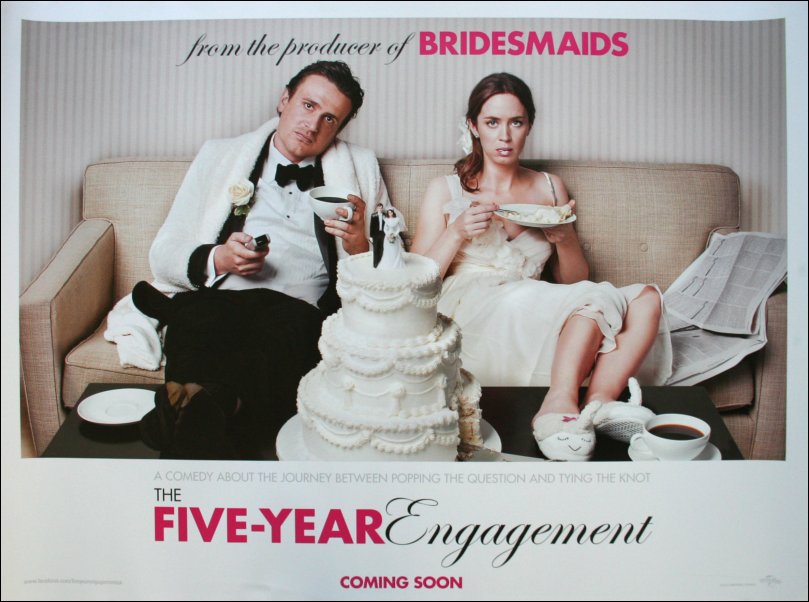
The Five-Year Engagement review


                When it comes to falling in love timing is everything. We have learned this through years of romantic comedies like “When Harry Met Sally”, “Manhattan”, and most recently in “The Five-Year Engagement”. Produced by the prolific Judd Apatow, this film is the follow up effort of director Nicolas Stoller and co-writer Jason Segal, the creators of 2008’s “Forgetting Sarah Marshal”. In this film Segal and Stoller bring us another forlorn tale of love gone astray, brought to us in that sometimes comfortably familiar, sometimes tired, comedic-slacker perspective.
                Jason Segel and Emily Blunt play Tom and Violet, a young and enthusiastic couple who have just become engaged.  While planning their wedding in their home city of San Francisco, life throws them a curveball when Violet is accepted into an academic psychology program in Minnesota. Being supportive, Tom quits his job as the assistant chef of one of Frisco’s hottest restaurants and follows his fiancés dream into the cold, cultureless Midwest, where the best job he can land is at a college sandwich deli. This of course delays the wedding, and as they plan on getting things back on track newer obstacles such as promotions, pregnancies, and family deaths keeps pushing their matrimonial hiatus further and further away from the foreseeable future. 
                “The Five-Year Engagement” tries to balance the high concept laughs with the crude and crass, while still trying to retain a warm heart for its characters and their plight.  Segel’s script commendably rounds out both the male and female protagonists and gives them both ample motivations for their behavior. This same script is also unstructured, undisciplined, sloppy, and at times over indulgent. Scenes drag on too long, many jokes are only peppered in to create comedy where it didn’t exist, and entire subplots should have cut out altogether. What results is a flabby five act comedy where you will feel every single minute of every year of their engagement.
                Luckily the cast is great. Segel and Blunt have very believable chemistry, and while you might be literally begging the movie to end at times, on the strength of their authentic charm you root for their relationship. The side performances from Brian Posehn, Chris Pratt, Jacki Weaver, and Rhys Ifans often steal the scenes they are in—sometimes to the movie’s detriment. In fact Jason Segel’s gift as a writer may be in his peripheral characters (as exemplified by Russell Brand who stole every scene from “Forgetting Sarah Marshall”).  As per-usual Jason Segel seems to be playing Jason Segel. And after “Freaks and Geeks”, “Sarah Marshall”, “How I Met Your Mother”, and “Jeff Who Lives at Home”, I really need him to quit playing the lovable and goofy tall guy who just can’t catch a break. In his next film if he isn’t playing either a drug addict or a child molester I may scream in my theater seat.
                What’s most disappointing about “The Five-Year Engagement” is that I strongly believe there is a 90 minute cut somewhere in there that works. Here is a film that could have been saved by good editing, but because everyone involved in a Judd Apatow production seems to have final cut, we are left with a labored mess of a film. Though there are well-done individual scenes, stand out performances and great exchanges of dialogue, they are trapped like mice in a meandering maze of a plot, where by the time we get to the finish it doesn’t feel like the reward was worth the effort.

Grade: C-

Originally Published in The Basic Alternative/May-2012

Tuesday, May 1, 2012

Cabin in the Woods review


A week before it was released “The Cabin in the Woods” had already boiled up quite a buzz. Premiering at South by Southwest, this film started an early positive campaign from nerds and critics alike. Written by Joss Whedon, creator of TV’s “Buffy: The Vampire Slayer”, “Firefly”, and director of Marvel’s upcoming “The Avengers”, and directed by Drew Goddard, writer of “Cloverfeild” and many episodes of “Lost”, this films fanboy pedigree is something to be distinguished. The few negative reviews there have been have only seemed to give the movie even more attention, as the geek fan-base has fought against these critics as misrepresenting and sometimes outright spoiling the film. So though it might be somewhat difficult, I will try to avoid as many spoilers as possible with this review.
            The film begins with the introduction of five college-aged friends, out to blow off some steam at a cabin…in the woods. The group consists of a blond jock, a shy brainy girl, an extroverted easy girl, a shy brainy dude, and their greasy haired pot-head friend—evocation of the “Scooby Doo” gang may or may not be intentional. After ignoring a warning of doom from a sketchy gas station attendant, they stick with their plan and settle into the creepy cabin for some beer drinking, weed smoking, sexy good fun. Not long after they enter, they notice some peculiar things, like one-way mirrors that have been used to spy on those in the next room, paintings of grotesque murder, and a basement full of ritualistic trinkets and ghostly diaries. Soon, without their knowledge, they unleash an ancient evil, which leads them to discover the sadistic secrets behind “The Cabin in the Woods”.
             If you know your horror movies than this plot should sound suspiciously familiar to the slasher films of the 80s like “Sleepaway Camp” and “Friday the 13th”, as well as Sam Raimi’s ultimate cabin-in-the-woods flick “The Evil Dead”. To just say ‘that’s kind of the point’ would be an understatement. Godard and Whedon wrote everything here to be incredibly self-aware and their screenplay makes many overt attempts to keep the audience conscious that they are watching a clichéd horror film, with an aim to destabilize all of these obvious horror tropes. What comes out of this is a thoughtful and oftentimes very funny post-modern exercise in genre. Throughout we get a picture of the films creators as two geeks who like horror and seem to be having a lot of fun playing around in it. The last twenty five minutes in particular feels a bit like a Halloween spook house mash-up of some of the most satisfying aspects the genre can deliver. 
           Now, is this the first time anyone has ever deconstructed a horror film within a horror film? No.  Back in the 90's one may remember Wes Craven’s “Scream”, a movie that made a specific attempt to address and poke fun at the basic horror movie structure. A few years ago Austrian director Michael Heneke released a home-invader thriller called “Funny Games” in which the screenplay unabashedly shattered the 4th wall. Last year the low budget splatter-comedy “Rubber” also played around with the ideas of the film, the filmmaker and audience (with mixed results for this critic).  But “Cabin in the Woods” seems to find a funny and entertaining way to communicate these ideas without confusing the audience or being pretentious. While the movie might be clever it never feels like homework, and there honestly hasn’t been anything else in theaters this year that made me laugh more.
           With all of that said, there are some aspects about the plot that don’t completely work for me. Without giving anything away, there is a final reveal that involves a strange and tired cameo in which a final showdown seems to redirect the tone into a much more apocalyptic direction. Given the rock and roll atmosphere the movie had up to that point, the ending seemed a bit too grim and ponderous. But nevertheless this movie is a hell of a good time! While you might enjoy everything a bit more if you’re a seasoned horror fan (I for one especially enjoyed the skewering of Japanese ghost movies) you can easily come into this without a point of reference and sit back and enjoy the bloody mayhem.

Grade: B+

Originally published in The Basic Alternative/May-2012

Thursday, April 12, 2012

Jeff Who Lives At Home review


           Writer/directors Jay and Mark Duplass have a keen sense of finding the drama and entertainment value in the most ordinary moments of our life. These brothers have since been growing in popularity and clout since their humble ‘mumblecore’ beginnings. Mark Duplass now has a regular acting gig on FX’s popular fantasy football sit-com “The League” and last year their third film “Cyrus”, starring Jonah Hill and John C. Reilly, earned them the best reviews of their career, expanding their following outside of their Sundance circles. This year they have returned with another meditation of the mundane called “Jeff who Lives at Home”, a dysfunctional family drama disguised as a slacker comedy.
                Jeff, played by Apatow regular Jason Segel, never seems bothered by anything. Some of that is due to the cannabis in which he is constantly sedated, and the rest is due to his strict philosophy that all things are connected and happen for a reason.  The film begins with Jeff talking into a voice recorde, sharing his thoughts on the M. Night Shyamalan film “Signs” and how its themes of destiny and fate had a profound impact on his world view. After receiving what seems to be a wrong number call for someone named Kevin, Jeff embarks on a personal journey to find this mysterious Kevin and discover what he needs to learn from him. Eventually he runs into his brother Pat, played by Hangover/Office star Ed Helms, who is spying on his wife during her lunch date with a coworker, with whom he suspects she is cheating with. Their mother, played by Susan Sarandon, is also trying to solve her own mystery, as she has been receiving love letters and flirtatious Instant Messages from her cubical at work. As the film progresses these plot threads interweave and connect in a somewhat mechanical but occasionally charming way.
What keeps “Jeff who Lives at Home” from being a total eye-roller is the charismatic performances from the very talented cast. Unlike many of the Duplass bros earlier films, this movie seems much more plot driven and the dialogue seems a bit more scripted, though there are certain scenes that have a kind of naturalism and fluidity that suggests long stretches of improvisation between the actors.  Jason Segal is warm and inviting and works very hard get the audience to consider his gonzo faith in synchronicity.  Scenes shared by Ed Helms  and Judy Greer, who plays his wife, show both actors going to very sincere and uncomfortable places, hinting at the type of realism and vulnerability that reminded me a bit of The Duplass’s first film “The Puffy Chair”.  Susan Sarandon’s turn as the lonely working mother is a delightfully uncharacteristic kind of performance that shows that women her age can and should be in more movies.
What lacks is the sense of weight that a movie this small needs. Since the plot is stretched out between these three different characters and their separate concerns, none of them seem to get quite enough attention they deserve to fully engage the audience. Weirdly enough, Jeff and his mission to find the meaning of Kevin almost becomes a distraction from the other, more interesting plots.  In the end when the movie begins to tie these stories together it takes several conveniences and contrivances to make everything work, not unlike a bad M. Night Shyamalan twist. You get a sense these directors let the story get a bit too big before they realized they had to deliver on their promise to get everything come together.  
                Though the movie doesn’t have the same kind of substance or the heart of something like “Cyrus”, it has its moments of brilliance and enough comic charm to keep you patient. The cast shines in every scene, even as the plot seems to meander around. Also, to see such a sensitive and meaningful roll written for an aging actress like Susan Sarandon is very welcomed and refreshing.  Unfortunately for the citizens of Pocatello the film is only seen in a limited release right now, currently playing in Salt Lake City. While I might not recommend that that you spend the gas money to see it, in a few months down the line you will more than likely be happy to rent “Jeff Who lives At Home” on a Friday night and giggle on the couch with your date.

Grade: B-

Originally published in The Basic Alternative/April-2012

Sunday, April 1, 2012

21 Jump Street review


Things have changed since I graduated from high school in 2004. Having now worked a number of years in retail and always having my finger tightly pressed against the cultural pulse, I have noticed the subtle differences in today’s youth verses my teenage experience. Back in those days I was active in the art club,I worked as the entertainment editor of the school newspaper, and I rubbed elbows with drama department. Basically, I was nerd before it was cool.  Divisions between class, race, religion and lifestyles were always clear, and if they were not enforced by the students than they were at least implied. However today, with the rise of the internet, with tolerance and diversity made marketable and the hipster culture coopting nerdiness as a fashion choice, it has become a whole new world out there. This seems to be the driving interest for “21 Jump Street”, a raunchy bromantic action-comedy, based on late 80s television series that launched Johnny Depp into stardom.
The film stars Channing Tatum and Jonah Hill, who play Shmidt and Jenko, two kids who didn’t get to go to their prom. Jenko (Tatum) was refused because of his bad grades and Shmidt (Hill) because he could find anyone who wanted to go with him. Later, though being enemies in high school, the two find themselves training together in the police academy and quickly become friends. After they botch a simple drug detainment they are both sent on a secret mission where they are put back to high school to gather evidence on a dangerous new drug that’s been making its rounds among the local teens. While working undercover as students they form new friends and allegiances. Soon they both realize that the newer generation’s politics have turned the tables on the jocks, leaving Jonah Hill’s character with the social advantage over the jock-ish Tatum.
There are a few reasons why “21 Jump Street” works. First of all it doesn’t bother to connect too much with the original source material of the old TV series. The plot follows the same conceit and shares the title obviously, but pretty quickly the movie becomes something of its own with an entirely different kind of appeal. It knows how poke fun at itself and breaks the fourth wall without becoming annoyingly self-aware or trying too hard to be hipper than the audience. The writer Michael Becall and directors Phil Lord and Chris Miller should be commended for rescuing this project that was probably conceived as a lazy marketing strategy (a funny bit of dialogue from the film even suggests this). What could have so easily just been studio-product was turned into a funny self-mocking satire with some interesting things to say.
Secondly, the performances by both Jonah Hill and Channing Tatum are great. They have genuine comedic chemistry and their characters both have a clear motivation and arc within the plot. Having not always been a supporter, Tatum in particular has been surprising me more and more as he has grows as an actor. After almost rescuing the confused Ron Howard film “The Dilemma” and keeping me laughing in this, it would seem that he has a unique comedic talent, especially when he lampoons the thickheaded/bighearted characters he began his acting career with. The side performances by Rob Riggle as the over excited coach, Ice Cube as the “angry black cop”, and Ellie Kemper as the horny chemistry teacher, are all chuckle-worthy as well.
My only beef with “21 Jump Street” is that once the third act begins and the plot has to be resolved, the movie begins to shift gears from socially conscious humor to broader slapstick humor based in elaborate action set-pieces. Some twists in the plot don’t pay off as much as the writers think they do and as I watched shoot-outs and explosions dominate the latter half of the film a good 12-15 minutes went by without a laugh. This unfortunately has been a common misstep in over-budgeted comedies.
So considering this franchise was neither required nor demanded to be made into a comedic reboot, the movie should make you laugh enough to feel like you spent your money wisely. If you’re like me and you feel a growing cultural disconnect with the kids who have been raised on iphones and vegan diets in their cafeteria, then you might even find a little insight and honesty behind the laughs. “21 Jump Street” delivers whether you went to school as a nerd or a jock. 

Grade: B

Originally published in The Basic Alternative/ April-2012